Home Weird World UFO sighting UFO Shot down over Rajasthan, India

UFO Shot down over Rajasthan, India

0
96

India’s Roswell? The Day a Fighter Jet Shot a UFO Out of the Sky

Some stories just refuse to die. They get buried under official reports and quiet explanations, but they don’t fade. They fester. They grow. They become legends whispered on the internet, tales of a truth that’s just out of reach.

This is one of those stories.

It’s about a day when the clear blue sky over a remote Indian desert was torn open by the roar of a top-tier fighter jet on a mission that sounds like something straight out of a Hollywood blockbuster. A mission to hunt, intercept, and destroy an Unidentified Flying Object.

And they succeeded.

But what they shot down that day… well, that’s where the mystery truly begins.

Scramble! Thunder Over the Thar Desert

Picture the scene. It’s January 26, 2016. Not just any day in India. It’s Republic Day, the nation’s biggest secular holiday. The entire country is on high alert. Military parades are marching in New Delhi. The border regions are buzzing with tension, watched by the most advanced surveillance systems on the planet. Especially the border with Pakistan.

It’s here, in the vast, sun-scorched expanse of the Thar Desert in Rajasthan, that our story unfolds. In a state-of-the-art radar control room for the Indian Air Force (IAF), a single, unexpected blip appears on the screen. It’s moving. It’s unidentified. And it’s in restricted airspace.

Instantly, the atmosphere crackles with urgency. This isn’t a drill.

Between 10:30 and 11:00 AM, the decision is made. The alarms scream. A pilot, strapped into the cockpit of one of the world’s most formidable aerial predators—a Sukhoi Su-30 MKI—gets the call. An intruder is in their sky. His mission: Intercept and identify. If necessary, eliminate.

The twin-engine beast rips through the air, climbing at a blistering rate. This isn’t some rickety old plane; the Su-30 MKI is a supermaneuverable, all-weather air superiority fighter, the backbone of the IAF. Whatever was up there was about to have a very bad day.

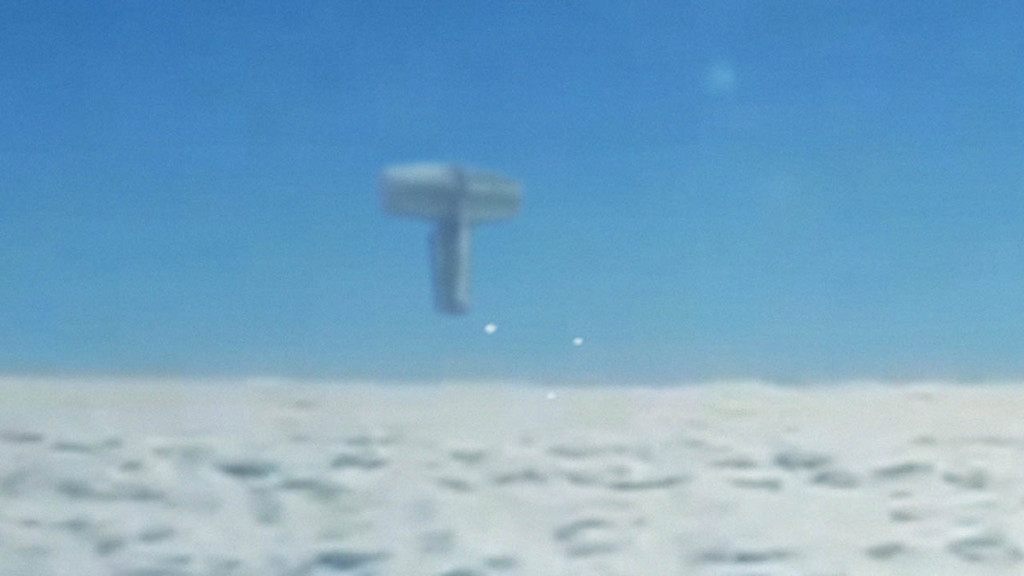
As the jet closed in, the pilot locked on. He saw it. The official report would later call it a “balloon-shaped object.” But what did that pilot truly see in those fleeting moments before he squeezed the trigger? What was its color? Its size? Did it move in a way that defied physics? Those details remain locked away, buried deep in a classified mission report we may never see.

The order came through his headset. Fire.

With a deafening roar, the Su-30 unleashed its cannons. The sky flashed. Residents in the villages of Gugdi and Panawara below reported hearing a series of thunderous, bone-rattling explosions—far too powerful, they said, for a simple balloon being popped. Something big had just been blown out of the sky.

ob_744d55_film183-v1-1280x720.webp

The Official Story: A Tale Full of Holes?

As pieces of twisted debris rained down on the desert, the cover-up machine began to grind into gear. The military and police quickly cordoned off the area near the village of Gugdi. They scoured the sand, collecting every last fragment.

The initial statement from the IAF was brief, clinical, and maddeningly vague.

“Between 10.30 and 11 am today an unidentified balloon-shaped object was picked up by the Indian Air Force (IAF) radar,” the statement read. “An IAF fighter was launched, which intercepted the object and brought it down. Materials have been retrieved and further investigation is ongoing.”

A balloon. That’s it. Nothing to see here, folks. Just a stray party balloon that wandered into a high-security military zone on a national holiday.

But wait. It gets weirder.

That’s No Weather Balloon

The local police, who were first on the scene, reported what they found. And their description didn’t sound like any balloon you’ve ever seen. They recovered five distinct pieces. They were described as “triangle-shaped” or “cone-shaped metallic objects.”

Metallic.

Think about that for a second. Standard weather balloons are made of latex or plastic. Their payloads consist of lightweight cardboard boxes or styrofoam containers holding small instruments. They are designed to be disposable and fragile. They are not made of multiple, cone-shaped metal pieces.

So, what was it? The strangeness of the debris immediately sparked speculation online. This wasn’t a case of mistaken identity. This was something else. The IAF’s swift and aggressive action—scrambling a frontline fighter jet—seemed like a massive overreaction for a simple weather balloon. Unless, of course, they knew it was something more.

The Explosions That Shook the Desert

Then there’s the matter of the sound. Eyewitnesses weren’t just casual observers; they were people living in a region accustomed to the sonic booms of military jets. They know what a normal explosion sounds like. The blasts they heard that morning were different. They were multiple, powerful, and reverberated for miles. A cannon round hitting a flimsy latex balloon would make a pop, not a series of earth-shaking booms.

Did the object’s power source detonate? Was it carrying some kind of ordnance? Or did the object itself violently disintegrate when hit, suggesting a complex and pressurized internal structure?

The questions began to pile up, and the official silence was deafening. All the recovered debris was immediately handed over to the IAF and disappeared into a black hole of “further investigation.” The story, it seemed, was being actively suppressed.

Is Barmer India’s Roswell?

For anyone who has spent time in the world of unexplained aerial phenomena, the parallels are impossible to ignore. A strange object comes down in a remote desert. The military swoops in. An initial, confusing report is followed by a mundane, almost insulting explanation. The debris is whisked away, never to be seen again. A wall of secrecy is erected.

It’s the Roswell Incident playbook, chapter and verse, just playing out in a different desert half a world away.

In 1947, the US military first announced they had recovered a “flying disc” outside Roswell, New Mexico, only to hastily backtrack and claim it was a common weather balloon. For decades, that was the official story, a story that nobody really believed. It took an avalanche of witness testimony and leaked documents to reveal that the “weather balloon” was actually a top-secret high-altitude surveillance device for monitoring Soviet nuclear tests.

Or so the *next* official story goes.

The Barmer incident feels just like that. The “balloon” explanation feels like a placeholder, a flimsy blanket thrown over a mountain of uncomfortable facts. A story crafted to shut down curiosity, not to provide real answers.

The recovery operation, the conflicting descriptions of the debris, the use of overwhelming force—it all points to one conclusion: the authorities were rattled. They shot something down, and they either didn’t know what it was, or they knew *exactly* what it was and wanted to make sure nobody else ever found out.

Beyond the Balloon: Exploring the Possibilities

If it wasn’t a simple balloon, what was it? The internet, as it always does, erupted with theories, ranging from the plausible to the truly mind-bending.

Deep Dive: The “Google Loon” Theory

Weeks after the incident, a new, slightly more detailed explanation began to trickle out. Defence Minister Manohar Parrikar eventually stated that the object was a balloon that belonged to an American company. He reportedly mispronounced the name as “Goggle.”

The internet hive mind quickly deduced he must have meant Google and its ambitious “Project Loon.”

What was Project Loon? It was Google’s audacious plan to create an internet network in the sky using massive, high-altitude balloons drifting on stratospheric winds. These balloons were huge, tennis-court-sized carriers of sophisticated solar-powered electronics. They were far more complex than a simple weather balloon.

Could this be our answer? At first glance, it seems plausible. Project Loon balloons did carry complex payloads. But when you look closer, this explanation springs even more leaks than the balloon story.

First, Project Loon was a high-profile international project. Their balloons were equipped with transponders and GPS. Air traffic control in the region should have known exactly what it was. Why shoot it down without attempting to establish communication?

Second, why the secrecy? If it was a stray Google balloon, why not just say so immediately? Why the vague initial reports and the confiscation of debris? A simple statement from Google and the IAF could have cleared it all up in hours.

Third, and most important: the debris. While a Project Loon payload is more complex than a weather balloon’s, does it include multiple, separate “cone-shaped metallic objects”? The design of the Loon electronics package doesn’t seem to match that description. And would its destruction result in massive explosions?

The Google Loon theory feels less like an answer and more like a convenient, tech-savvy scapegoat. A perfect modern update to the classic “weather balloon” excuse.

Theory 2: A Secret Military Drone?

The location is key. Right on the Pakistani border. This is spy-versus-spy country. Could the object have been a new type of stealth reconnaissance drone, either from Pakistan or even China, testing India’s air defenses on its most important day?

This would explain the aggressive response. A foreign military drone in your airspace is an act of aggression. It has to be brought down, and its technology must be captured and analyzed. The secrecy would also make perfect sense; you wouldn’t want to publicize the details of a foreign spy drone you recovered, as it would reveal your capabilities and potentially escalate a diplomatic crisis.

The problem? The shape. “Balloon-shaped” and “cone-shaped metallic” parts don’t align with any known drone design. Drones, even stealthy ones, typically need wings and aerodynamic surfaces to fly. Unless, of course, it was a completely new and revolutionary type of lighter-than-air spy craft. A possibility, but one that remains pure speculation.

Theory 3: The Extraterrestrial Hypothesis

And so we arrive at the edge of the map. The place where conventional explanations fail and stranger possibilities take root.

What if the object wasn’t from Pakistan, China, or a tech company in California? What if it wasn’t from Earth at all?

A non-aerodynamic shape that can fly. Metallic components of unknown purpose. An apparent lack of concern for sensitive international borders or national holidays. A military response that seems both swift and panicked. It checks all the boxes for a classic UFO encounter.

Perhaps it was a probe, a small scout craft sent to gather data. Maybe its propulsion system failed, leaving it to drift helplessly on the wind until it was detected. The “explosions” could have been its power core rupturing when hit by cannon fire. The “cone-shaped” debris could be fragments of technology so advanced, we have no frame of reference to understand them.

India, after all, has a long and storied history with strange objects in the sky. Ancient texts like the Vedas and the Mahabharata speak of “Vimanas”—flying craft of the gods that could travel through the air and into space. For centuries, reports of strange lights and aerial phenomena have been a part of the subcontinent’s folklore. Was the Barmer incident just the latest chapter in a story thousands of years old?

The Silence That Speaks Volumes

Years have passed since that January morning. The Barmer UFO incident has faded from the headlines, just as the authorities hoped it would. No official report on the debris analysis was ever made public. The pilot’s testimony remains classified. The photographs of the strange metallic cones, taken by local police, have never been released.

All we are left with are the gaping holes in the official story. A story that asks us to believe that a harmless balloon from a US company somehow drifted into the most sensitive airspace in India on the most sensitive day of the year, that it was made of strange metallic parts, that it exploded violently when shot, and that the entire incident required a level of secrecy usually reserved for matters of war.

The sands of the Thar Desert hold many secrets. But on January 26, 2016, something new fell from the sky and was buried—not by the sand, but by a wall of official silence. The Barmer incident isn’t a closed case. It is a throbbing, unanswered question. The official story says “balloon.” The evidence, the eyewitnesses, and common sense all whisper a different word.

They whisper… something else.

Originally posted 2016-01-29 08:13:44. Republished by Blog Post Promoter