Saturday, September 5, 2026
HomeCrime & ConspiracyConspiraciesTop 5 Reasons the Moon Landings Could Be a Hoax

Top 5 Reasons the Moon Landings Could Be a Hoax

The Greatest Hoax? 5 Pieces of ‘Evidence’ That We Never Went to the Moon

July 20, 1969. A date seared into the collective memory of humankind. Neil Armstrong takes one small step. A giant leap for mankind. We did it. We beat the Soviets. We conquered the final frontier.

Or did we?

For over fifty years, a persistent, nagging question has echoed in the backrooms of the internet, in late-night talk radio shows, and in the minds of millions. A question that, if true, would rewrite history. What if the whole thing was a lie? A fabrication? The most audacious piece of propaganda ever conceived, staged in a secret film studio somewhere in the Nevada desert?

The official narrative is sealed in history books. But the photos, the videos… they tell a different story. A story with plot holes. Glitches in the matrix. Anomalies that, once you see them, you can’t unsee. NASA has an answer for everything, of course. Tidy, scientific explanations for every weird detail. But do those explanations hold up? Or are they just part of a cover story that’s been running for half a century?

Forget what you’ve been told. Forget the history class documentaries. Today, we’re looking at the raw data. The visual clues that believers say are the smoking guns. We’re going down the rabbit hole to examine five of the most compelling pieces of “evidence” that the moon landing was the greatest show on Earth, not on the Moon. Prepare to have your reality questioned.

1. The Case of the Crooked Shadows

It starts with something simple. Something we learn in grade school. Light.

On the moon, there is only one source of bright light. A single, magnificent, powerful lamp in the sky. The Sun. With no atmosphere to scatter the light, shadows should be razor-sharp, pitch-black, and, most importantly, they should all run parallel to each other. Simple physics, right?

So why don’t they?

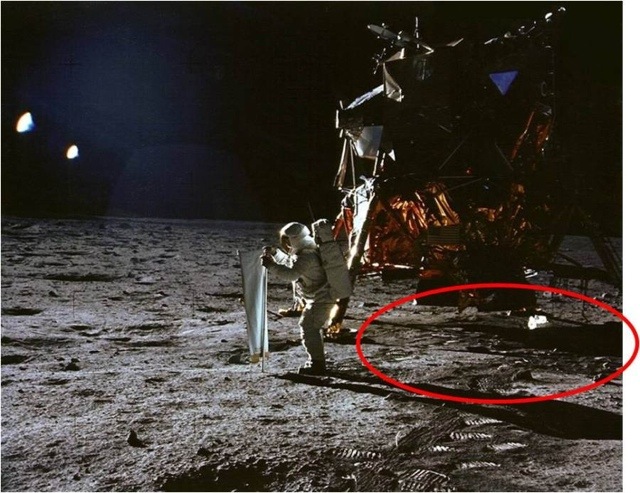
Look at the evidence. In photo after photo from the Apollo missions, the shadows are all over the place. They scatter. They diverge. They behave as if there are multiple light sources lighting the scene, just like you’d find on a professional film set. One key light. A fill light. Maybe a back light.

The image above is one of the most famous examples. The shadow cast by the Lunar Module streaks off in one direction. But the shadows cast by the rocks in the foreground? They go in a completely different direction. The angle is not subtle. We’re talking about a difference of nearly 45 degrees. How is that possible with a single sun?

Deep Dive: NASA’s “Bumpy Ground” Defense

The official explanation from NASA sounds plausible at first. They blame the moon’s terrain. They say the surface isn’t a flat parking lot; it’s full of small hills, craters, and undulations. These slopes and bumps, they argue, can make parallel shadows appear to converge or diverge from a certain camera angle. It’s a matter of perspective.

But does that really explain the massive discrepancies? Theorists cry foul. Loudly. They argue that for a small hill to cause such a dramatic shift in a shadow’s angle, it would have to be an incredibly steep, almost comical slope. The ground in the photos, however, looks relatively flat. Skeptics have taken to online forums, using 3D modeling software to try and replicate the effect. Many have concluded that you simply cannot create the shadows seen in the Apollo photos using a single light source and the gentle slopes visible in the pictures.

The questions just keep coming. Why is Buzz Aldrin’s entire spacesuit perfectly illuminated even when he’s standing in the shadow of the Lunar Module? The sun is behind him, yet we see him clear as day. NASA says it’s because the lunar surface itself—the regolith—is highly reflective and acts like a giant bounce card, filling in the shadows. But would that gentle reflection be powerful enough to act like a Hollywood-grade studio light? To many, the answer is a resounding no. It smells like a film set.

2. The Reflection in the Visor: A Studio Light in Space?

This one is a mind-bender. It’s a tiny detail in a vast photograph that could unravel the entire story.

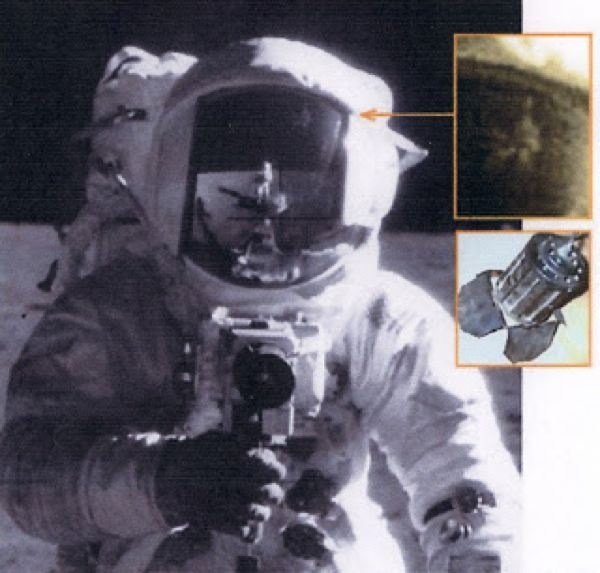
During the Apollo 12 mission, a picture was taken of two astronauts working on the lunar surface. The photo itself isn’t remarkable, until you zoom in. Way in. You have to look at the reflection in the astronaut’s polished helmet visor. In that curved, distorted mirror, you see the moonscape, another astronaut… and something else. Something that has no business being there.

20131202-233122.webp

Floating. Suspended in the blackness. It’s an object that appears to be hanging from a wire or a chain. It’s symmetrical. It looks, for all the world, like an overhead spotlight rig. The kind you would find hanging from the ceiling of a massive sound stage.

What is it? It’s definitely not part of the Lunar Module. Other photos show no such apparatus extending from the lander. It’s not another piece of equipment. It’s just… there. Hanging in the void.

The Unexplained Object

The quality of the image isn’t perfect, a fact that defenders of the official story are quick to point out. They’ll say it could be a lens flare, an artifact of the film, or a distorted reflection of something mundane on the MESA (Modularized Equipment Stowage Assembly). But the shape is so distinct. The line extending upwards is so clear. It doesn’t look like an accident or a glitch. It looks manufactured. Intentional.

This single, tiny anomaly has fueled decades of speculation. It’s the “ghost in the machine.” If the astronauts were really on the moon, in the vacuum of space, what could possibly be suspended in mid-air above them? Was it part of the infrastructure used to create the illusion? A piece of the Hollywood magic accidentally caught in the shot?

NASA has remained largely silent on this specific object, letting defenders debate its possible origins. But for those who believe the landings were faked, this isn’t a mystery. It’s a confession, accidentally captured in a reflection.

3. The Lunar Leap and the Wires You Weren’t Meant to See

One of the most iconic parts of the moon landing footage is the movement. The way the astronauts bounce. The way they bound across the surface in what appears to be low gravity. It looks utterly alien. But is it real?

A fascinating and easily testable theory emerged decades ago. If you take the original NASA footage and speed it up by 2.5 times, something incredible happens. The astronauts stop bouncing in low gravity. They start running. They move with the weight and cadence of people in normal, Earth-gravity, just slowed down. Go ahead, try it. You can find the clips online. The effect is uncanny and deeply unsettling.

This led to a stunning suggestion: the low-gravity effect wasn’t real. It was a simple cinematic trick. They just filmed the astronauts running and jumping on a set and then played the footage back in slow motion. Easy.

But what about the incredible jump height? Some of those leaps were huge, seemingly impossible for a man in a bulky 180-pound suit on Earth. The answer, according to theorists, is as old as theater itself. Wires.

20131202-233208.webp

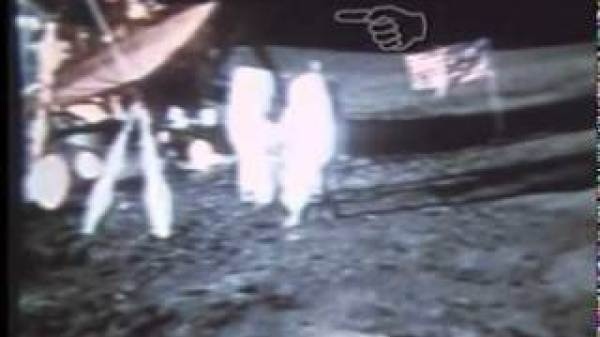
They believe the astronauts were suspended on hidden cables and wires, giving them an unnatural, floaty buoyancy. These wires, attached to a harness under the suit, would have been carefully positioned to be out of the camera’s view. Mostly.

Occasionally, a glint of light or a poorly framed shot might give the game away. The image above is a famous screenshot that believers point to as proof. It’s grainy, yes. It’s vague. But there appears to be a faint line extending from the top of the astronaut’s backpack into the blackness above. Is it a film artifact? A scratch on the negative? Or is it the thin wire that was holding him up, accidentally catching the studio light?

The Dust Conundrum

The official story has a powerful counter-argument here: the lunar dust. When the astronauts or the rover kick up dust, it flies up and falls back down in a perfect parabolic arc. It doesn’t swirl or hang in the air like it would on Earth. This, scientists say, is conclusive proof of a vacuum. But conspiracy theorists have answers for this, too. Could a massive, sealed vacuum chamber have been built for the production? It sounds incredible, but was it more incredible than sending men a quarter of a million miles through space in 1969? For a government locked in a Cold War and desperate to claim a victory, what was off the table?

4. The Cross-hairs: A Photographic Impossibility?

This piece of evidence is, for many, the most damning of all. It’s not open to interpretation about shadows or reflections. It’s a technical, photographic problem that seems to have no logical explanation.

The Hasselblad cameras used by the astronauts were fitted with a special glass plate called a Réseau plate. This plate was etched with a grid of small cross-hairs, or fiducials. The purpose of these crosses was to help with calibration and measurement in the photographs. Because they were etched into the camera system itself, between the lens and the film, they are a physical part of the camera. Therefore, they MUST appear on top of every single thing in every single photograph. Always. No exceptions.

But they don’t.

20131202-233330.webp

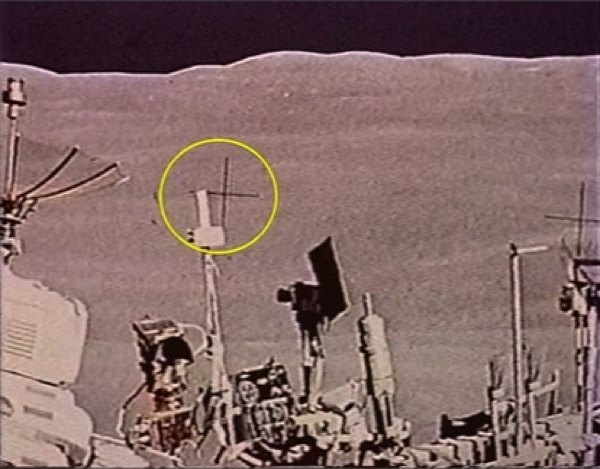
In numerous official NASA photos, objects are clearly seen IN FRONT of the cross-hairs. The photo above shows a piece of equipment, and the cross-hair is mysteriously behind it. In other photos, the American flag pole is in front of a cross-hair. The lunar rover is in front of a cross-hair. The cross-hair simply vanishes where it should be layered over the object.

How is this physically possible? It isn’t. An object in a photo cannot be in front of a marking etched into the camera that took the photo.

A Sloppy Cut-and-Paste Job?

The immediate conclusion for anyone questioning the mission is obvious: the photographs were doctored. It was a cut-and-paste job. Theorists propose that NASA faked the images using a composite technique. Perhaps they took photos of a real lunar landscape, then superimposed images of the astronauts and their equipment on top. In the process of layering these images, they clumsily pasted the objects over the pre-existing cross-hairs from the background plate.

NASA’s explanation is that the effect is an optical illusion caused by “flaring” or “blooming” on the high-contrast film. They claim that on extremely bright white objects, the photographic emulsion can become so overexposed that the white image area bleeds over the thin black line of the cross-hair, effectively making it disappear. Plausible? Perhaps. But it seems to happen an awful lot, and always on the man-made objects. It looks less like a photographic quirk and more like a sloppy forgery. A smoking gun left behind by a photo editor in a hurry.

5. The Identical Backdrops: Déjà Vu on the Moon

Consistency is key. When you’re building a world, whether for a movie or an elaborate hoax, you need to keep your sets consistent. But what if you get lazy and reuse the same backdrop for different scenes? That’s exactly what critics accuse NASA of doing.

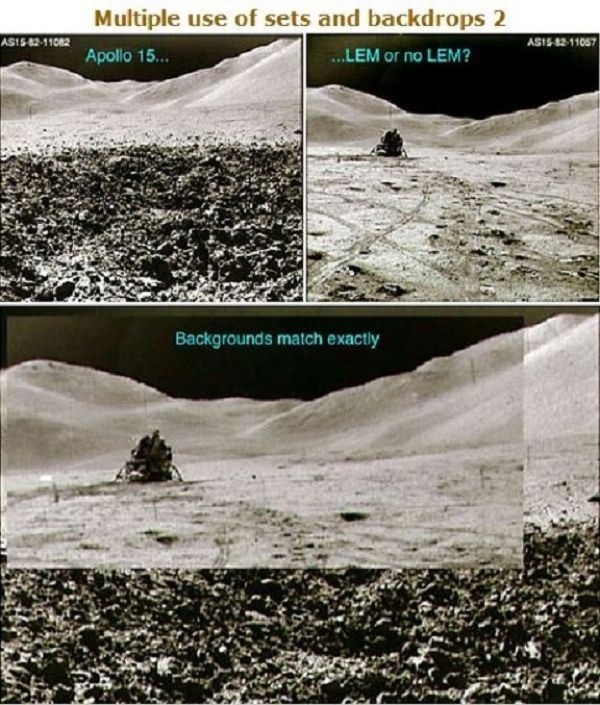
Two photos from the Apollo 15 mission, officially cataloged by NASA as having been taken at two different locations “miles apart,” show a startling similarity. The background, a rolling set of lunar hills, is not just similar. It is absolutely identical.

20131202-233432.webp

Every crater, every ridge, every shadow lines up perfectly between the two photos. Yet the foreground is completely different. One photo clearly shows the Lunar Module sitting on the surface. The other does not. How can two photos taken miles apart feature the exact same mountain range, viewed from the exact same angle and with the exact same lighting?

For a theorist, the answer is simple and devastating. It wasn’t a mountain range. It was a backdrop. A painted or projected background on a sound stage. The Apollo 15 crew filmed one scene with the Lunar Module prop in place, then removed it for the next scene, all without changing the set.

Deep Dive: An Alien Sense of Scale

NASA’s defense here ventures into the bizarre nature of lunar perception. They argue that on the moon, with no atmosphere, there is no haze to obscure distant objects. A mountain 20 miles away can look as sharp and clear as a rock 20 feet away. This lack of atmospheric perspective completely messes with our Earth-trained brains and our ability to judge distance and scale. NASA claims the hills in the background are not small hills nearby, but are actually massive mountains many miles away. From that distance, moving a few miles left or right in the foreground wouldn’t significantly change your view of the background.

But does this explanation hold water? Look at the photos again. The textures, the shadows, the details are pixel-perfect matches. Would a perspective shift of several miles really result in zero discernible difference? Zero? It feels like a stretch. A big one.

The identical backdrops remain one of the most visually arresting and difficult-to-debunk pieces of evidence in the moon hoax arsenal. It’s one thing to argue about the physics of light, but it’s another to look at two pictures and see the same thing, while being told you’re in two different places. It’s a direct challenge to our own eyes.

What Do You Believe?

We’ve looked at the strange shadows, the mysterious reflection, the wire-fu astronauts, the impossible photos, and the recycled sets. Each one is a fascinating puzzle. Are they all just a series of coincidences, misunderstandings of physics, and optical illusions? Or are they breadcrumbs? Clues left behind in a conspiracy so vast, so audacious, that it changed the course of human history?

Perhaps the truth isn’t a simple “yes” or “no.” Could some of it have been real, and some of it faked to ensure a flawless PR victory in the Cold War? We may never know for sure. The men who were there are leaving us, and the secrets, if there are any, may be buried forever.

But the photos remain. The footage is still there. The questions echo louder than ever in the digital age. Look at the evidence again. What does your gut tell you? Did we land on the moon, or did we watch the greatest movie ever made?

Amit Ghosh
Amit Ghoshhttps://coolinterestingnews.com
Aloha, I'm Amit Ghosh, a web entrepreneur and avid blogger. Bitten by entrepreneurial bug, I got kicked out from college and ended up being millionaire and running a digital media company named Aeron7 headquartered at Lithuania.
RELATED ARTICLES
- Advertisment -

Most Popular

Recent Comments

Warren Pan Abbott on The legend of the Devil Monkey !
chris davies on The McPherson Tape Mystery
Reed Reedly on ET has Internet!
Bea Houseoffashion on Proof Of Time Travellers – Gallery
Marcus2012 on ET has Internet!
Reed Reedly on ET has Internet!
LaughsAtConspiracyNuts on The 9/11 Conspiracy – Myths and Facts
Alex Sliverman on Did the ancients fly?
Doctor Wholigan on Time Traveler in 1938 film
chris davies on The McPherson Tape Mystery
Archie1954 on 10 secret UFO hideouts
chris davies on Ghosts of flight 401
Marcus2012 on ET has Internet!
jason Macdonald on Proof of Time Travel? – China
chris davies on Long-Lost Pyramids Found?
Reed Reedly on ET has Internet!
Milkman on Connected Universe
Tenmiles on Baigong Pipes Mystery
Simon Foster on Sirius – The Documentary
From the 1st April on 2013 – Alien Contact date ?
SkyWatcher on Is ET ignoring us?
I Come From The Future on Obama to make UFO Alien disclouser soon ?
ÛñK?øWn on 2013 – Alien Contact date ?
Just another person on 2013 – Alien Contact date ?
Malcolm Windowcleaner on The strange case of Rudolph Fentz
Mason Servio on Strange Things on Mars
Marke Wisdom Seeker on What will we find as arctic melts?
Andrea A Elisabeth Levyne on Aliens Captured in Varginha, Brazil
Mitch Grouyeki on Amazing Space Shuttle pictures