
Home Weird World Time Travel Time Travel – will it happen?

Time Travel – will it happen?

0
59

Is Time Travel Possible? The Shocking Truth Hiding in Plain Sight

Ever get that weird feeling of déjà vu? A flash of a memory that doesn’t quite feel like your own? We all dream of it. The power to witness history. The chance to undo one terrible mistake. The fantasy of skipping ahead to see how it all turns out.

Time travel.

It’s the stuff of blockbuster movies and dusty science fiction novels. But what if it’s more? What if the line between fiction and reality is blurrier than we’ve been led to believe? Forget the cheesy internet hoaxes and the convoluted stories you’ve heard before. We’re going on a deep dive into the actual science, the chilling theories, and the photographic “evidence” that just won’t go away.

The question isn’t just “is it possible?” The real question is… has it already happened?

2218367-time_travel

The “Easy” Part: A One-Way Ticket to the Future

Let’s get one thing straight. Traveling into the future isn’t just possible; it’s happening right now. You’re doing it. The catch? You’re doing it at a rate of one second per second. Pretty boring, right?

But what if you could speed it up? What if you could jump ahead a hundred years while only aging a single day?

Science doesn’t just allow this. It demands it.

This isn’t about cryo-sleep or suspended animation, though those are fascinating ideas in their own right. No, this is about bending time itself. It all goes back to one man: Albert Einstein. His theories of relativity completely shattered our old, comfortable ideas about time being a constant, universal clock ticking away at the same rate for everyone.

He revealed that time is relative. It’s flexible. It’s a river that can speed up and slow down.

Deep Dive: The Twin Paradox and Cosmic Speeding

Einstein’s theory of special relativity gives us the first key. It tells us that the faster you move through space, the slower you move through time.

Imagine two identical twins, both 20 years old. One stays on Earth. The other gets in a hyper-advanced spaceship and travels to a nearby star at, say, 99.9% the speed of light. For the twin on the ship, the journey might only take two years round-trip. He gets back to Earth, ready for a welcome home party, at the age of 22.

But when he steps out of his ship, he finds a world he barely recognizes. His twin brother is no longer 22. He’s an old man of 65. Decades have passed on Earth. While the space twin experienced only two years, Earth experienced forty-five.

He literally flew into the future.

Think this is just a thought experiment? Think again. This effect, called time dilation, is a measured and proven fact. Every time an astronaut goes to the International Space Station, they are traveling much faster than us on the surface. When they return, they have aged just a tiny fraction of a second less than we have. Russian cosmonaut Sergei Krikalev holds the current record, having spent over 803 days in orbit. The result? He has time-traveled approximately 1/48th of a second into his own future. It’s not a huge leap, but it’s real, physical proof.

Gravity’s Heavy Hand: The Other Way to Bend Time

Speed isn’t the only way to play with time. Gravity works, too. Einstein’s theory of general relativity shows that massive objects warp the fabric of spacetime. Think of it like placing a bowling ball on a stretched-out rubber sheet. The sheet curves and dips around the ball.

Time is part of that sheet. The stronger the gravity, the more time gets stretched and slowed down.

This means time ticks ever-so-slightly faster at the top of a skyscraper than it does on the ground floor. It’s an infinitesimal difference, but it’s there. And it has huge real-world consequences. The GPS satellites orbiting Earth are in a region of weaker gravity and are also moving very fast. They experience time differently than we do. If scientists didn’t constantly adjust their clocks to account for both special and general relativity, your GPS would be off by several miles every single day. Your Uber would never find you.

So, what’s the extreme version? A black hole. The gravitational pull near a black hole is so immense that time slows to a crawl. If you could safely orbit a supermassive black hole for just one hour, you could return to Earth to find that a thousand years had passed. You would become a visitor in a world you no longer know, a living relic from a forgotten past.

time travelers are real.fw

The Forbidden Frontier: Rewinding the Clock

Jumping to the future is one thing. It follows the known rules of physics, even if it pushes them to their limits. But going back? That’s where things get… weird.

Traveling to the past is the holy grail. It’s the one that could break the universe. It’s where science bleeds into paradox and conspiracy.

Faster Than Light: Tearing a Hole in Reality

One of the most famous theoretical paths to the past involves breaking the universe’s ultimate speed limit: the speed of light. Einstein’s equations suggest that if you could somehow travel faster than a light beam, you would effectively be moving backward in time. You could arrive at your destination before you even left your starting point.

There’s just one problem. A massive one. According to E=mc², as an object with mass approaches the speed of light, its mass increases. At the speed of light, its mass would become infinite. To push an infinite mass would require infinite energy. In other words, it’s impossible. The universe has a built-in firewall to prevent this.

But what if there’s a loophole? Physicists have hypothesized about particles called “tachyons” that, if they exist, would *always* travel faster than light. Could we use them to send messages to the past? Perhaps a simple string of ones and zeros, a warning sent back through time? Some theories popping up in deep-web forums suggest that certain “glitches” or Mandela Effects could be the result of future information streams bleeding into our present. For now, it’s pure speculation. But the possibility is tantalizing.

Cosmic Tunnels and Spacetime Shortcuts

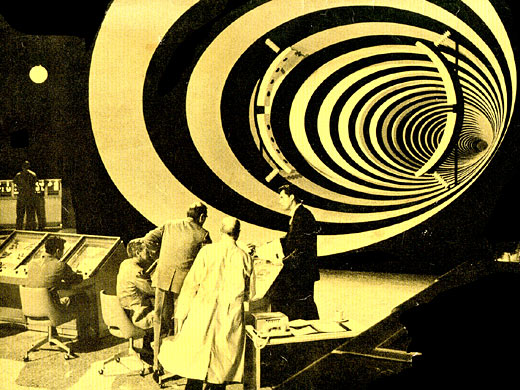
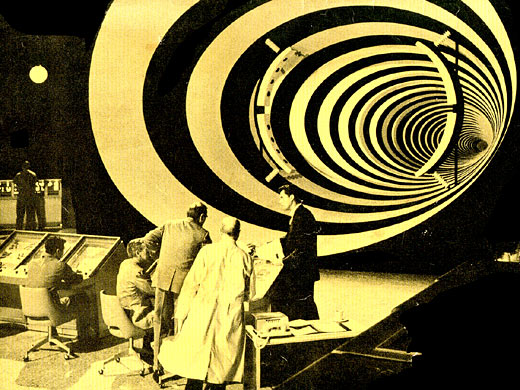
If you can’t go through the barrier, maybe you can go around it. Enter the wormhole, or what scientists call an Einstein-Rosen bridge. Imagine spacetime is a giant sheet of paper. To get from one point to another, you have to travel across the paper. But what if you could just fold the paper over and poke a pencil through it, creating a direct tunnel?

That’s a wormhole. It’s a theoretical shortcut through spacetime, connecting two distant points in space… or two different moments in time. You could step into one end of the wormhole here and now, and step out on the other side a hundred years in the past.

The catch? Building one and keeping it stable is a nightmare. Our current understanding suggests you’d need a form of “exotic matter” with negative mass and negative pressure to prop the tunnel open. We don’t know if such matter can even exist. And if it can, the energies involved would be astronomical, requiring the power of an entire star.

Or what if they form naturally? Could there be ancient, stable wormholes left over from the Big Bang, just waiting for us to find them? It’s a mind-bending thought.

The Glitches in the Matrix: Has It Already Happened?

Enough theory. Let’s get to the juicy part. The part the academics don’t like to talk about. What if time travelers are not a future possibility, but a present (or past) reality? For decades, strange photographs and stories have circulated, presenting anomalies that seem to defy any logical explanation.

Case File #1: The Time-Traveling Hipster of 1941

You’ve probably seen the photo. It’s a black-and-white shot from the 1941 reopening of the South Fork Bridge in British Columbia, Canada. The crowd is filled with people in 1940s hats, suits, and dresses. And then there’s him.

A young man in what appears to be modern wrap-around sunglasses, a t-shirt with a printed logo, a casual zip-up hoodie, and holding a portable camera that looks decades ahead of its time. He sticks out like a sore thumb. He looks like someone Photoshopped a guy from the early 2000s into a historical photograph.

Debunkers have come up with explanations, of course. They claim the sunglasses were an available style, the “t-shirt” is a stitched sweater from a hockey team, and the camera was a prototype Kodak model. But are these explanations enough? Or are they just a convenient way to smooth over a crack in our reality? The man’s casual, modern posture, his total disconnect from the stiff formality of everyone around him, remains deeply unsettling.

Case File #2: John Titor, The Soldier from 2036

In late 2000, a man calling himself “John Titor” began posting on internet forums. He claimed to be an American soldier from the year 2036, sent back on a military mission. His objective? To retrieve an IBM 5100, a “portable” computer from 1975 that had a unique feature needed to debug massive computer systems in his time.

Over several months, Titor shared incredible details about his future. He spoke of a devastating civil war in the United States, followed by a brief but intense World War III in 2015. He described his time machine, a “C204 Gravity Distortion Time Displacement Unit” installed in a 1967 Chevrolet. He even posted diagrams and explained the physics, referencing Kerr black holes and the “many-worlds” interpretation of quantum mechanics.

Many of his specific predictions failed to come true. But some were chillingly vague or eerily prescient, touching on growing civil unrest and a distrust of the government. He vanished as suddenly as he appeared in early 2001, never to be heard from again. Was he an elaborate hoaxer? A brilliant prankster? Or was he telling the truth, and by interacting with us, did he push our timeline onto a different path? The mystery of John Titor remains one of the internet’s greatest legends.

time travelers are real.fw

The Ultimate Problem: What If You Break It?

Let’s say you succeed. You build the machine, you open the wormhole. You step back into the past. Now what? You are a bull in the china shop of history, where one wrong move could shatter everything.

The Grandfather Paradox

This is the big one. The classic. You travel back in time and kill your own grandfather before he met your grandmother. What happens? If he dies, your parent is never born. If your parent is never born, you are never born. If you are never born, you couldn’t have gone back in time to kill him in the first place.

Poof. Logic collapses. It’s a contradiction that seems to make travel to the past an absolute impossibility. But what if the universe has fail-safes?

Solution 1: The Ironclad Timeline

The Novikov self-consistency principle suggests that the past is fixed and unchangeable. You can go back, but you can’t change a thing. The laws of physics would conspire to stop you. If you tried to kill your grandfather, you would fail. Your gun would jam. You’d slip on a banana peel. A car would splash mud in your eyes at the last second. In fact, your presence in the past was *always* part of that past. Anything you do was destined to happen and is already factored into the timeline that leads to your own birth. You are not an agent of change; you are just another actor in a play that has already been written.

Solution 2: The Endless River of Timelines

This idea, rooted in the “many-worlds” interpretation of quantum mechanics, is even wilder. It suggests that there isn’t just one timeline, but an infinite number of parallel universes. Every time an event could go multiple ways, the universe splits. In this model, you *can* go back and kill your grandfather. But the moment you do, you splinter off into a new, alternate timeline. In this new reality, you were never born. But your original timeline—the one you came from—remains completely untouched and safe. The only problem is, you’ve become a paradox, an orphan of time, trapped in a universe that is no longer yours.

So where does that leave us? Standing on the edge of a precipice, staring into the abyss of what might be possible. The science for future travel is solid. The theories for past travel are mind-bending but not entirely ruled out. And the anecdotal evidence? It just keeps piling up, little tears in the fabric of what we think is real.

Perhaps the silence from the future isn’t because time travel is impossible. Perhaps it’s because the first rule of time travel is that you don’t talk about time travel. Are they walking among us right now, silent observers from another age? Is the key to unlocking these secrets hidden in a government vault, or is it waiting for the next Einstein to have a flash of insight?

The next time you see something that doesn’t belong, pause for a second. It might not be a trick of the light. It might just be a visitor, lost and a long, long way from home.

Originally posted 2013-10-25 19:11:18. Republished by Blog Post Promoter










