Home Weird World Space Ticket to the moon, $1.4b

Ticket to the moon, $1.4b

0
67

The Billion-Dollar Moon Mission That Simply Vanished

Remember this? A promise whispered on the winds of the early 2010s. A ticket to the moon, not for a superpower, but for *anyone* with a big enough checkbook. A private company, staffed by the very legends who put NASA on the map, was about to sell lunar real estate experiences. They called themselves Golden Spike.

They held press conferences. They had a plan. A price tag. They were going to put new bootprints in the moondust by 2020.

Then… silence.

They disappeared. Faded into the static of internet history like a lost transmission from a distant probe. What happened to the company that promised to sell the moon? Was it just a failed business venture? Or was it something more? Did they get too close to a truth that the powers-that-be wanted left undisturbed, sleeping in the silent, grey dust 238,900 miles away?

A Ticket to Tranquility Base: The Billion-Dollar Promise

Let’s rewind the clock. The year is 2012. The Space Shuttle program is a museum piece. NASA’s focus is on Mars and low-Earth orbit. The moon, our celestial companion, the site of humanity’s greatest single achievement, felt abandoned. Forgotten.

Suddenly, a flash of light. A group of absolute titans from the golden age of space exploration step into the spotlight. We’re talking people like Gerry Griffin, a former Apollo flight director. The guy who was in mission control during the most dangerous and triumphant moments of the lunar program. And leading the charge? Dr. Alan Stern, a former top NASA science administrator, the very same man who spearheaded the New Horizons mission that gave us our first stunning photos of Pluto. These weren’t dreamers in a garage. These were the architects of the cosmos.

Their company, Golden Spike, had a pitch so audacious, so brilliantly simple, it sent shockwaves through the industry. They weren’t going to reinvent the wheel. No. They were going to use existing, commercially-built rockets and capsules to create a lunar taxi service.

The price for a two-person, round-trip ticket? A cool $1.6 billion.

Sounds insane, right? But here’s the genius part. Their target wasn’t just thrill-seeking billionaires. Their primary customers were nations. “Mid-size” countries. Think South Korea. Indonesia. South Africa. Nations with burgeoning economies, scientific ambitions, and a deep-seated hunger for the prestige that only a flag planted on the moon can provide.

Dr. Stern laid it out himself. “We can make it affordable for mid-sized countries… to be in the business of lunar exploration, which would cost them a great deal more to invent that capability.” It was brilliant. For a fraction of the cost of starting a national space program from scratch, a country could leapfrog to the front of the line, sending its own scientists, its own heroes, to walk among the stars.

Deep Dive: The Economics of a Moon Shot

To understand how revolutionary this sounded, you have to grasp the sheer cost of the original space race. The Apollo program, from start to finish, cost an estimated $25.4 billion in 1960s money. In today’s dollars, that’s well over $280 billion. It was a monumental national effort, an economic and industrial mobilization second only to war.

Golden Spike was proposing to do it for a tiny fraction of that. How? By piggybacking. By letting companies like SpaceX and ULA (United Launch Alliance) handle the heavy lifting of getting to orbit. Golden Spike would be the “last mile” service provider—the lunar lander, the suits, the training, the logistics. By standing on the shoulders of a new, burgeoning private space industry, they believed they could turn a government-sized project into a commercial enterprise. The first trip would be expensive, a “pathfinder” mission costing $7 to $8 billion to develop all the hardware. But after that? The cost would plummet to that magic $1.6 billion number.

For their money, customers would get the trip of a lifetime. A 36-hour stay on the lunar surface. Two moonwalks. The ability to bring back 50kg of priceless moon rocks. They could even visit historic Apollo landing sites, standing in the literal footprints of Neil Armstrong or Alan Shepard. It was history, science, and national pride, all wrapped up in a commercial package.

The Ghost of Apollo’s Glory

For over four decades, only one nation had put men on the moon. Twelve American astronauts. That’s it. An exclusive club with a membership that was literally aging out. The technology that took them there was, in many ways, lost to time. Blueprints were missing. The institutional knowledge had retired. The Saturn V, the most powerful rocket ever built by humanity, was a relic.

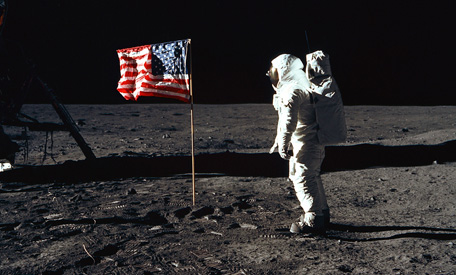
A classic image of an Apollo astronaut on the moon.

Golden Spike represented a new way. An “entrepreneurial spirit,” as Dr. Stern called it. It was a profoundly American idea: if the government won’t do it anymore, let the free market take over. This wasn’t just about going back. It was about kicking the door open for everyone else. For science. For commerce. For prestige. For, as their own materials suggested, “entertainment and even personal achievement.”

They had a vision of a bustling moon, with missions launching every six months. A steady stream of new visitors from new nations, conducting new experiments, making new discoveries. The silence of the moon was about to be broken. Or so we thought.

Red Flags on the Launchpad

Even in the first flush of excitement, for those of us watching from the fringes, the questions started to pile up. The plan was slick. The people were legendary. But the details… the details were hazy. Eerily so.

First, the technology. They planned to use “existing rockets and spacecraft.” In 2012, this was a bold assumption. SpaceX’s Falcon Heavy hadn’t flown yet. Blue Origin’s New Glenn was just a drawing on a piece of paper. The rockets powerful enough for a lunar mission were still largely theoretical or in early development. They were betting on a future that hadn’t arrived yet. It was a huge technological gamble.

Second, the money. That initial $7-8 billion development cost is not chump change. Where was it coming from? Golden Spike was famously tight-lipped. They mentioned investors but never named them. They spoke of customer interest but never produced a signed contract. Dr. Stern admitted they’d need to sell more than a few missions to make it work, but the whole enterprise felt like it was running on faith and press releases.

And third, the silence from the establishment. You would expect a project this big, run by NASA royalty, to get some kind of endorsement from… well, NASA. Or the US government. But there was largely… nothing. A quiet acknowledgment, but no partnership, no ringing endorsement. It was odd. It was like the cool kids in school were ignoring the new guy, hoping he’d just go away.

The pieces just didn’t quite fit. Something felt off.

Whispers from the Void: Three Theories on the Vanishing

By 2015, the news had dried up. The website went dark. The phone numbers were disconnected. Golden Spike had become a ghost. So what really happened? Here’s where the story leaves the world of business plans and enters the realm of deep mystery.

Theory #1: A Simple, Boring Business Failure

This is the official story. The one you’ll find in the footnotes of aerospace history. The money never materialized. The customers never signed on the dotted line. The technological hurdles were just too high, the price tag too steep, even for a prestige-hungry nation. The market research that showed “15 to 25 nations” ready to buy a ticket was, perhaps, just wishful thinking. In this version, Golden Spike is a classic case of a brilliant idea that was simply ahead of its time. A beautiful dream that crashed and burned on the cruel launchpad of economic reality. It’s clean. It’s simple. And to some, it’s completely unsatisfying.

Theory #2: The Gatekeepers of Space

Let’s get a little conspiratorial. Who really controls access to space? A handful of governments and their designated corporate partners. The military-industrial complex. Think about it. For 50 years, the moon was the exclusive backyard of the United States and, to a lesser extent, the Soviets. It was an arena for superpower competition.

What if they didn’t *want* the moon commercialized? What if the idea of Indonesia or South Africa setting up their own lunar base, outside the direct control and surveillance of the established powers, was unacceptable? Perhaps Golden Spike’s biggest mistake wasn’t its business plan, but its very premise: that the moon was for sale to the highest bidder.

In this theory, quiet phone calls were made. Investors were “advised” to pull their funding. Political pressure was applied. The message was sent, not with a bang, but with a silent, suffocating squeeze: *This is our territory. You are not welcome here.* Golden Spike wasn’t just a failed company; it was a neutralized threat to the established cosmic order.

Theory #3: The Lunar Cover-Up

Now we go deep. This theory presupposes one terrifying fact: there is something on the moon that they do not want us to see. Something the Apollo astronauts found. Something that has been kept under the tightest wraps of national security for over half a century.

What could it be? Alien artifacts? The ruins of a long-dead civilization? A source of energy or a material so powerful it would shatter the global economy? We’ve all seen the strange photos from the Apollo missions—the weird lights, the unnatural-looking structures, the censored images. Most are dismissed as photo glitches or tricks of the light. But what if they aren’t?

Imagine a private company like Golden Spike, not fully under government control, taking a group of international scientists to the moon. What if they “accidentally” landed near one of these sites? What if they stumbled upon the truth? The potential for a global panic, for a complete upending of human history and religion, would be immense. The risk would be unacceptable.

From this dark perspective, the disappearance of Golden Spike looks less like a business failure and more like a successful containment operation. They weren’t just warned off; they were shut down to protect a secret so profound it has been kept for generations. They promised to sell trips to the moon, but they never realized that some destinations are permanently off-limits.

The New Moon Rush: A Ghostly Legacy

Here’s the strangest part of all. Today, the dream of Golden Spike is slowly, quietly, becoming a reality. But not for them. Elon Musk’s SpaceX is building Starship with the explicit goal of lunar and Martian colonization. Jeff Bezos’ Blue Origin is developing its Blue Moon lander. And NASA’s Artemis program is a public-private partnership designed to put Americans back on the moon, this time to stay.

The private moon rush is happening. It just seems that Golden Spike was the sacrificial lamb. The pioneer that got scalped so the settlers could move in safely.

Watching their old promotional video today is a haunting experience. It’s a transmission from an alternate timeline, a future that never was. It’s filled with the passion and expertise of people who truly believed they could reopen the frontier. Their vision—of using commercial rockets, of selling seats to international partners—is the exact model being used today. They were right. They were just, perhaps, the wrong people at the wrong time.

Was their failure a necessary catalyst? Did it prove to the major players that the idea was viable, but that it needed to be handled by those already inside the club? Or is their story a warning, a ghost story told to any other upstarts who think they can just buy a rocket and fly to the moon without permission?

The truth remains buried. Golden Spike is now little more than a Wikipedia entry and a few forgotten news articles. A footnote. But for those of us who watch the skies, their story is a chilling reminder. The path to the stars is not just paved with money and technology. It’s littered with secrets. With gatekeepers. And with the ghosts of dreams that got a little too close to the sun… or, perhaps, a little too close to the moon.

So the next time you see a billionaire’s rocket tear a hole in the sky, heading for the heavens, ask yourself: Are they just exploring space? Or are they part of a story that began with a company that promised us the moon… and then vanished into thin air for reasons we may never truly know?

Originally posted 2016-04-16 12:28:10. Republished by Blog Post Promoter