The House Built by Ghosts: Cracking the Code of the Winchester Mystery Mansion
What if a house wasn’t just a home? What if it was a prison? A sprawling, nonsensical labyrinth of wood and glass designed not to keep people in, but to keep something else trapped forever. Something angry.
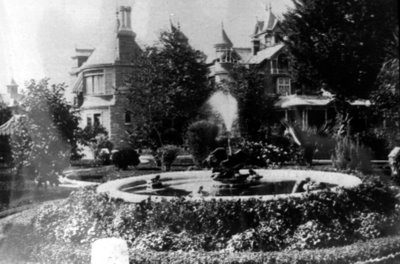
This isn’t the plot of a horror movie. This is the story of a real place. A house that continues to baffle architects, historians, and paranormal investigators to this very day. In the heart of sunny San Jose, California, sits a monument to one woman’s terror, a sprawling Victorian oddity that defies all logic. They call it the Winchester Mystery House.
It was the personal residence, the obsession, and the life’s work of Sarah Winchester, the widow of the gun magnate William Wirt Winchester. But she wasn’t just building a home. She was building an apology. An architectural maze to confuse the legions of phantoms she believed were hunting her, spirits created by the very rifle that gave her an unimaginable fortune.
Blood Money and a Widow’s Curse
To understand the house, you have to understand the gun. The Winchester repeating rifle. It wasn’t just a weapon; it was a legend. Dubbed “The Gun That Won the West,” it was a tool of expansion, of conflict, of death on a scale the world had never seen. Every pull of the trigger, every life it took, added another dollar to the Winchester family coffers.
For Sarah, that fortune felt less like a blessing and more like a curse written in blood. Tragedy stalked her. In 1866, her infant daughter, Annie, was stolen from her by a childhood illness, a wound from which Sarah never truly recovered. Then, just fifteen years later, her husband William was taken by tuberculosis. Suddenly, Sarah was left alone. Devastatingly alone, with a fortune equivalent to nearly half a billion dollars today and a crushing, all-consuming grief.
She was adrift in a sea of sorrow. And that’s when the whispers began. Or so the story goes.
A Psychic’s Chilling Prophecy
Desperate for answers, a grieving Sarah sought the help of a spiritualist, a popular practice in the late 19th century. Legend points to a famed Boston medium named Adam Coons. Imagine the scene: a darkened room, the air thick with incense and desperation. The medium’s eyes roll back, his voice changes, and he claims to be channeling the spirit of her dead husband, William.
The message he delivered was not one of comfort. It was a terrifying warning.
William’s spirit allegedly told her that the family was cursed. Haunted. They were being pursued by the spirits of every single soul cut down by a Winchester rifle. The Native Americans, the soldiers, the countless others. Their blood was on her hands, and they wanted revenge. The spirits, he warned, were responsible for the deaths of her daughter and husband.
And now, they were coming for her.
But there was a way out. A strange, almost insane solution. The psychic’s voice, channeling her dead husband, laid out the plan: “You must leave your home in New Haven and travel West. There, you must build a great house. A home for yourself and for the spirits who have fallen from this terrible weapon. You must never stop building. If you continue building, you will live. But if you stop… you will die.”
Madness Forged in Redwood and Glass
A prophecy like that would break a person. Or, in Sarah’s case, it gave her a singular, bizarre purpose. She packed her bags, left her old life behind, and headed west to the Santa Clara Valley in California. In 1884, she purchased a humble, unfinished eight-room farmhouse.
And then the hammering began.
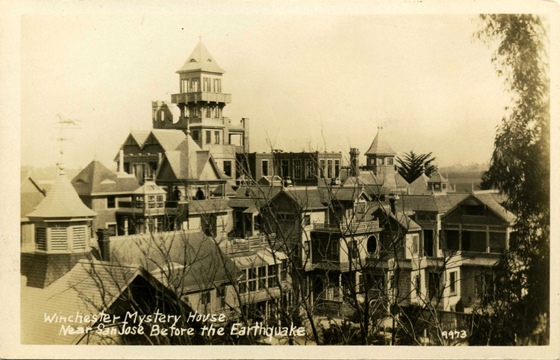
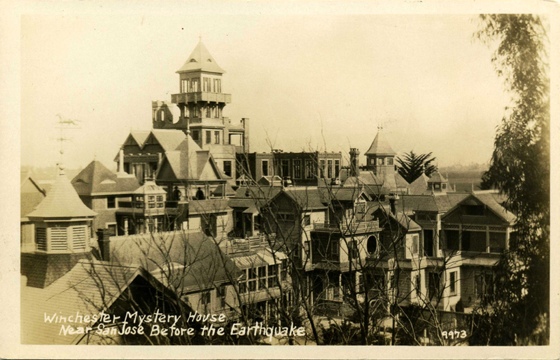
It wouldn’t stop for 38 years. Not for a day. Not for an hour. Carpenters were hired around the clock, working in shifts, 24 hours a day, 7 days a week, 365 days a year. The quiet farmhouse began to metastasize. It grew, twisting and turning upon itself, a chaotic explosion of Victorian architecture with no rhyme, no reason, and absolutely no master plan. Sarah Winchester was the only architect, relaying cryptic, rambling instructions to her foreman each morning, plans she said were given to her by the spirits themselves in the dead of night.
The result is a building that feels like a glitch in the architectural matrix. It’s a place of deliberate confusion, a physical manifestation of a haunted mind.
Stairways That Lead to Nowhere
Imagine walking up a beautiful, ornate staircase, only to find it slams directly into the ceiling. There’s no door, no landing. Just… ceiling. The house is full of them. One set of stairs, the “Switchback Staircase,” has seven flights with 44 steps, yet it only rises about nine feet, with each step a mere two inches high. Was this to confuse ghosts who couldn’t navigate such strange paths? Or was it to accommodate Sarah’s own crippling arthritis?
Doors That Open to Nothing
Even more jarring are the doors. Doors that open onto solid walls. Tiny doors fit for a child. And most famously, a door on the second floor that opens outward to nothing but a two-story drop to the garden below. A fatal misstep for any uninvited guest, living or dead. It’s known as the “Door to Nowhere,” a terrifying feature designed, believers say, to trick a pursuing phantom into taking a deadly plunge.
A Labyrinth of Deception
The oddities don’t stop there. Windows are installed on interior walls, looking from one room into another. Cupboards are an inch deep. Chimneys stop halfway to the roof. Hallways twist into dead ends. The entire mansion was designed to be a puzzle. Sarah reportedly slept in a different bedroom every night, chosen from the 40 available, so that any vengeful spirits hunting her in the darkness would never know where to find her.
At the very heart of this maze was the Séance Room. It had one entrance but three exits—one of which was a secret panel. This was Sarah’s command center, where she would supposedly retreat each night at midnight to commune with the “good” spirits, who would give her the architectural plans for the next day’s construction.
Decoding the Symbols: The Number 13 and the Spider’s Web
As the house grew, so did Sarah’s obsessions. The number 13 appears everywhere, almost like a secret code. A beautiful, expensive imported chandelier that originally held 12 candles was modified to hold 13. There are 13 bathrooms, and the 13th bathroom has 13 windows. Walls have 13 panels. The grand staircase has 13 steps. Even the drain covers in the sinks are drilled with 13 holes.
In most of Western culture, 13 is a number of bad luck. But for Sarah, it may have been a way to embrace the supernatural, a tool to control the forces that tormented her. It was her number.
Alongside this numerical fixation was the constant motif of the spider web. This pattern is most famously found in a stunning stained-glass window she designed herself. For many, a spider’s web is a symbol of entrapment and horror. But for some spiritualists, it represents creation, patience, and protection. Was Sarah trying to trap the evil spirits in her web, or was she weaving a protective shield around herself?
The Skeptic’s Corner: Madwoman or Misunderstood Genius?
It’s an easy story. A grieving, superstitious woman goes mad and builds a crazy house. But is it the truth? In recent years, a compelling counter-narrative has emerged.
What if Sarah Winchester wasn’t crazy at all? What if she was a brilliant, progressive, and deeply misunderstood philanthropist?
The Benevolent Employer Theory
Think about it. In an era with no social safety net, Sarah Winchester created a massive, decades-long jobs program. She paid her workers exceptionally well—three dollars a day when the going rate was a dollar and a half—and gave them steady employment for 38 years. She kept entire families afloat. From this perspective, the constant, seemingly pointless construction wasn’t an act of madness; it was an act of profound charity. As long as the hammering continued, people had food on their tables.
An Innovator’s Dream
And for a “crazy” house, it was remarkably advanced. The mansion had features decades ahead of its time: three elevators (including one of the first of its kind in the US), modern indoor plumbing, and even a forced-air heating system. These aren’t the projects of someone completely detached from reality. These are the additions of a forward-thinking innovator.
But the story took a dark turn on April 18, 1906. The Great San Francisco Earthquake shook the Santa Clara Valley violently. The mansion’s seven-story tower collapsed. The house was severely damaged. Legend claims Sarah was trapped in her “Daisy Bedroom” for hours. When her staff finally broke down the door to free her, she saw the destruction not as a natural disaster, but as a message. The spirits were furious. She had been spending too much time and money making the front sections of the house beautiful, and she had neglected her duty to simply build and confuse. As a result, she ordered the front 30 rooms of the mansion boarded up. They were never entered again as long as she lived.

The Day the Hammers Fell Silent
The psychic’s prophecy had a chilling condition: “if you stop, then you will die.” On September 5, 1922, Sarah Winchester passed away in her sleep at the age of 83. The moment her death was confirmed, the hammers stopped. Mid-swing. Nails were left half-driven into planks of wood. The ceaseless noise that had been the heartbeat of the valley for 38 years fell silent. The work immediately ceased.
Her will left her vast fortune to her favorite niece, but made no mention of the bizarre mansion. Her relatives, reportedly bewildered by the sprawling labyrinth she left behind, auctioned off the contents. It took six trucks working for six weeks to empty the house of furniture.
One of the most enduring legends is that of Sarah’s safe. When her family finally managed to crack it open, hoping to find jewels or a hidden fortune, they found something far more personal. Inside were only two things: the tiny coffin of her infant daughter, Annie, and a lock of her husband William’s hair. A heartbreaking reminder of the profound grief that started it all.
The Haunting Continues
Today, the Winchester Mystery House is a world-famous tourist attraction. The endless construction is over, but the story is not. Visitors and staff regularly report chilling paranormal experiences. The sounds of disembodied footsteps echoing down empty halls. Doors slamming on their own. The ghostly apparition of a man in overalls, thought to be a former carpenter, still dutifully working on the house. Some even claim to have seen the faint, spectral figure of a small woman in black Victorian dress. Sarah, perhaps, still wandering her eternal prison.
Internet forums and paranormal YouTube channels buzz with new theories. Has another secret room been discovered? (It happens more than you think—the 161st room was found in 2016). Is there a hidden numerical code in the house’s dimensions? Some believe the house isn’t just haunted, but that it’s a “liminal space,” a place built so illogically that it has weakened the barrier between our world and the next.
So what is the truth? Was Sarah Winchester a tormented soul, held hostage by a legion of ghosts and a terrifying prophecy? Was she a brilliant philanthropist creating a unique and lasting monument of charity? Or was she simply a woman drowning in a grief so deep that she spent the rest of her life, and her entire fortune, building a physical representation of her own broken heart?
Maybe it was all three. The house keeps its secrets. And perhaps, late at night, when the tourists are gone and the halls are dark, the hammers start up again. One nail at a time. Building forever.