Home Weird World Strange Stories The very scary mystery of The Ghost of the Great Eastern

The very scary mystery of The Ghost of the Great Eastern

0
53

The Cursed Leviathan: The Ghost Trapped in the Hull of the SS Great Eastern

Forget the Titanic. Before that doomed vessel ever met its iceberg, there was another ship. A bigger ship. A ship so colossal, so ambitious, it was considered a wonder of the world. And it was born with a curse hammered into its very bones.

They called her the SS Great Eastern. She was a floating city of iron, a testament to the wild genius of her creator. But from the moment her keel was laid, she was a magnet for disaster, a floating tomb that sailed the seas with a terrible secret locked deep within her hull. A secret that made itself known with a constant, maddening sound.

A hammering.

This isn’t just a ghost story. It’s a true-to-life maritime mystery, a tale of ambition, death, and a chilling discovery that makes your blood run cold. What really happened aboard the Great Eastern? Was she truly cursed? And who—or what—was making that noise from inside a sealed metal grave?

20140105-232530.webp

A Titan Forged in a Madman’s Dream

To understand the curse, you first have to understand the ship. And to understand the ship, you must understand the man who dreamed her into existence: Isambard Kingdom Brunel.

Brunel was a rock star of the Industrial Revolution. A genius engineer with a top hat and an ego to match. He built revolutionary tunnels, bridges that defied gravity, and railways that spanned nations. He didn’t just think big. He thought impossibly. And the Great Eastern was his most impossible dream yet.

The year was 1852. The challenge? Getting passengers and cargo from Britain to Australia without stopping to refuel. It was an epic journey, and no ship in the world could do it. Brunel’s solution was brutally simple.

Build a bigger boat.

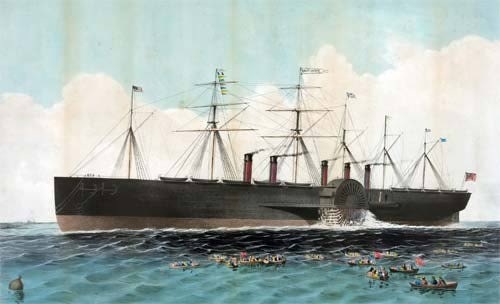
Not just bigger. Gigantic. A monster. The final design was staggering: 692 feet long, weighing nearly 19,000 gross tons (that’s over 32,000 tons displacement, an absolutely mind-boggling figure for the era). This iron behemoth was designed to carry 4,000 passengers—more than a small town—across the globe.

Deep Dive: Technology from the Future

The Great Eastern wasn’t just large; it was a technological marvel. Brunel threw every cutting-edge idea at it.

  • Dual Propulsion: It had not one, but three power sources. Two massive paddle wheels, each 56 feet in diameter, adorned its sides. It also had a single, 24-foot screw propeller at the stern. And just in case both steam engines failed, it carried six masts capable of holding 18,000 square feet of sail. It was a hybrid beast, part steamer, part sailing ship.
  • The Double Hull: This was perhaps Brunel’s most important innovation. The ship was essentially built with two skins of iron, an inner hull and an outer hull, separated by a space of nearly three feet. This made the ship incredibly strong and safe from punctures. It was a design so advanced it wouldn’t become standard for another century. It was this feature that would both save the ship and seal its terrifying secret.
  • Five Funnels: Its iconic five funnels made it instantly recognizable and signaled the immense power churning in its belly. It looked less like a ship and more like a factory that had decided to go for a swim.

Construction began in 1854 on the banks of the River Thames. Thousands of workers, an army of riveters and boilermakers, swarmed over its growing frame. The air was filled with the deafening clang of hammers on iron. A constant, percussive symphony of creation. But somewhere in that noise, something went horribly, horribly wrong.

A Curse Laid at the Keel

Maritime superstition is as old as sailing itself. Sailors say a ship’s fortune is decided before it ever touches water. And the Great Eastern’s fortune was rotten from the start.

The first dark omen came during construction. It’s a story whispered by the workers, a legend that grew with every strange event that followed. The story of the missing men.

In the chaos of building such a vessel, accidents were common. But this was different. A master shipwright—some say a riveter—and his young apprentice vanished. One day they were there, working deep within the claustrophobic space between the two hulls. The next, they were gone. A search was conducted, but in the labyrinth of iron plates and scaffolding, they were never found. The official explanation was that they simply walked off the job. The workers, however, knew better. They whispered that the two had been accidentally sealed inside. Trapped. Entombed in the ship’s iron gut.

The story was dismissed as a morbid fantasy. But the whispers had begun. The ship, they said, had demanded a sacrifice.

The Launch Fiasco: A Titan That Wouldn’t Budge

January 30, 1858. Launch day. It was a massive public event. Crowds gathered. Dignitaries watched. Brunel, a nervous wreck, gave the signal.

Nothing happened.

The Great Eastern, all 12,000 tons of it at that point, moved a few feet and then stopped with a gut-wrenching groan. It was too big, too heavy for the launch mechanism. The massive chains and steam rams strained, one man was killed when a winch flew back into the crowd, and the ship refused to move. It was a humiliating, public failure. It took three more months of brute force, hydraulic pressure, and immense cost to finally coax the behemoth into the water.

The failed launch bankrupted the original company. The half-finished ship sat rusting in the harbor for a year, a monument to hubris. Already, the press was calling it “the great white elephant.”

A Trail of Blood and Bad Luck

Eventually, the “Great Ship Company” was formed to buy and complete the vessel. But the curse was just getting started. The ship seemed to actively resent its own existence.

During its first sea trials in September 1859, a massive explosion ripped through the ship. A steam valve on one of the forward funnels had been mistakenly left closed. The pressure built to an impossible level, and the funnel erupted like a volcano, launching the massive iron tube into the air and showering the deck with scalding water and debris. Five men were killed, several others horribly burned. The grand saloon was destroyed.

The news reached Isambard Kingdom Brunel, already a sick man, and broke him. He suffered a severe stroke upon hearing of the disaster aboard his masterpiece. Ten days later, he was dead. He never saw his great ship carry a single paying passenger.

The Hammering Ghost

The Great Eastern was finally put into service as a transatlantic passenger liner. And that’s when the crew began to hear it.

It was a sound that defied explanation. A strange, rhythmic hammering noise. It came from deep below the decks, from the very bowels of the ship. It was faint at first, but it was persistent. Sailors on the lonely night watch would hear it. *Clang… clang… clang…* A steady, metallic beat.

They tried to find the source. Engineers checked the engines. Carpenters checked the fittings. Nothing. The sound seemed to come from nowhere and everywhere at once. It was most unnerving during storms. When the wind howled and the sea raged, the ghostly hammering could be heard even over the gale, a desperate, lonely sound from deep within the iron hull.

Sailors, a superstitious lot, started to talk. They remembered the stories of the men sealed inside. Was it one of them? A ghost, trapped for eternity, hammering on the walls of his iron coffin, begging to be let out? The sound drove some men mad. Captains reported it in their logs. Passengers complained of the unsettling noise that woke them from their sleep.

A Career of Calamity

The ship was a commercial disaster. It was too big for its time. No port was equipped to handle it. It never once carried a full complement of passengers. Its vast, opulent lounges and dining rooms were often eerily empty.

And the disasters kept coming.

  • The Hurricane (1861): On only her fourth voyage, she was caught in a brutal three-day storm. A massive wave tore off one of her paddle wheels and smashed the other. The rudder was destroyed. The ship, powerless, rolled violently in the waves, turning her luxurious interiors into a demolition zone. Pianos, furniture, and luggage were smashed to pieces. The ship and her 400 passengers were lucky to survive.
  • The Great Eastern Rock (1862): Sailing near New York, the ship struck an uncharted pinnacle of rock. It tore an enormous gash in her outer hull—83 feet long and 9 feet wide. Any other ship would have sunk in minutes. But Brunel’s double hull saved her. The inner hull remained intact, and the ship limped into port. The incident, while proving the genius of her design, added to her reputation as an unlucky vessel. The very thing that saved her was the same structure rumored to hold a terrible secret.

She lost money on every single voyage. The Great Ship Company bled cash until it could bleed no more. The great dream was a failure.

One Great Act of Redemption

Just when it seemed the ship was destined for the scrap heap, it was given a new purpose. One final, noble task. In 1865, the world needed to lay a telegraph cable across the bottom of the Atlantic Ocean, connecting Europe and North America in real-time for the first time.

No other ship on Earth had the size or stability to carry the 2,300 nautical miles of coiled cable required for the job. The Great Eastern, the failed passenger liner, was the only ship for the job.

Her vast passenger cabins were ripped out and replaced with massive tanks to hold the cable. For several years, the Great Eastern found her calling. She successfully laid the first permanent transatlantic cable, a feat that changed the world forever. She was no longer a failure, but a hero. The hammering, it was said, was quieter during these years, as if the ship’s tormented spirit was finally at peace with its new, important purpose.

But the peace didn’t last. Newer, more efficient cable-laying ships were soon built, and the Great Eastern was once again obsolete.

The Long, Slow Death of a Titan

For twelve long years, the mighty ship sat and rusted. She was passed from owner to owner, each with a grand scheme that never materialized. She became a floating circus. A gymnasium. A giant, floating billboard for a department store, moored in Liverpool.

It was a sad, undignified end for the wonder of the age. Crowds no longer came to marvel at her size, but to gawk at her decay. Finally, in 1889, the decision was made. The Great Eastern was sold for scrap.

The Final, Horrifying Discovery

Dismantling the ship was a monumental task. It took two years and hundreds of workers. They tore apart the decks, ripped out the engines, and peeled away the iron plates like the skin of an onion. The ship resisted, fighting to the very end.

And then they reached the double hull. The ship’s great secret.

As the ship-breakers from the Henry Bath & Son company cut into the section between the hulls, a space that had been sealed for over thirty years, the air filled with a foul stench. The workers recoiled. They brought lamps closer, peering into the dark, narrow space.

There, lying amidst the rust and dust, was a human skeleton. The skeleton of a grown man. And clutched in his bony hand was a riveter’s hammer.

The old story, the shipyard legend dismissed as fantasy, was true. The master shipwright—or his apprentice—had been trapped. He had been sealed alive inside the ship’s hull. The constant, ghostly hammering that had haunted the ship for decades was not a ghost at all. It was the sound of a real man, trapped in an iron tomb, hammering in the darkness, hoping against hope that someone would hear him, until he finally starved or suffocated. His desperate final moments, echoing through the iron plates, became the ship’s eternal, cursed heartbeat.

The Mystery Lingers: Truth or Legend?

So, is this incredible, horrifying story actually true? This is where the mystery deepens, and modern internet sleuths and historians clash.

Skeptics point out that contemporary accounts from the ship’s dismantling in 1889-1890 don’t mention the discovery of a skeleton. The first widely circulated versions of the story seem to appear years, even decades, later in popular magazines and books on maritime lore. Could it be a “retcon,” a dramatic story invented after the fact to explain the ship’s legendary bad luck?

Yet, the legend is persistent. Authors like James Dugan, in his book “The Great Iron Ship,” and L.T.C. Rolt, a respected biographer of Brunel, both repeat the story as fact, suggesting it was a well-known tale at the time, even if official sources stayed quiet. Perhaps the ship-breaking company hushed it up to avoid a scandal. The legend of the hammering sound itself is much older and better documented in sailors’ memoirs from the time the ship was active.

What if the story is true? Imagine it. The sheer terror of it. Trapped in a pitch-black, coffin-sized space. The sounds of the shipyard outside slowly fading as your colleagues unknowingly seal your fate with every hammer blow. Your own hammer, once a tool of creation, becomes your only hope for rescue. You bang and you bang, and you listen to the sounds of the ship coming to life around you, the sounds of it sailing the open ocean, while you are left to die in the dark.

The SS Great Eastern was more than just an unlucky ship. It was a tragedy written in iron and steel. A story of one man’s brilliant dream becoming another man’s living nightmare. It serves as a chilling reminder that sometimes, the most terrifying monsters aren’t out in the deep, but the ones we seal away and build our world on top of.

Originally posted 2014-01-05 21:29:49. Republished by Blog Post Promoter