
Home Weird World Mayan 2012 The unexplained events of December 26, 2004!

The unexplained events of December 26, 2004!

0
56

The 2012 Apocalypse Was a Hoax. The REAL Date Was 2004—And We All Missed It.

Remember 2012? The hype. The parties. The endless History Channel specials breathlessly counting down to December 21st. We all held our collective breath, waiting for the great cataclysm, the pole shift, the alien saviors—whatever the Mayan Long Count calendar was supposed to bring.

And then… nothing.

The sun rose on December 22nd. The world kept spinning. We all had a good laugh, called the Mayans out on their cosmic prank, and went back to our lives. The great prophecy was a dud. A historical misfire.

But what if it wasn’t?

What if the experts, the archaeologists, and the New Age gurus were all looking at the wrong date? What if a shocking, hidden calculation error points not to 2012, but to a day eight years earlier? A day when the cosmos screamed, the Earth cracked open, and the world was fundamentally, and perhaps permanently, altered.

A day we all remember, but for entirely different reasons.

Get ready. Because the evidence suggests the Mayan apocalypse wasn’t a prediction of a single, fiery event. It was the starting gun for the chaotic world we’re living in right now. And it all began on December 26th, 2004.

The Calendar Confusion: How Could Everyone Be So Wrong?

To understand the mistake, you have to understand the machine. The Mayan Long Count calendar wasn’t just a way to track seasons. It was a complex, cyclical engine for measuring vast spans of time. Think of it like the odometer on a car, with interlocking wheels of days (Kʼin), 20-day months (Winal), 360-day years (Tun), and so on, all the way up to the Baktun, a period of 144,000 days (or roughly 394 years).

The 2012 prophecy hinged on the end of the 13th Baktun. For the Mayans, 13 was a sacred, powerful number of completion. The end of the 13th Baktun was meant to signify the end of a World Age. A cosmic reboot.

But here’s the dirty little secret of archaeology: converting a Mayan date to our modern Gregorian calendar is a nightmare. It’s not a simple one-to-one conversion. It relies on something called a “correlation constant”—a complex mathematical bridge between their system and ours. The most widely accepted one, the GMT correlation, is what pointed everyone to December 21, 2012.

It’s the academic standard. It’s what’s taught in universities. But it’s not the only one.

In the quiet corners of academic debate and online forums, a fierce argument has raged for decades. Other researchers have proposed different correlation constants, some shifting the “end date” by years, even decades. They argue the mainstream view is based on fragmented evidence, colonial-era misinterpretations, and a few key carvings that could be read in multiple ways. They point to the mass burning of Mayan books by Spanish conquistadors, an act of cultural genocide that left us with only a handful of original texts. How can we be so certain of a date when the library of knowledge was turned to ash?

One of these alternative timelines suggests a massive, eight-year error. An eight-year gap between the celebrated date and the *real* one.

And when you adjust the calendar by that margin, the date of the Great Cycle’s end lands squarely on December 26, 2004. And on that day, the universe decided to put on a show.

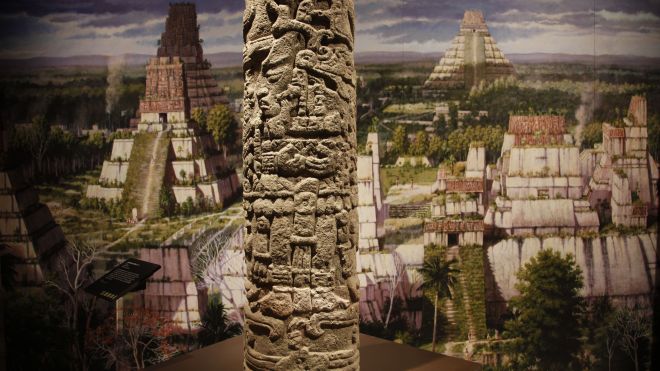
Maya Exhibit Apocalyp_four

December 26, 2004: A Day of Cosmic Fury

The ancient prophecies, according to some interpretations, didn’t just give a date. They gave a sequence of events. The end of the cycle would be marked by a “blast of energy from out of the sky.” Earthquakes would shake the world. The seas would rise. The very wobble of the Earth would change.

On December 21, 2012, none of that happened. But on December 26, 2004, it *all* did. Precisely.

A Message from Beyond: The SGR 1806-20 Event

It began with a silent flash. A cosmic scream from 50,000 light-years away.

On that day, a magnetar—a type of neutron star with a magnetic field so powerful it defies imagination—suffered a “starquake.” This star, named SGR 1806-20, erupted with a blast of gamma rays and x-rays so colossal it remains the brightest extraterrestrial event ever witnessed from Earth. For a fraction of a second, it was brighter than a full moon and released more energy than our Sun does in 150,000 years.

This wasn’t some distant, academic observation. This blast of pure energy hit us. It slammed into our planet’s upper atmosphere, violently stripping atoms of their electrons and disrupting communications across the globe. NASA’s SWIFT gamma-ray satellite, designed for this very purpose, was completely blinded. Its sensors were wiped out by the sheer intensity of the wave.

Think about that. A blast of energy from the sky, so powerful it fried the sensors of our most advanced space telescopes. An event of almost unbelievable violence, arriving from the heavens without warning.

Is that a coincidence? Or was this the celestial starting gun the Mayans had been warning us about for millennia?

The Earth Groans and the Seas Rise

While the upper atmosphere was still reeling from the cosmic assault, the planet itself began to tear apart.

At 7:58 AM local time, off the west coast of northern Sumatra, a 1,600-kilometer stretch of the Earth’s crust snapped. The resulting earthquake registered a magnitude of 9.1-9.3, making it the third most powerful quake ever recorded by a seismograph. It was so powerful it caused the entire planet to vibrate by as much as one centimeter. The planet rang like a bell.

The energy it released was staggering. The equivalent of twenty thousand nuclear bombs. But the true horror was yet to come.

This was no ordinary earthquake. It triggered the Boxing Day Tsunami. A series of monstrous waves, some reaching nearly 100 feet high, radiated out across the Indian Ocean at the speed of a jetliner. They crashed into the coasts of 14 countries, wiping entire communities off the map and claiming the lives of over a quarter of a million people in one of the deadliest natural disasters in recorded history.

The seas rising. Earthquakes shaking the whole world.

But the prophecy spoke of one more thing. A change in the very wobble of the Earth. According to scientists at NASA’s Jet Propulsion Laboratory, that’s exactly what happened. The sheer force of the 2004 earthquake, which shifted massive amounts of rock on the seafloor, permanently altered the planet. It made the Earth slightly more compact, causing it to spin a tiny bit faster and shortening the length of a day by 2.68 microseconds. It also changed the “mean North Pole” by about an inch.

The effect was minuscule. But it was real. On December 26, 2004, a cataclysm literally knocked our world off its axis.

So let’s recap. On the *revised* Mayan end date, we have: a record-shattering blast of energy from space, a planet-ringing earthquake, the deadliest tsunami in modern history, and a measurable change in the Earth’s rotation. That’s not a coincidence. That is a checklist.

The Quiet Apocalypse: Did We Cross Into a New World?

Maybe the Mayan apocalypse was never meant to be a Hollywood blockbuster. No fireballs raining from the sky. No continents sinking into the sea in a single day.

Maybe it was a shift. A turning point. The end of one stable reality and the beginning of a new, more volatile one. Look at the world since that fateful day. Does it feel the same? Or does it feel like something fundamentally broke?

Since the end of 2004, we’ve seen a documented and dramatic increase in extreme weather events. Record-breaking hurricanes like Katrina, which devastated New Orleans just months later in 2005. Unprecedented heatwaves, floods, and wildfires. A surge in major earthquakes and volcanic activity around the globe.

Scientists will give you a thousand reasons for this. Climate change. Natural cycles. But they can’t explain the timing. The way the world seemed to lurch onto a different, more chaotic track right after the cosmic and terrestrial events of December 26, 2004.

Echoes in the Code: Glitches in the New Reality

This theory is no longer confined to dusty books. It’s alive and well on the internet. On forums and subreddits, people who have never heard of the 8-year calendar correction talk about a strange feeling. A sense that the world went “off-script” sometime in the mid-2000s.

They talk about the Mandela Effect, a phenomenon where large groups of people misremember the same historical facts. They talk about a sense of growing polarization and unreality in our daily lives. A feeling that the simulation is starting to stutter.

Could it be? Could the combined shock of the gamma-ray burst and the massive earthquake have been enough to “nudge” our reality? To push us from one timeline to another, slightly different, and far more unstable one? Was the Mayan calendar not a doomsday clock, but a warning that the very nature of our existence was about to change?

The Mayans were master astronomers. They tracked celestial cycles with a precision that we are only now beginning to fully appreciate. They understood that the cosmos and the Earth were not separate, but deeply interconnected. A blast from the heavens could, in their worldview, absolutely trigger a reaction from the planet itself.

The Calendar Stopped. But Did We?

The world didn’t end in fire and fury. It ended quietly.

We crossed a threshold on December 26, 2004, and most of us were too busy with holiday leftovers to even notice. We stepped out of the old world, the world of the 12th Baktun, and into the chaotic, unpredictable energy of the 13th. We’ve been living in the “apocalypse”—the great unveiling, the transformation—ever since.

Look around you. At the state of the world. At the state of our society. Does this feel like the same world you grew up in?

The evidence is there, written in the seismic data, burned into our satellite sensors, and felt in the very spin of our planet. The Mayans weren’t wrong about the end of an era. We were just wrong about the date.

We threw a party for an apocalypse that never came, all while living through the one we never saw.

Originally posted 2013-04-13 20:48:57. Republished by Blog Post Promoter









