The Impossible Disappearance of Pauline Picard: A Century-Old Mystery That Defies All Logic
Some stories are more than just mysteries. They are fractures in reality. They are chilling tales that crawl under your skin and stay there, whispering questions that have no answers. This is one of those stories.
Imagine this. A sun-drenched afternoon in rural France. The year is 1922. A two-year-old girl is playing on her family farm, the picture of innocence. One moment she is there, a tiny splash of life against the green fields of Brittany.
The next? Gone.
Vanished. Utterly and completely.
But the disappearance of little Pauline Picard is not the real story. It’s not even the beginning of the madness. The real story begins when she was *found*. Because the girl who came back was not the girl who left. And the discovery that followed would unearth a horror so bizarre, so twisted, it feels like it was ripped from a nightmare.
This isn’t just a cold case. This is a rabbit hole. And we’re going all the way down.

A Hole in the World
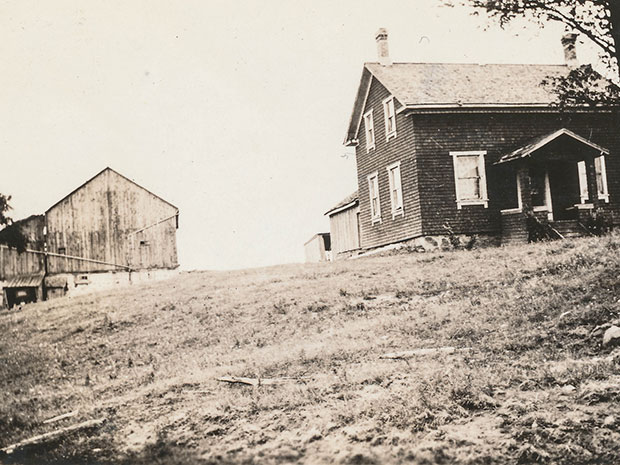
It was April of 1922 in Goas Al Ludu, a tiny farming hamlet in Brittany, France. Life here was simple, dictated by the seasons and the soil. For the Picard family, life revolved around their farm and their children. Two-year-old Pauline was the light of their lives. On that fateful day, she was playing outside, as she had a hundred times before, while her parents worked the land nearby. They looked away for a moment. A brief, insignificant moment.
When they looked back, the space where she had been was empty.
Panic. Raw, primal panic. Her name was screamed until their throats were raw. Frantic searching turned into a desperate, organized hunt. Neighbors, friends, the entire community poured out across the fields and forests. They checked every ditch, every barn, every well. The local police joined in, their search methodical but fruitless. Days bled into a week.
Nothing.
It was as if the earth itself had swallowed the little girl whole. In the absence of evidence, terrifying theories took root. The most common whisper was of gypsies, a travelling caravan that had been seen in the area. It was a convenient, prejudiced explanation common for the time. That a shadowy outsider had swooped in and stolen their child was, for some, more comforting than the alternative—that she had simply wandered off and met a terrible end in the wild countryside.
The family was shattered. Hope was a flickering candle in a hurricane. And then, a miracle happened. Or so it seemed.
The Phantom from Cherbourg
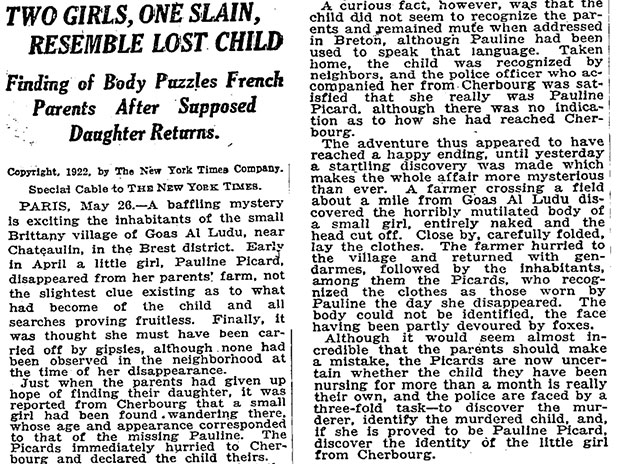
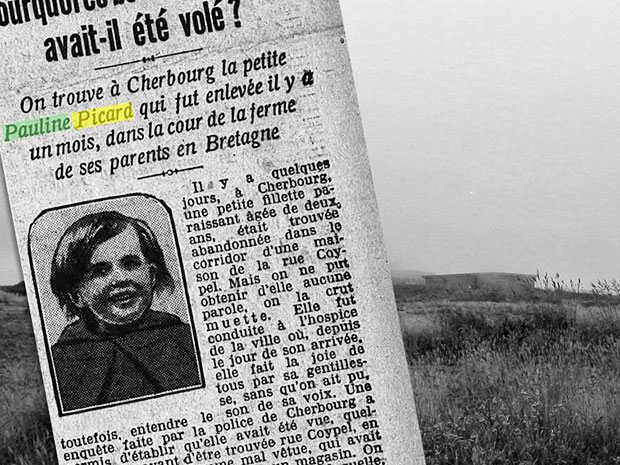
Weeks later, a telegraph arrived. The words on it must have felt like a prayer answered. A small girl, matching Pauline’s description, had been found wandering the streets of Cherbourg. Cherbourg. A bustling port city over 300 miles away. How could a two-year-old possibly travel that far on her own? It made no sense. But the Picards didn’t care about the logistics. They only cared that a child who looked like their daughter was alive.
The authorities in Cherbourg sent a photograph. In the grainy, black-and-white image, the Picards saw what they desperately wanted to see: their lost little girl. Without hesitation, they confirmed her identity. Relief washed over the family and the entire region. Newspapers from Paris to New York ran sensational headlines about the miraculous return of the missing farm girl.
The Picards traveled to Cherbourg, their hearts pounding with a mixture of joy and apprehension. But the reunion was… strange. The girl they met was quiet. Distant. She showed no recognition, no spark of familiarity when she saw her supposed parents. She didn’t cry for them. She didn’t reach for them. She was a placid, empty vessel.
A Stranger in Her Own Home
The police and the Picards brushed it off. Trauma, they said. The poor thing has been through an unimaginable ordeal. Of course she’s not herself. Overjoyed and pushing their doubts aside, they brought the little girl back to the farm in Goas Al Ludu.
But the strangeness didn’t fade. It grew.
The girl wouldn’t respond to her name. She seemed confused by the layout of the house she had supposedly lived in her entire life. Most damning of all, she did not understand a single word of the Breton dialect. This was not a minor detail. In that part of rural Brittany in 1922, Breton was the language of the home. A two-year-old child of the Picards would have known it intimately. This girl only seemed to understand French.
The joyful homecoming began to feel like a wake. A creeping, horrifying doubt began to poison the family’s relief. The neighbors started to whisper amongst themselves. They looked at the child playing in the yard and saw a stranger. This wasn’t Pauline. Something was terribly, terribly wrong.
The Madman’s Confession
The tension finally broke in a moment of pure cinematic drama. A neighboring farmer, a man named Yves Martin, saw the Picards with the new child. He marched up to them, his eyes wide with a frantic energy. He stared at the girl, then at the parents, and asked them point-blank if they truly believed this was their daughter.
Before they could answer, he collapsed, screaming a confession that would electrify the investigation.
“God help me,” he wailed. “I am guilty!”
Guilty of what? He didn’t say. Before he could be properly questioned, Martin was declared insane. He was dragged away, committed to a mental asylum, and was never heard from in a public capacity again. Was he a madman driven to a false confession by the town’s collective trauma? Or was he the killer, silenced and hidden away before he could reveal the whole, ugly truth? His outburst confirmed the Picards’ deepest fears: the girl in their home was an imposter, and their real daughter was still out there, her fate tied to this raving man.
And then, just one month after the “miraculous” return from Cherbourg, a local made a discovery that would turn the strange case into a truly macabre circus of horror.

A Grisly Discovery in a Familiar Field
A farmer, taking a shortcut across the Picard’s property, was struck by a foul odor. He followed the smell to a ditch. There, partially concealed, he found a nightmare.
It was the body of a small child. The corpse was badly decomposed and mutilated. The child was naked, and her clothes were found in a neat pile beside her. But that wasn’t the worst part. The body was decapitated.
Lying near the small, broken frame was a human skull.
The authorities were called. The devastated Picards were brought to the scene. Through their tears, they made a positive identification. Not of the body—it was too far gone for that. They identified the clothes. It was the exact outfit Pauline had been wearing on the day she vanished.
The most chilling detail? The location where the body was found had been searched. Extensively. Dozens of people, including the police, had combed that exact patch of land in the early days of the search. The conclusion was inescapable: the killer hadn’t just murdered Pauline. They had kept her body for weeks, only to return and dump it near her own home. It was a taunt. A final, cruel act of psychological torture against the family.
The Riddle of the Second Skull
The investigation moved to the local morgue, where the autopsy was expected to confirm the grim reality. The small, headless body was clearly that of a child matching Pauline’s age. The focus turned to the skull found nearby. The medical examiner cleaned it, measured it, and made a discovery that sent the case spiraling from a tragedy into a piece of high strangeness.
The skull did not belong to the body.
It was far too large. In fact, it wasn’t the skull of a young girl at all. It belonged to a full-grown adult. A man.
Think about that. A decapitated child’s body. A disembodied adult male skull. Found together. The case had just exploded. This wasn’t one murder; it was at least two. Who was this man? Was he the killer, who then met his own violent end? Was he another victim of Yves Martin, the madman in the asylum? Was his murder connected to Pauline’s, or was this a deranged killer’s trophy, left at the scene for reasons no sane mind could comprehend?
The police had no missing men reported in the area. The skull offered no clues. It was a complete and total dead end, a piece of a puzzle that didn’t seem to fit anywhere.

Untangling the Threads: What Really Happened?
A century has passed, and we are no closer to the truth. The case of Pauline Picard remains a knot of impossible questions. But with the benefit of hindsight and modern curiosity, we can explore the theories that have haunted this case for generations.
Theory 1: The Mad Farmer
The most straightforward suspect is Yves Martin. Did he snatch the girl, kill her in a fit of madness, and hide her body? Did his guilt finally overwhelm him, leading to his public confession? It’s plausible. Perhaps he also killed the unknown man for some reason, and in his deranged state, brought the skull to the disposal site. His swift commitment to an asylum could be seen as a convenient way for the local authorities to “close” the case and remove a disturbed individual from the community without a messy trial. But it leaves too much unexplained. Why the theatrical return of the body? What was his motive?
Theory 2: The Doppelgänger Conspiracy
This is where things get wild. What about the girl from Cherbourg? Modern internet sleuths often focus on her. Her appearance is too much of a coincidence. Could she have been part of a deliberate plot? Some have speculated that someone wanted to get rid of both Pauline and the unknown man, and placing the lookalike child with the family was a bizarre, complex form of misdirection. Perhaps the plan was for the family to accept the new child, allowing the real Pauline’s body to decompose undiscovered. When the Picards started having doubts, the killer panicked and dumped the body back on the farm to be found, hoping to end the charade.
Theory 3: A Crime Interrupted
Another compelling theory suggests Pauline was simply in the wrong place at the wrong time. What if she wandered from the farm and stumbled upon the murder of the unknown man? The killer, needing to silence the only witness, then killed her as well. This neatly explains the presence of two victims. This killer, perhaps a local, would have known the area well and could have hidden both bodies, only returning Pauline’s later for unknown reasons—perhaps a pang of guilt, or a desire to have her receive a proper burial.
The Fates of the Lost
In the end, there was only heartbreak and confusion. The unidentified girl from Cherbourg, the phantom Pauline, was taken from the Picards and placed in an orphanage. Her true identity, where she came from, and who her parents were, was never discovered. She simply vanished back into the bureaucracy, a ghost in the system, her own story a tragic mystery.
The Picards were forced to bury the mutilated remains found on their land, accepting that it was their daughter, Pauline, though concrete proof was impossible in that era. They lived out the rest of their lives under the shadow of this immense, unsolvable sorrow.
And the skull? It was never identified. It remains a silent, grinning testament to the case’s profound strangeness. The disembodied head of a nameless man, forever linked to the death of a little girl he may or may not have ever met.
Today, with DNA technology, this case could likely be solved in days. A sample from the bones could identify Pauline. A test of the skull could be run against databases to find the man’s identity. But in 1922, there was only mystery. There was only the word of grieving parents, the ravings of a madman, and a collection of horrors that made no sense. A century later, the fields of Brittany keep their secrets. A lost girl, a stranger who wore her face, and a nameless skull. Three lives tangled together by a crime that time forgot, but whose echoes refuse to fade.
Originally posted 2016-12-16 12:12:15. Republished by Blog Post Promoter