Friday, April 10, 2026
HomeWeird WorldStrange StoriesSea Monster Mystery Deepens

Sea Monster Mystery Deepens

The Creature on Folly Beach: A Mystery Washes Ashore

It began with the smell. A rank, salty stench that clung to the humid air of Folly Beach, South Carolina. It was the smell of the deep ocean giving up a secret. A big one.

Then, they saw it.

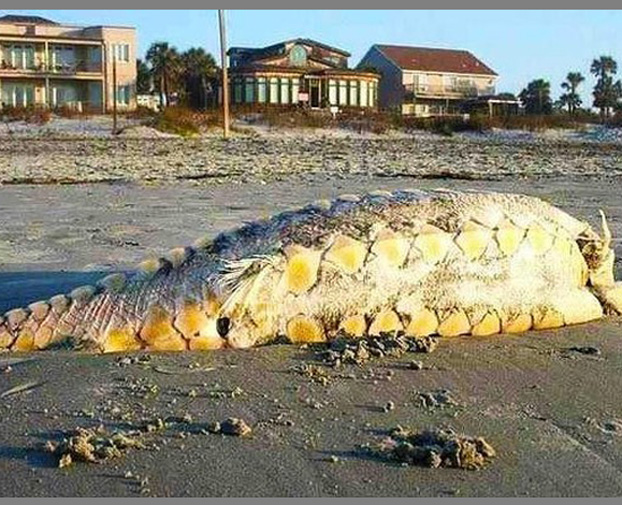
Sprawled across the sand, looking like something torn from a prehistoric nightmare, was a carcass. It was huge. Alien. Its skin was a sickly brownish-tan, stretched tight over a bizarre, armored frame. This was no fish. Not any fish they knew. This was something else. Something ancient and wrong.

Crowds gathered. Whispers turned into theories. Phones came out, snapping pictures of the impossible beast the tide had coughed up. The digital age was in full swing, and a modern mystery was born right there on the shoreline. Before the day was out, the images would hit the web, and the real frenzy would begin.

The Internet’s Wildest Guesses Go Viral

The pictures spread like wildfire. Forums lit up. Social media feeds exploded. Everyone had a theory, and each one was wilder than the last. This wasn’t just a dead animal; it was a global Rorschach test for our deepest fears of the ocean.

What WAS it?

The speculation ran rampant. Some, looking at its massive size and armored appearance, jumped to one thrilling conclusion: a dinosaur. A living plesiosaur, a creature from 66 million years ago, had somehow survived in the abyss only to meet its end on a tourist beach. It was the stuff of legends.

A large, decomposed sea creature washed up on a sandy beach

Others went darker. They saw a mutation. A grotesque monster spawned from a toxic soup of ocean pollution and chemical waste, a horrific omen of humanity’s carelessness. The creature’s strange form and color seemed to support this terrifying idea. It was a monster of our own making.

Then came the cryptid hunters. The name was whispered, then shouted across comment sections: “Chupacabra!” Never mind that the legendary “goat-sucker” is typically a land-dweller of North and South American folklore. The beast on the beach was so bizarre, so unearthly, it seemed to fit the bill. Maybe it was an aquatic variant? A “Sea-Chupacabra”? When you have a monster with no name, any name will do.

The internet detectives were on the case, and they were leaving no stone unturned.

Deep Dive: The Bizarre World of ‘Globsters’

To understand the excitement, you have to understand the phenomenon. The Folly Beach creature wasn’t the first of its kind. Far from it. For centuries, sailors and beachcombers have been haunted by the appearance of “globsters”—a fantastic name for an often-disgusting reality. A globster is a massive, unidentified organic mass that washes ashore. It has no visible bones, often no recognizable eyes or head, and looks more like a giant, fleshy blob than any known animal.

History is littered with them.

  • The St. Augustine Monster (1896): Two boys in Florida stumbled upon an enormous, pale mass buried in the sand. It was rubbery, almost white, and weighed an estimated five tons. For decades, it was championed as the remains of a gigantic octopus, a true kraken. The debate raged for nearly 100 years until DNA analysis in the 1990s suggested a far more mundane, yet still fascinating, origin: a massive lump of whale blubber.
  • The Tasmanian Globster (1960): This one was even stranger. A 20-foot by 18-foot mass washed up in Tasmania, covered in what looked like white “hair.” It was tough, fibrous, and completely baffling. Scientists were stumped. Was it a new kind of sea creature? A strange, oversized sea-fungus? Decades later, electron microscope analysis pointed toward the same culprit: a highly decomposed whale, with the “hair” being exposed strands of collagen from its blubber.
  • Trunko (1924): Perhaps the most legendary of all. Off the coast of South Africa, witnesses claimed to see a bizarre, white-furred creature with a trunk-like appendage battling two killer whales. The creature’s body later washed ashore, where it was dubbed “Trunko.” No scientist ever examined it, and the story became pure folklore… until 2010, when old photographs of the carcass were unearthed. The consensus now? Once again, almost certainly the decomposing carcass of a whale, its blubbery form twisted into a monstrous shape by the sea and scavengers.

These historical accounts show a clear pattern. The ocean is great at taking something we know and turning it into something we don’t. Decomposition, especially in water, works strange magic. It bloats, distorts, and strips away recognizable features until you’re left with a monster. The creature on Folly Beach was just the latest star in a long-running, mysterious show.

The Expert Arrives: A Voice of Reason in the Madness

While the internet was busy chasing dinosaurs and mutants, scientists were taking a calmer, more methodical look. And they were far more skeptical.

One of the first to weigh in was Dr. Shane Boylan, a veterinarian with the South Carolina Aquarium. When he saw the photos, he didn’t see a monster from the deep. He didn’t see a science-fiction nightmare. He saw a fish.

A very, very big fish.

According to Dr. Boylan, two massive clues cut through all the speculation and pointed directly to the creature’s true identity. He didn’t even need to be on the beach to solve the puzzle.

Clue #1: The Distinctive Bony Plates

The first giveaway was the “armor.” Running along the creature’s body were rows of hard, diamond-shaped plates. These weren’t scales. They were scutes—bony protrusions that are part of the animal’s skin, forming a kind of natural, external skeleton. Very few fish have this feature, and it immediately narrowed the possibilities from millions of species down to just a handful.

Clue #2: The Overall Shape

Even in its decomposed state, the creature’s fundamental form was clear. It had a long, torpedo-like body, a pointed snout, and a shark-like tail where the top lobe is longer than the bottom (a heterocercal tail). When you combine that unique body plan with the unmistakable rows of bony scutes, there’s really only one candidate that fits.

The marine monster, the dinosaur, the toxic mutant… was an Atlantic sturgeon.

Meet the Real Monster: The Astonishing Atlantic Sturgeon

An anticlimax? A boring answer? Absolutely not. The truth was, in some ways, even more incredible than the fiction.

Calling this creature a sturgeon doesn’t diminish its mystery; it deepens it. Because the Atlantic sturgeon is one of the most remarkable, primitive, and awe-inspiring animals on the entire planet. The people who thought it was a dinosaur were, in a way, closer to the truth than they could have possibly imagined.

A Survivor from the Age of Dinosaurs

This is not an exaggeration. The sturgeon family has been swimming in Earth’s oceans and rivers for more than 120 million years. They were here long before the T-Rex. They swam in the same waters as the giant mosasaurs. They survived the asteroid that wiped out 75% of life on Earth. They have outlasted ice ages and geological upheavals. They are, quite literally, living fossils.

Their bodies are a roadmap to a bygone era. They lack the calcified skeleton of most modern fish, having one made mostly of cartilage, like a shark. Those bony scutes are a primitive defense mechanism from a time when the seas were filled with terrifying predators. Looking at a sturgeon is like looking through a time machine into a lost world.

Anatomy of a River Titan

It’s no wonder people were scared and confused. Atlantic sturgeon are titans. They have been known to reach lengths of over 15 feet and weigh more than 800 pounds. Seeing one up close, even a healthy one, is not for the faint of heart. They are true giants of the aquatic world.

Their features are just as alien as their lineage. They are bottom-feeders, using four sensitive, whisker-like barbels that dangle from their snouts to detect crabs, worms, and mollusks in the mud. They have no teeth. Instead, they use a protrusible, vacuum-like mouth to slurp up their food. They are armored, ancient, behemoths that spend part of their lives in the salty ocean and part in the freshwater rivers where they were born.

The Ugly Truth: How a Majestic Fish Becomes a “Monster”

So if this was a sturgeon, why did it look so… monstrous? Why the strange, leathery, brown skin instead of the silvery-white color of a living sturgeon?

The answer is simple, and a little grim: the sun and the process of decay.

When a large marine animal dies and washes ashore, nature begins a rapid and unflattering transformation.

  1. Bloating: Bacteria inside the carcass produce gas, causing the body to swell to unnatural proportions, distorting its shape.
  2. Discoloration: The sun is brutal. It effectively “cooks” the exposed flesh, breaking down the skin and changing its color. The silvery sheen of a living fish quickly turns to a leathery, dark tan or brown, just like the creature on Folly Beach.
  3. Decomposition: The softest parts of the body rot away first. Gills, fins, and eyes are often the first to go, leaving behind a strange, featureless lump. What remains are the tougher parts—cartilage, thick skin, and, in the sturgeon’s case, the incredibly durable bony scutes.

The result is a perfect storm of misidentification. You’re left with a giant, bloated, brown, armored creature that looks like nothing you’ve ever seen before. It’s no longer a fish; it’s a monster from the id.

But What If… Do Real Sea Monsters Exist?

The Folly Beach mystery was solved. Case closed. It was a sturgeon. A magnificent, ancient, and sadly deceased sturgeon.

But does solving one mystery mean they’re all solved?

Every time a globster is identified as a whale, or a sea monster turns out to be a sturgeon, it’s easy to feel a little disappointed. It feels like a small piece of magic has left the world. We want to believe that the maps of old, with their warnings of “Here be dragons,” were right.

And maybe they are. We have explored more of the surface of Mars than we have of our own ocean floor. Over 80% of our ocean is unmapped, unobserved, and unexplored. The pressure is crushing, the light is non-existent, and the temperatures are extreme. Who are we to say, with absolute certainty, what does or does not live down there?

Every year, scientists discover hundreds of new marine species. Most are small, but some are surprisingly large. The giant squid was a creature of myth, the stuff of Jules Verne novels, until we finally captured one on film in 2004.

So while the creature on Folly Beach may have been a case of mistaken identity, it serves as a powerful reminder. The ocean is vast, and its secrets are well-kept. The “monster” on the sand wasn’t a plesiosaur, but it was a genuine monster of a different sort: a survivor. A ghost from a time before man, a relic from the age of dinosaurs, reminding us that the deep still holds wonders beyond our comprehension.

And you have to ask yourself… what else is down there, waiting for its turn to wash ashore?

Amit Ghosh
Amit Ghoshhttps://coolinterestingnews.com
Aloha, I'm Amit Ghosh, a web entrepreneur and avid blogger. Bitten by entrepreneurial bug, I got kicked out from college and ended up being millionaire and running a digital media company named Aeron7 headquartered at Lithuania.
RELATED ARTICLES
- Advertisment -

Most Popular

Recent Comments

Warren Pan Abbott on The legend of the Devil Monkey !
chris davies on The McPherson Tape Mystery
Reed Reedly on ET has Internet!
Bea Houseoffashion on Proof Of Time Travellers – Gallery
Marcus2012 on ET has Internet!
Reed Reedly on ET has Internet!
LaughsAtConspiracyNuts on The 9/11 Conspiracy – Myths and Facts
Alex Sliverman on Did the ancients fly?
Doctor Wholigan on Time Traveler in 1938 film
chris davies on The McPherson Tape Mystery
Archie1954 on 10 secret UFO hideouts
chris davies on Ghosts of flight 401
Marcus2012 on ET has Internet!
jason Macdonald on Proof of Time Travel? – China
chris davies on Long-Lost Pyramids Found?
Reed Reedly on ET has Internet!
Milkman on Connected Universe
Tenmiles on Baigong Pipes Mystery
Simon Foster on Sirius – The Documentary
From the 1st April on 2013 – Alien Contact date ?
SkyWatcher on Is ET ignoring us?
I Come From The Future on Obama to make UFO Alien disclouser soon ?
Just another person on 2013 – Alien Contact date ?
Malcolm Windowcleaner on The strange case of Rudolph Fentz
Mason Servio on Strange Things on Mars
Marke Wisdom Seeker on What will we find as arctic melts?
Andrea A Elisabeth Levyne on Aliens Captured in Varginha, Brazil
Mitch Grouyeki on Amazing Space Shuttle pictures