The Octopus in Room 517: The Man Who Knew Too Much
The air in Room 517 of the Sheraton Hotel was thick. Stale. On August 10, 1991, in the quiet town of Martinsburg, West Virginia, housekeeping staff unlocked a door and walked straight into a nightmare.
It was a scene of calculated carnage. A man, naked, lay submerged in a bathtub filled with crimson water. His wrists were a geography of deep, horrific gashes. So many cuts. Blood was everywhere—on the walls, the floor, the porcelain. A gruesome tableau that screamed violence.
The man was Joseph Daniel Casolaro. An American freelance writer. A father. A man who had told his family just days before, “If anything happens to me, don’t believe it’s an accident.”
And yet, that’s exactly what the authorities wanted everyone to believe. Beside the tub, a single, neatly torn page from a legal pad offered a supposed confession: “To those who I love the most: Please forgive me for the worst possible thing I could have done.”
Case closed. Suicide.
But for those who knew Danny Casolaro, and for those who knew what he was chasing, this was no suicide. This was an execution. This was a message. Because Danny Casolaro hadn’t just been writing a story. He was hunting a monster. A creature with tentacles wrapped around the highest levels of global power, a shadowy cabal of spies, arms dealers, and political puppeteers.
He called it “The Octopus.” And in that bloody hotel room, it seems the Octopus finally squeezed back.

Who Was Danny Casolaro?
To understand the sheer madness of his death, you have to understand the man. Danny wasn’t some wild-eyed conspiracy theorist living in a basement. He was a respected journalist. Polished. Ambitious. He’d written about everything from Soviet naval power to the Fidel Castro regime. But by the late 1980s, he had stumbled onto something different. Something bigger.
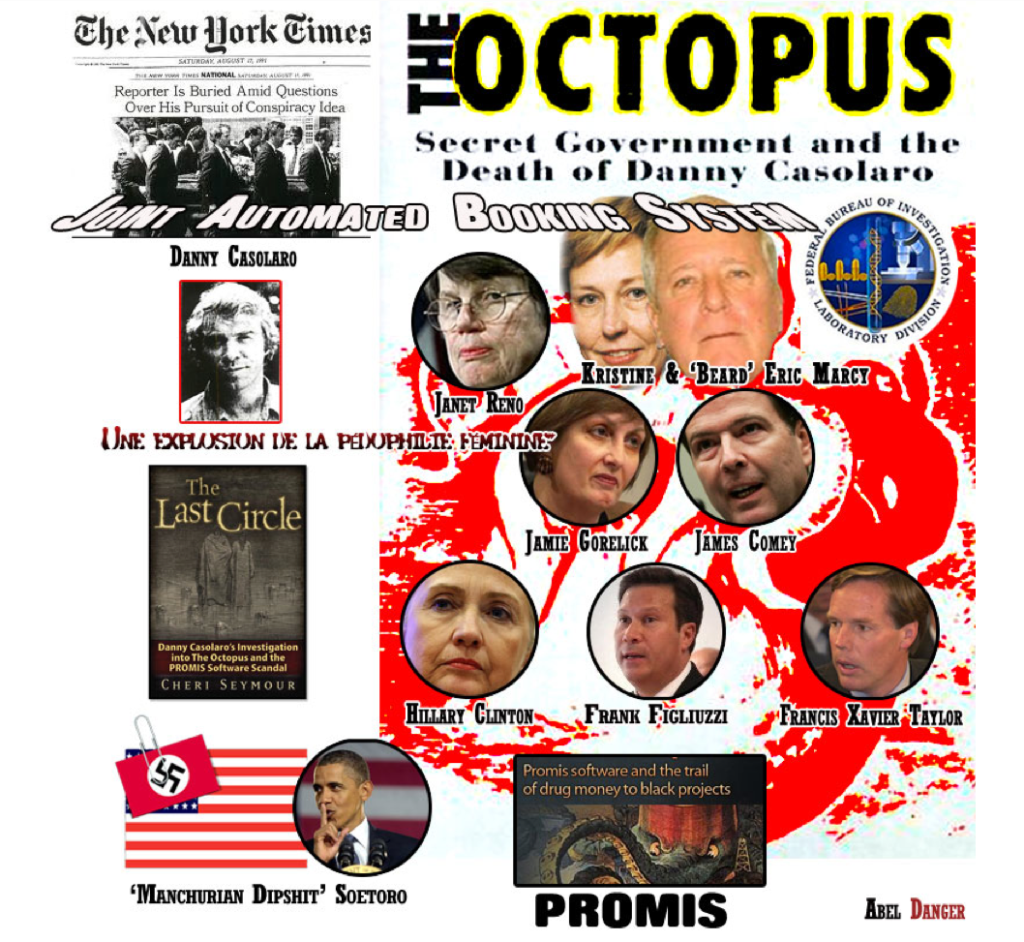
It started with a single thread. A friend asked him to look into a case involving a small software company called Inslaw. The owner, Bill Hamilton, claimed the U.S. Department of Justice had stolen his revolutionary case-management software, PROMIS. A simple case of corporate theft, right? A business dispute.
Wrong. So very wrong.
As Danny dug, that single thread began to unravel, revealing a web of connections that defied belief. The Inslaw case wasn’t just about stolen software. It was the key. The entry point into a hidden world operating just beneath the surface of our own. A world of off-the-books spy operations, secret political deals, and dirty money flowing through a global pipeline.
This was the Octopus. And Danny Casolaro was about to map every single one of its toxic arms.
Untangling The Octopus: A Deep Dive into the Conspiracy
What exactly was this monster Casolaro was chasing? It wasn’t one single conspiracy. It was a fusion of them. A mega-conspiracy. The Octopus, as he saw it, was a loose-knit group of about eight men, many with ties to the CIA and military intelligence, who had been operating as a kind of shadow government since the mid-1970s. They were untouchable. They moved in the dark. And their influence was everywhere.
Tentacle One: The Inslaw Affair and the All-Seeing Software
This is where it all began. Bill Hamilton’s company, Inslaw, had developed a software program called PROMIS (Prosecutor’s Management Information System). It was revolutionary for its time. It could track people. It could connect disparate pieces of information—linking suspects to evidence, cases to court dates, criminals to organizations. The Department of Justice loved it. They bought it. And then, according to Hamilton, they stole it.
But why? Why would the powerful DOJ go to such lengths to bankrupt a small tech company?
Danny’s sources gave him a chilling answer. The DOJ, working with intelligence operatives, had modified PROMIS. They had secretly installed a “backdoor” into the software. This modified version was then sold, or sometimes given, to the intelligence agencies of both allied and enemy nations. Countries like Israel, Jordan, Canada, and even Iraq and Libya, were using PROMIS to manage their own intelligence and law enforcement data.
And the entire time, the U.S. government was using the backdoor to read it all. They were spying on the world’s spies. It was the ultimate intelligence coup. The profits from these illegal sales, sources claimed, went directly into funding covert operations that Congress would never approve. Black ops. Assassinations. All funded by the sale of stolen software.
Tentacle Two: The October Surprise
As Casolaro followed the money from the PROMIS software, he hit another explosive story: the “October Surprise.” The theory alleges that in 1980, Ronald Reagan’s presidential campaign team, desperate to beat incumbent Jimmy Carter, made a secret deal with Iran. At the time, Iran was holding 52 American diplomats hostage, a crisis that was crippling Carter’s presidency.
The deal was simple and treasonous: Iran would hold the hostages until after the November election. In exchange, the incoming Reagan administration would secretly funnel weapons to Iran. It worked like a charm. The hostage crisis dragged on, Carter looked weak, and Reagan won in a landslide. And, in a moment of almost unbelievable timing, the hostages were released just minutes after Reagan was sworn into office.
Coincidence? Casolaro didn’t think so. He believed the same shadowy figures involved in the PROMIS software deal were the architects of the October Surprise. It was another operation by the same cabal, flexing its power to install a friendly president who would let their off-the-books world continue to thrive.
Tentacle Three: The BCCI – Bank of Crooks and Criminals
Every shadow government needs a shadow bank. For the Octopus, that bank was the Bank of Credit and Commerce International (BCCI). On the surface, it was a major global financial institution. Beneath the surface, it was a laundromat for the world’s dirtiest money.
BCCI serviced a client list from hell: dictators like Saddam Hussein and Manuel Noriega, the Medellin drug cartel, terrorist organizations, and intelligence agencies from dozens of countries, including the CIA. It was the financial hub where money from arms deals, drug running, and covert operations could be washed clean and redistributed to fund more chaos.
Casolaro discovered that the money trails from both the Inslaw affair and the Iran-Contra scandal (another tentacle of the Octopus involving illegal arms sales to Iran to fund anti-communist rebels in Nicaragua) ran directly through BCCI. It was the circulatory system of the beast, pumping illicit cash to wherever the Octopus needed it.
The Final Days: “They’re Going to Kill Me”
By the summer of 1991, Danny Casolaro felt he was getting close. Dangerously close. The pieces were fitting together. He had sources, documents, and a book deal in the works. But the closer he got, the more the Octopus seemed to be aware of him.
He started receiving strange phone calls in the middle of the night. Sometimes, the line would just be silent. Other times, a voice would whisper a threat. He told his friends and family he was being watched. He told his brother, “I have been getting some very threatening phone calls. If I die, don’t assume it was an accident.”
Then, a breakthrough. A source promised to deliver the final, damning piece of evidence that would tie everything together. The meeting was set for a hotel in Martinsburg, West Virginia. A quiet, out-of-the-way place. Perfect for a secret exchange.
Casolaro packed his bags, including a briefcase stuffed with all his research—the culmination of years of work. He told his housekeeper where he was going. He was excited. He believed he was about to blow the lid off the biggest scandal in American history.
He checked into the Sheraton on August 8th. He was last seen alive on August 9th, having a coffee in the hotel cafe with an unidentified man.
The next day, he was found dead in that bathtub.
Room 517: The Anatomy of a “Suicide”
The official story fell apart almost immediately for anyone who looked closely. The Martinsburg police, perhaps out of their depth or perhaps instructed to be, seemed content to accept the suicide note and close the books. But the red flags were everywhere.
The Wounds
The medical examiner noted 10-12 deep slashes on Casolaro’s wrists. Seven or eight on his left, three or four on his right. This is highly unusual for a suicide. The sheer number of cuts, and the fact that they were on both arms, suggests hesitation or a struggle. Furthermore, his family insisted Danny was intensely squeamish. He was terrified of needles and hated the sight of blood. The idea that he would choose such an agonizing and bloody method to end his life struck them as impossible. They said he wouldn’t even watch his son get a blood test.
The Missing Briefcase
This is the smoking gun. Danny Casolaro went to Martinsburg with a briefcase overflowing with his notes, documents, and source contacts. When police “searched” his room, the briefcase was gone. All his research, the evidence he was supposed to receive, his entire investigation—vanished. The legal pad with the “suicide note” was there, but the life’s work that brought him to that room had been surgically removed from the scene.
The Tidy Scene and Questionable Forensics
Aside from the bloodbath in the bathroom, the rest of the hotel room was suspiciously neat. Towels were folded. His things were put away. Police interviews with hotel staff and guests turned up nothing—no one heard a struggle, no one saw anything suspicious. And the forensic work was shockingly poor. The bathwater was drained away, potentially washing away foreign skin, hair, or fibers. Even more disturbing, Casolaro’s body was embalmed less than two days after being found, an unusually rapid process that made a comprehensive toxicology screen for subtle poisons or drugs impossible. It was almost as if someone wanted to erase any evidence that didn’t fit the suicide narrative.
Aftermath and the Digital Echo
In the wake of Danny’s death, his family and a handful of fellow journalists cried foul. They passed his remaining notes to major news outlets, but the official investigations went nowhere. The story was too big, too convoluted, too dangerous. The powers that be declared it a suicide, and the world, for the most part, moved on.
But the story never truly died. It lived on in the margins, a cautionary tale for reporters who dig too deep. And now, in the internet age, the story of Danny Casolaro and his Octopus has found a new life.
Online forums and investigative communities have pored over every document, every interview, every strange detail of his death. Modern sleuths connect the dots between the Octopus and other major conspiracies, from the JFK assassination to 9/11, viewing it all as the work of a persistent deep state. They see Casolaro not as a victim, but as a martyr. A pioneer who walked into the heart of the beast and paid the ultimate price.
Was he a brilliant investigator on the verge of exposing a shadow government? Or was he a man who got lost in a labyrinth of paranoia, connecting dots that weren’t there until the pressure became too much? The official story tells one tale. The blood in Room 517, the missing briefcase, and the warnings to his family tell another.
We may never know for certain what happened in that hotel room. We may never know if the man he met for coffee was his source or his killer. But one thing feels chillingly certain: Danny Casolaro believed The Octopus was real. He chased it to Martinsburg, and he never came back. The story he was writing remains unfinished, its final chapter written in blood in a lonely hotel bathroom. And you have to wonder… is the Octopus still out there, its tentacles still pulling the strings, waiting for the next person who gets too close?