The Chupacabra: A Modern Monster or Something More?
It starts with a sound. A screech in the dead of night that doesn’t belong. Not a coyote. Not a dog. Something else. The next morning, a farmer walks out to his field and finds… carnage. But it’s not the work of a wolf or a wildcat. There’s no shredded flesh, no sign of a struggle. There’s just… stillness. A dozen goats, lying on their sides. Perfect. Untouched. Except for two small, impossibly neat puncture wounds on their necks. And they are empty. Drained completely of blood.
This is the calling card of the creature they call El Chupacabra.
The Goat Sucker.
For decades, this name has been whispered in terrified tones from the jungles of Puerto Rico to the dusty plains of Texas and beyond. It’s a legend that refuses to die, a monster that shapeshifts with every telling. Is it just a scary story, a modern folktale born of fear and misunderstanding? Or is it a chilling warning about something very, very real that stalks the shadows of our world?
Forget what you think you know. We’re going deep. We’re going to follow the trail of blood and ask the questions the mainstream won’t touch.
The Birth of a Legend: Puerto Rico, 1995
The story doesn’t begin in some ancient, dusty tome. It explodes into the modern world. The year is 1995. The place? The small, rural towns of Puerto Rico, specifically Canóvanas. Farmers started reporting a rash of baffling livestock deaths. Chickens, sheep, and most famously, goats, were being slaughtered in the night. The method was always the same. Strange. Surgical. The animals were exsanguinated, their bodies left behind like empty bags.
Local authorities were stumped. They blamed wild dogs, maybe a satanic cult. But the evidence didn’t fit. The wounds were too precise. And where was all the blood?
Then came the eyewitness.
Madelyne Tolentino’s Terrifying Encounter
A woman named Madelyne Tolentino from Canóvanas gave the creature its face. What she described was not of this Earth. Peering from her window, she saw something that would haunt her dreams. It was bipedal, standing on two powerful legs, maybe four to five feet tall. Its skin was a sickly greyish-green, and its head was a large oval, dominated by huge, almond-shaped eyes that glowed with a terrifying red light. And down its back, a row of sharp, menacing spikes or quills.
Think about that. This isn’t a bear or a dog. This is something alien. Something that seems pulled directly from a science-fiction horror film.
Her account opened the floodgates. Suddenly, everyone had a story. Sightings poured in from across the island. The media latched on, and Puerto Rican comedian Silverio Pérez jokingly gave it the name that would stick forever: “El Chupacabra.” The Goat Sucker. The name was perfect. It was catchy, terrifying, and it captured the public imagination. A legend was born, spreading faster than any jungle virus.
Anatomy of a Monster: What Does It Actually Look Like?
Here’s where things get strange. The Chupacabra isn’t just one monster. It seems to be two. Over the years, the descriptions have split, creating two distinct versions of the creature. Are they related? Is one a case of mistaken identity? Or are we dealing with multiple threats?
The Reptilian Original: The Puerto Rican Terror
This is the classic. The O.G. Chupacabra. Based on the initial reports from Tolentino and others in the 90s, this version is distinctly reptilian or even extra-terrestrial. The key features are terrifyingly consistent in the early days:
- Stands on Two Legs: It moves like a person but with a strange, hopping gait.
- Glowing Red Eyes: Not just reflecting light, but seemingly self-illuminated. A feature that paralyzes witnesses with fear.
- Spikes or Quills: A defining characteristic, running from the base of the skull down its spine.
- Grey-Green Skin: Often described as leathery or scaly, completely unlike any native mammal.
- Fangs and Claws: Sharp and ready to puncture, but not to tear.
Some have even suggested it has small, leathery wings, allowing it to glide or make massive leaps. This version looks and feels like something that doesn’t belong here. Some researchers at the time pointed out its striking similarity to the alien creature from the 1995 film *Species*. Coincidence? Or did the movie give people a template for their fears?
The Canine Imposter: The Texas Blue Dog
As the legend jumped from the island to the mainland United States, something changed. A new Chupacabra began to appear, primarily in Texas, Arizona, and New Mexico. This creature was completely different.
It was a quadruped. It ran on four legs. And it looked… like a dog from hell.
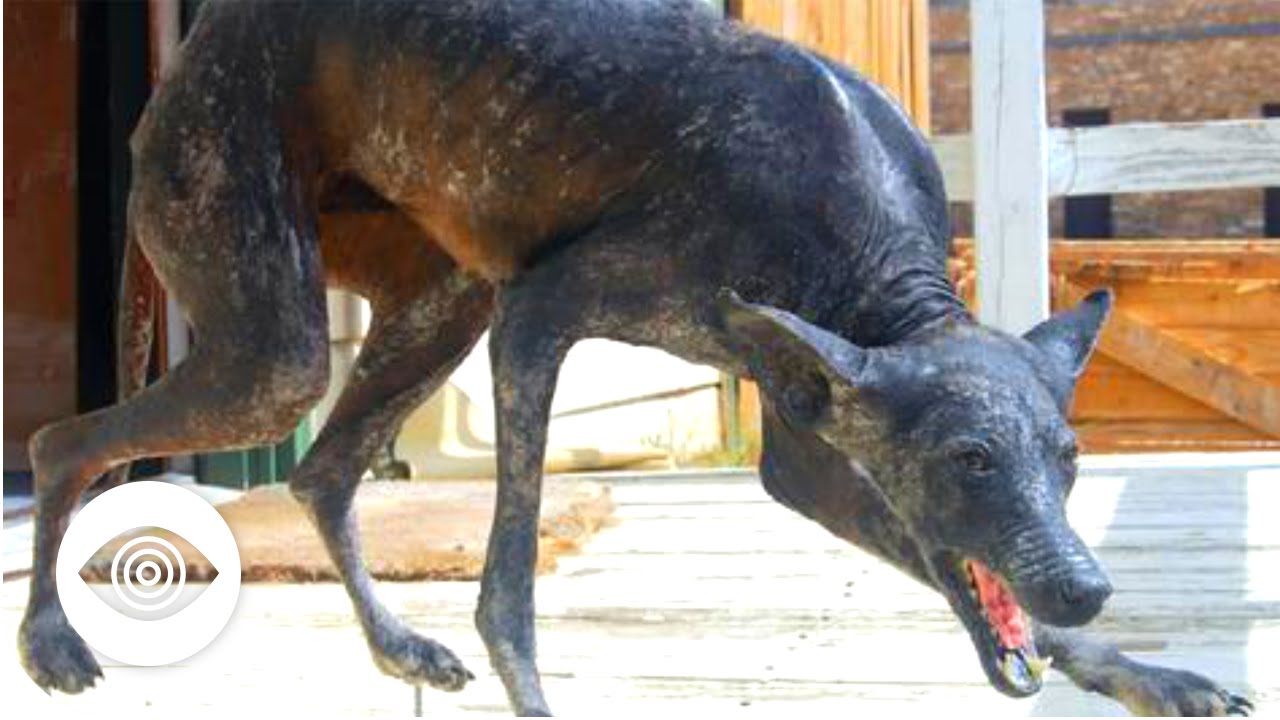
This is the version you’ve probably seen in grainy photos and supposed “captured” carcasses. It’s often called the “Texas Blue Dog.” It’s completely hairless, its skin a strange bluish-grey or leathery black. It’s gaunt, emaciated, with its ribs and spine clearly visible. It has a long snout, large fangs, and powerful hind legs. While still terrifying, it feels more… terrestrial. More like an animal we know, just hideously twisted.
So what gives? Did the creature evolve? Or did the legend get co-opted, with any strange-looking canine carcass being slapped with the Chupacabra label?
The Skeptic’s Corner: What’s Really Killing the Goats?
Of course, there’s the official story. The explanation that scientists and government officials want you to believe. They say there’s no monster, just a perfect storm of disease, misidentification, and mass hysteria. And to be fair, some of their arguments seem pretty convincing. At first glance.
The Mange Theory
The number one explanation for the “Texas Blue Dog” version of the Chupacabra is an animal—usually a coyote, dog, or even a raccoon—suffering from a severe case of Sarcoptic mange. This isn’t just a little rash. It’s a horrific skin disease caused by burrowing mites. It makes an animal’s hair fall out in clumps, leaving behind thickened, cracked, and discolored skin. It causes intense itching and pain, leading to secondary infections.
A coyote with advanced mange is a pitiful, horrifying sight. It’s hairless, skeletal, and its skin can look blue or grey. The disease makes it weak, so it can’t hunt its usual prey like deer. It’s forced to go after easier targets. Chickens in a coop. Goats in a pen. Sound familiar?
Almost every single “Chupacabra” body that has been recovered and subjected to DNA testing has come back as a coyote or dog with severe mange. Case closed, right?
Not so fast.
The Blood-Draining Mystery Explained?
What about the most famous detail of all? The drained blood. Skeptics have an answer for that, too. They argue that predators, like coyotes, often attack the neck, where major arteries are located. The puncture wounds are from their canine teeth. After the animal dies, gravity causes the remaining blood to pool at the bottom of the carcass, and the blood that does spill can be lapped up by the predator or absorbed into the ground. To an untrained eye, it might *look* like the animal was drained like a juice box, but it’s just a natural process.
Is that really what’s happening? Some farmers and investigators who have seen the bodies firsthand swear this isn’t the case. They describe a scene with an unnatural lack of blood. Not just on the ground, but in the body itself. They claim the corpses are strangely dry.
Beyond the Mange: The Unexplained Evidence
The mange theory is neat. It’s tidy. It explains the Texas Blue Dog almost perfectly. But it leaves gaping holes in the story. Holes big enough to drive a conspiracy theory through.
What About the Original Monster?
Let’s go back to Puerto Rico, 1995. Madelyne Tolentino did not see a sick coyote. She saw a bipedal, spiky-backed creature with glowing red eyes. Mange doesn’t make an animal grow a row of spikes down its spine. It doesn’t teach a dog to walk on its hind legs like a man. It doesn’t make its eyes glow in the dark.
The mange theory completely and utterly fails to explain the original wave of sightings. It only explains the later, canine version. So, are we supposed to believe the entire Puerto Rican population simultaneously hallucinated the same reptilian alien? Or was there something real there, something that was later forgotten or conflated with the sightings of sick coyotes on the mainland?
A Government Experiment Gone Wrong?
This is where we enter the rabbit hole. Let’s look at Puerto Rico’s unique position. It’s home to significant US military and scientific installations. The Arecibo Observatory (before its collapse) was a hub of advanced research. El Yunque National Forest has long been rumored to be a site for clandestine military experiments. What if the Chupacabra wasn’t a natural creature? What if it was created?
Think about it. A creature designed for stealth, capable of neutralizing targets (livestock, in this case) with surgical precision, leaving behind minimal evidence. Sounds a bit like a prototype for a biological weapon, doesn’t it? Perhaps an experiment in genetic engineering, splicing DNA from different species, got loose from a hidden lab deep in the jungle.
This would explain its bizarre, unnatural appearance. It would explain the government’s quickness to dismiss all sightings as fantasy. They aren’t trying to cover up a monster; they’re trying to cover up their own catastrophic mistake. Maybe the “Texas Blue Dog” is a second, different experiment. Or perhaps it’s a red herring, a naturally occurring phenomenon that officials are happy to promote as the “real” Chupacabra to draw attention away from the original, far more terrifying truth.
The Chupacabra in the Modern Age
The Goat Sucker has become a global icon of the strange and unexplained. It has appeared in cartoons, movies, and video games. It’s a cryptozoological superstar, right up there with Bigfoot and the Loch Ness Monster. But sightings haven’t stopped.
In the age of the internet and camera phones, the legend continues to evolve. Every few years, a new blurry photo or shaky video emerges, often from Latin America or the American Southwest. Trail cams capture eerie images of hairless, four-legged creatures slinking through the woods at night. Reddit threads and paranormal forums light up with new eyewitness accounts.
The Chupacabra has become more than a monster. It’s a symbol. It represents our primal fear of the unknown predator that lurks just beyond the safety of our homes. It embodies the modern anxiety of science run amok, of government secrets, and of the possibility that we are not alone in the universe.
So what is the truth? Is it a sick coyote, twisted by disease into a monstrous form? Is it a mass hallucination, a boogeyman born from fear? Is it an escaped lab experiment, a testament to humanity’s arrogance? Or is it something else entirely? Something ancient, or something alien, that has chosen our world as its hunting ground?
The one thing we know for sure is that the reports continue. The livestock deaths continue. And in the quiet, dark corners of the world, farmers still lock their doors at night, listening for that unearthly screech in the darkness. Listening for the Goat Sucker.