Did the Nazis Build a Secret Base in Antarctica? The Chilling Truth Behind Base 211
Antarctica. A continent of ice, bigger than Europe, shrouded in six months of darkness. It’s the most remote, most hostile, most alien place on Earth. It’s the last place you’d expect to find the remnants of history’s greatest evil.
Or is it the perfect place?
The story sounds like something ripped from a pulp fiction novel. A secret Nazi redoubt, hidden beneath a mile of ice. A sanctuary for the Third Reich’s most brilliant, and most twisted, minds. Flying saucers. Super-weapons. And a massive American military operation, sent to wipe it off the map, that came home with its tail between its legs.
Crazy, right? Except… some parts of it are disturbingly true. The paper trail is real. The expeditions happened. And the questions they leave behind are so profound, so chilling, they have haunted researchers for over 75 years. Forget what you learned in history class. We’re going deep down the rabbit hole, into the frozen heart of the world’s biggest conspiracy. Did the Nazis build a secret base in Antarctica?
The answer might change everything you think you know about World War II.
Neuschwabenland: The Official Story (And Why It’s So Weird)
Our story doesn’t begin with jackboots and Panzers. It begins with margarine. Seriously.
In the late 1930s, Germany was on a collision course with the rest of the world, and its leaders knew it. Part of preparing for a massive war is stockpiling resources. One of the most vital? Fats. Whales were the world’s primary source of industrial oils and fats, used for everything from nitroglycerine to common margarine. Germany was one of the biggest buyers of Norwegian whale oil, and Hermann Göring, head of the Four Year Plan to get Germany’s economy war-ready, hated that dependency.
His solution was simple: Germany needed its own whaling station. In Antarctica.
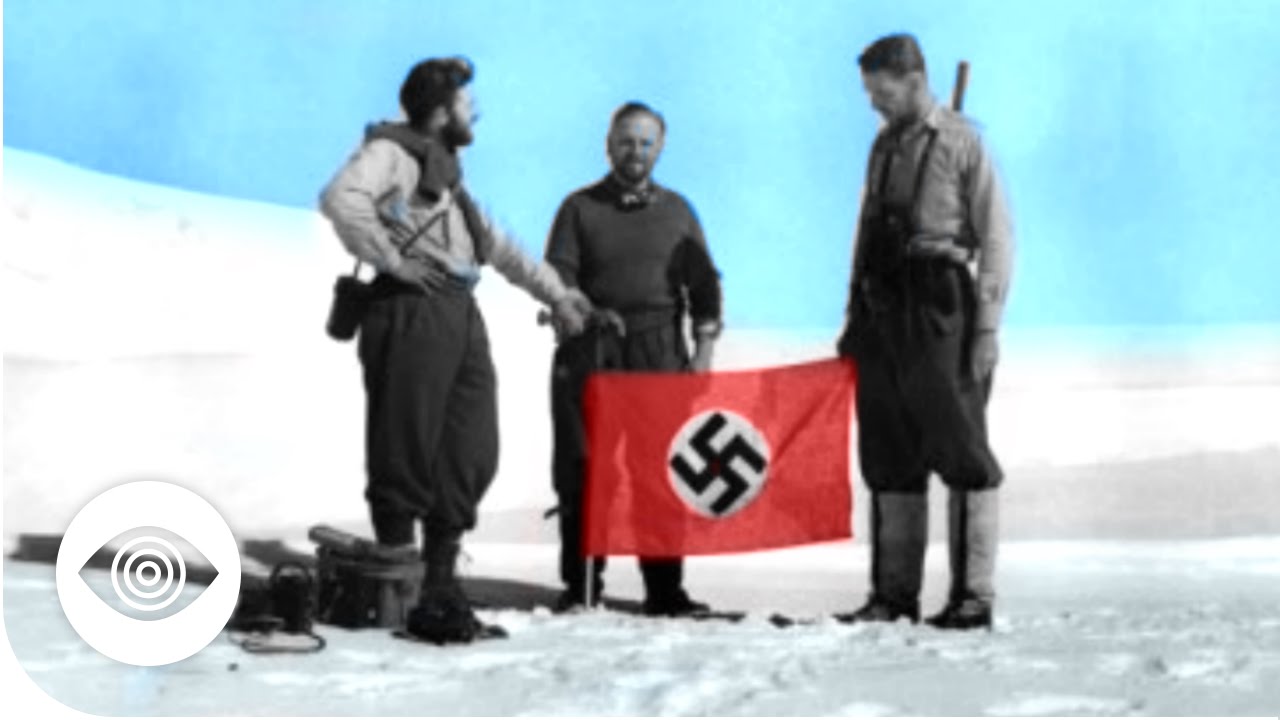
So, in 1938, the Third Reich launched its third official German Antarctic Expedition. They repurposed a freighter, the *MS Schwabenland*, a ship that could launch and retrieve seaplanes with a massive steam-powered catapult. Under the command of polar veteran Captain Alfred Ritscher, they sailed south. Their mission was clear: find a suitable spot, claim a massive chunk of the continent for Germany, and secure the Reich’s future fat supply.
Dropping Darts on an Icy Kingdom
The *Schwabenland* reached the coast of Antarctica in January 1939. For weeks, its two Dornier Wal seaplanes, the *Passat* and *Boreas*, flew back and forth in a grid pattern. They mapped an area of over 600,000 square kilometers from the air. This was an immense territory, larger than Germany itself.
And they claimed it. Boy, did they claim it.
Every 25 kilometers, the planes dropped specially designed metal darts from the sky. These long poles, emblazoned with the swastika, plunged into the ice below, marking the land as German territory. They named this new frozen province “Neuschwabenland,” or New Swabia, after the region the expedition’s ship hailed from.
The expedition also made a startling discovery. They found vast, ice-free areas. Oases. Warm-water lakes in the middle of the frozen desert, surrounded by rocky, barren hills. Captain Ritscher called it the “Schirmacher Oasis.” It was a geological anomaly, a place where geothermal heat from beneath the Earth’s crust warmed the surface.
A perfect place to build a base. Hidden. Sheltered. Supplied with fresh water not locked in ice.
And then, just before the outbreak of war in Europe, the expedition packed up and went home. The official record of Neuschwabenland goes cold. That’s where the accepted history ends. But for us, it’s where the real story begins.
The Whispers Start: U-Boats, Missing Leaders, and a Ghostly Reich
The war ended in fire and ruin in May 1945. The top leaders of the Reich were dead or captured. Or were they? As the Allies sifted through the rubble of Berlin, they found that some of the biggest fish had slipped through the net. Martin Bormann, Hitler’s private secretary. Heinrich “Gestapo” Müller, head of the secret police. And hundreds of other high-ranking officials, scientists, and SS officers simply vanished.
Where did they go?
Then something strange happened. Months after Germany’s surrender, two German U-boats surfaced in Mar del Plata, Argentina. First came U-530 in July 1945, two months after the war was over. Then, in August, U-977 arrived. The crews were taken into custody. Their stories were… thin. They claimed they had been on a final patrol and had just been hiding out. But their logs were gone. Their journeys were unaccounted for. And these weren’t ordinary submarines; they were advanced, long-range vessels capable of traveling immense distances without surfacing.
Could they have made a side trip? A long one? All the way south?
The legend grew. These “ghost” U-boats, it was said, weren’t just carrying their crews. They were the final pieces of a massive evacuation plan. A plan to transport Germany’s most valuable assets—top scientists, secret technology, and perhaps even key leaders—to a pre-built sanctuary. A place far from the reach of the Allies. A place no one would ever think to look.
A place like Neuschwabenland.
Operation Highjump: An Invasion Force in Disguise?
The war was over. The world was exhausted and trying to rebuild. So why, in 1946, did the United States Navy assemble one of the largest naval task forces in its recent history and send it to Antarctica?
It was called Operation Highjump. And it was a monster.
The official story? It was a scientific expedition to train personnel and test equipment in frigid conditions. A mapping mission. Nothing more.
But look at the list of hardware. Task Force 68 included an aircraft carrier (the USS *Philippine Sea*), thirteen support ships, destroyers, oilers, icebreakers, and a submarine. It carried over 4,700 men. This wasn’t a science fair project. This was a full-blown military invasion force.
The man in charge was Admiral Richard E. Byrd, America’s most famous polar explorer. A national hero. He was brought out of retirement to lead this massive fleet. The mission was scheduled to last for six to eight months. They arrived in late December 1946.
They fled in a panic just eight weeks later.
What happened? The official report cites worsening weather conditions and the onset of the early polar winter. It talks about a few accidents, including a plane crash that killed three men. Case closed.
But the rumors that trickled out from the men who were there told a different story. A story of a battle. A story of losses far greater than were ever admitted. A story of encountering forces they were completely unprepared for.
Admiral Byrd’s Chilling Warning
The most explosive piece of evidence comes from an interview Admiral Byrd supposedly gave to a South American newspaper, the *El Mercurio* of Santiago, Chile, on his way back home in March 1947. While the original clipping has become the holy grail for researchers, the quotes attributed to him are terrifying.
He allegedly warned that the United States needed to prepare to defend against “enemy fighters that can fly from pole to pole at incredible speeds.”
Pole to pole. From the Antarctic.
He spoke of a “new war” where America could be “attacked by objects that can fly from pole to pole with tremendous speed.” He described seeing something that defied all logic. Was he talking about advanced Nazi aircraft? Or something else they had found buried in the ice?
Upon his return to the States, Byrd was reportedly whisked away to Washington D.C., debriefed behind closed doors, and ordered never to speak of what happened on Operation Highjump again. He never did. The entire event was buried under layers of official secrecy.
So what did they find? What could have possibly sent a US Navy battle group running for home?
Base 211: The Reich’s Frozen Fortress?
This is the heart of the mystery. The prize at the bottom of the rabbit hole. Base 211. Or “New Berlin.”
According to the lore, this wasn’t just a few huts in the snow. This was the Third Reich’s Area 51, its command and control center for a shadow government. The theory claims that those U-boats weren’t just dropping off a few escapees. They were the final links in a supply chain that had been running for years, ferrying prefabricated building materials, scientists, heavy equipment, and the Reich’s most advanced, secret weapon projects to Neuschwabenland.
And where did they build it? Not on the ice, but under it.
They built it in the warm Schirmacher Oasis the 1938 expedition had discovered. They supposedly used massive boring machines to expand the geothermally heated caves into a sprawling underground city. A self-sufficient metropolis, powered by the Earth’s own heat, with hydroponic farms, laboratories, and aircraft hangars, all hidden from the prying eyes of Allied bombers and, later, spy satellites.
Nazi UFOs and Super-Weapons Under the Ice
And what were they building in this secret lair? This is where the story goes from a political conspiracy to something far, far stranger.
The legends speak of the *Wunderwaffen*, the “wonder weapons.” Projects so advanced they sound like science fiction.
- The Haunebu and Vril Saucers: While Allied engineers were perfecting propeller planes and jet engines, theorists claim Nazi scientists, led by figures like Viktor Schauberger, had cracked the code of anti-gravity. They built flying discs, silent, circular craft that could outmaneuver any aircraft on Earth. Were these the “enemy fighters” that Byrd’s men encountered? Craft that could appear out of nowhere and attack with devastating effect?
- Die Glocke (“The Bell”): A more sinister project, a metallic, bell-shaped device that supposedly used exotic, radioactive materials to warp spacetime itself. A weapon, a time machine, or a gateway to another dimension? Its secrets supposedly went to the grave with SS General Hans Kammler, the man in charge of the Reich’s most secret projects… unless he took it with him to Antarctica.
The idea is staggering. That a remnant of the Third Reich didn’t just survive, but thrived. That they continued their work, perfecting technology decades ahead of its time, waiting for the right moment to emerge from their frozen fortress and complete their quest for world domination.
Modern Echoes in the Ice
This isn’t just an old story. It’s a conspiracy that’s alive and kicking in the 21st century. The internet is flooded with supposed new evidence. Researchers pour over declassified documents from Operation Highjump, looking for clues between the lines of the heavily redacted text.
Satellite imagery has added a new layer of intrigue. People using Google Earth have claimed to find strange anomalies in Neuschwabenland. Perfectly geometric shapes under the ice. Dark, cave-like openings on the sides of mountains that look suspiciously like hangar doors. A massive object, miles long, that some claim is a crashed extraterrestrial ship the Nazis discovered and were reverse-engineering.
And what about the high-profile visitors? Why did US Secretary of State John Kerry make a sudden, unannounced trip to Antarctica on the very day of the 2016 US presidential election? What was so important? Why did Patriarch Kirill, the head of the Russian Orthodox Church, travel there to meet… penguins?
Are world leaders secretly making pilgrimages to the pole? Are they in contact with whatever, or whoever, is still down there? Or are they just checking to make sure the lid stays on this planetary secret?
The Unanswered Question
So, what are we left with? Is it all just a fantastic story? A myth woven from a few strange historical oddities? Maybe.
But the pieces fit together just a little too well.
You have a confirmed Nazi expedition that claimed a huge, resource-rich territory filled with mysterious warm-water oases. You have the confirmed, inexplicable surrender of long-range U-boats months after the war. You have the confirmed, massive US military operation that was supposed to last for half a year but was cut short after only two months. And you have the chilling, on-the-record (or is it?) warning from its legendary commander about hostile craft flying from pole to pole.
Could it all be a coincidence? Perhaps. But in the world of shadows and secrets, there’s rarely such a thing as coincidence.
The truth remains locked away. It’s buried under miles of ice, in classified government archives, and in the silence of old men who took their secrets to the grave. But the question still hangs in the frigid air of the world’s most mysterious continent. Did the Third Reich die in a Berlin bunker? Or did it just… move?
And is it still there, waiting, under the ice?