The Bimini Road: An Accident of Nature or Atlantis’s Doorstep?
Forget what you think you know. Forget the dusty history books and the boring documentaries. Some mysteries aren’t found in ancient tombs or forgotten manuscripts. Some are hiding in plain sight, just beneath the waves, waiting for us to look.
We’re going to the Bahamas. Not for the sun or the sand. We’re going for what lies just 20 feet beneath the crystal-clear turquoise water off the coast of North Bimini island.
A road. Or a wall. Or… something else entirely.
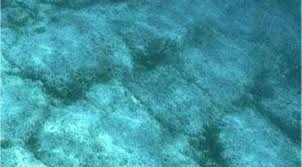
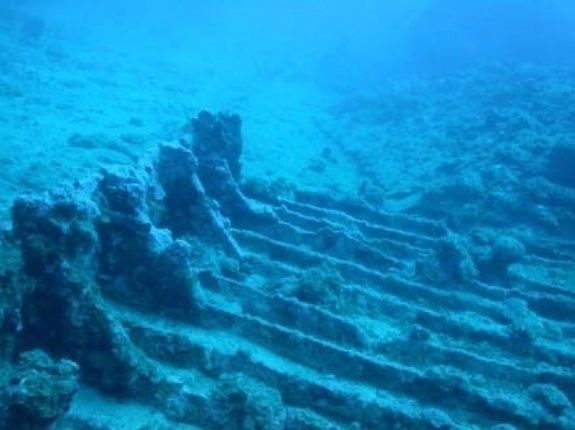
They call it the Bimini Road. A perfectly aligned, half-mile-long pavement of colossal stone blocks, some as large as a pickup truck. It’s a geometric formation so precise, so seemingly intentional, that it screams one word.
Man-made.
The official story? It’s a natural beachrock formation. A geological anomaly. A trick of the light and a quirk of erosion. Nothing to see here, folks. Move along.
But what if the official story is wrong? What if those stones are the last remaining cornerstone of the greatest legend of all time? The lost city of Atlantis.

A Prophecy Frozen in Time: The Edgar Cayce Connection
Our story doesn’t start in 1968, when divers first stumbled upon this impossible underwater highway. It starts 30 years earlier, in the quiet study of a man they called the “Sleeping Prophet.”
His name was Edgar Cayce. And he had a vision.
Cayce was a psychic, a mystic, a man who would enter a trance-like state and deliver stunningly accurate readings on everything from medical diagnoses to the secrets of ancient history. He spoke of Atlantis often. He described it not as a myth, but as a real, historical super-civilization with technology that would rival our own. A civilization destroyed by a cataclysm of its own making.
Then, in 1938, he made a prediction so specific it would send chills down the spine of history. He was asked when and where evidence of Atlantis would be found. His answer, recorded in black and white, was haunting.
He said, “A portion of the temples may yet be discovered under the slime of ages and sea water near Bimini… Expect it in ‘68 or ‘69 – not so far away.”
Think about that. The name. The place. The *exact years*. Thirty years before it happened.
And then, right on schedule, in September of 1968, zoologist and adventurer J. Manson Valentine was flying over the shallow waters of Bimini when he spotted it. A strange, dark, linear shape under the water. He led a dive team to the location. What they found would ignite a firestorm of controversy that burns to this day. They found a pavement of massive, flat-topped, rectangular stones. They found the Bimini Road.
Coincidence? A lucky guess? Or did a man in a trance three decades earlier see across time and point the world to the first physical proof of Atlantis?
The Case for a Lost Civilization
Let’s be clear. This isn’t just a jumble of rocks. Skeptics want you to believe it’s a random assortment of broken stone, but the evidence, when you truly look at it, tells a different story. A much, much older story.
The Stones Don’t Lie: Evidence of Intelligent Design?
The main structure is a J-shaped formation running for about 0.8 kilometers, or half a mile. The stones are huge, squarish, and rectangular limestone blocks. Some are 16 feet long. They fit together with an unnerving precision in places, almost like a giant’s jigsaw puzzle.
Proponents of the Atlantis theory point to several key features that scream “artificial”:
- Right Angles: Nature loves chaos. It creates jagged edges, curves, and random patterns. It doesn’t often create clean, 90-degree angles on this scale. The Bimini Road is full of them.
- Consistent Thickness: Many of the stones appear to be of a uniform thickness, almost as if they were cut or molded to a specific size.
- Supporting Stones: Divers have documented smaller stones placed under the corners of some of the larger megaliths, almost like props or supports used during construction to level the structure. Why would a natural formation need leveling shims?
- Tool Marks?: Over the decades, some explorers have claimed to find what look like tool marks on the stones. While heavily disputed due to erosion, the claims persist. Could these be the faded signatures of ancient masons?
–
This isn’t just one or two odd-looking rocks. It’s a consistent, organized, massive structure. It looks less like a reef and more like the foundation of a seawall or a major thoroughfare.

That Second Layer: Dr. Little’s Game-Changing Discovery
For years, the debate raged on. Geologists insisted it was a single, fractured layer of natural beachrock. One solid piece that cracked over time. It was a neat, tidy explanation.
Too tidy.
Then came Dr. Greg Little. In a more recent expedition, the amateur archaeologist and researcher did what no one had done before. He started digging. With a simple probe, he investigated the sand *around* the massive stones. And he found something incredible.
Another row of rocks. A second layer. Directly below the first.
This changed everything. Everything.
A single layer of fractured rock can be explained away by geology. But two distinct layers, with the top blocks being roughly twice the size of the bottom ones, stacked neatly on top of each other? That’s not a natural formation. That is construction. That is a wall. A pier. A water dock. It’s a structure built with purpose by intelligent hands.
Little’s discovery suggests the “road” isn’t a road at all, but the very top of a much larger, now-buried wall. What else is down there, hidden beneath centuries of sand and silt?
The Official Story: Debunking the Bahama’s Biggest Mystery
Of course, mainstream science has an answer for everything. Their explanation for the Bimini Road is simple, elegant, and, for many, completely unsatisfying.
The Science of “Beachrock” Explained
The official explanation is “beachrock.” It’s a type of sedimentary rock that forms in the intertidal zone, right where the waves crash. Basically, sand, shells, and other sediments get glued together by calcium carbonate precipitating out of the seawater. This process can form large, flat slabs of rock.
The theory goes like this: thousands of years ago, the sea level was lower. A massive sheet of beachrock formed along the ancient coastline of Bimini. As sea levels rose, this giant slab was submerged. Over time, subjected to the pressures and stresses of the ocean, it fractured. The fractures, following natural stress lines in the rock, happened to form a grid-like pattern of surprisingly rectangular blocks.
Voilà. Mystery solved. It just *looks* like a road. It’s an example of tessellated pavement, a rare but known natural phenomenon most famously seen on the coast of Tasmania.
But does that explanation really hold water?
The critics of this theory ask a simple question: if this is a common natural process, where are all the other Bimini Roads? Why is this half-mile stretch so unique, so linear, so different from any other beachrock formation on Earth? The one in Tasmania is impressive, but it’s a tiny fraction of the scale we see in the Bahamas. The official explanation feels like a cheap suit—it covers the basics, but it just doesn’t fit right.
Beyond Atlantis: What Else Could It Be?
Okay, let’s say it’s not Atlantis. The carbon dating of the rock itself (not the shells within it) places it around 3,500 years old. That’s long after Plato’s Atlantis was said to have sunk. The pro-Atlantis crowd argues the dating is flawed, that it only measures the newer cement binding much older stones together. But what if the date is right?
What if it isn’t Atlantis… but it’s still man-made?
This opens up an even more mind-bending possibility. A 3,500-year-old massive harbor wall or pier in the Americas would predate the “advanced” civilizations we know about in the region by a thousand years or more. It would mean a powerful, unknown maritime culture existed in the Caribbean, building on a megalithic scale, long before the history books tell us they should have.
Who were they? Where did they come from? And, more importantly, where did they go?
The Bimini Road might not be the doorstep to Atlantis, but a clue to a different lost civilization, one whose entire existence has been wiped from the memory of humanity. It becomes part of a global pattern of out-of-place artifacts—ancient structures and technologies that simply shouldn’t exist in the time periods they are found.
The Cover-Up? What They Aren’t Telling You
And so we come to the darkest corner of the mystery. The question that keeps people up at night. Is this just an academic debate between geologists and amateur archaeologists? Or is something else going on?
Modern internet forums and research groups are buzzing with new theories. High-resolution satellite photos appear to show other linear features on the seafloor nearby, almost invisible to the naked eye. Sonar scans conducted by independent teams hint at much larger structures buried deeper, suggesting the Bimini Road is just the tip of a colossal iceberg.
Why isn’t this front-page news? Why aren’t massive, internationally-funded expeditions excavating the site around the clock?
The conspiracy theory is simple: they already know. The “powers that be” know that the Bimini Road is artificial. But its existence—the existence of a pre-historic, highly advanced civilization—would shatter our established timeline of human history. It would force us to rewrite every textbook. It would challenge the foundations of modern religion and society.
It’s easier to label it “beachrock.” It’s safer to call anyone who questions it a crackpot. It’s better to let the truth remain submerged, hidden under a few fathoms of water and a mountain of academic ridicule.
The Bimini Road sits there, silent. Is it a geological fluke? A one-in-a-billion accident of nature that happens to look exactly like the work of intelligent beings and happens to be located exactly where a famous prophet predicted? Or is it something more?
Is it a relic? A message? A tombstone for a world we have forgotten?
The stones aren’t talking. But maybe, just maybe, we’re finally starting to listen.
Originally posted 2013-12-13 19:18:31. Republished by Blog Post Promoter
![20131213-201422[1]](https://coolinterestingnews.com/wp-content/uploads/2013/12/20131213-2014221.webp)