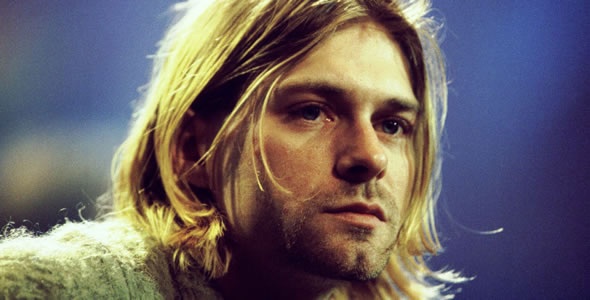
It was the shot heard ’round the world. Or, more accurately, the silence that followed it. When the news broke, it didn’t just break hearts; it shattered the entire cultural landscape of the 90s. Kurt Cobain. The voice of a generation. Gone.
But almost immediately, the whispers started. The story we were told—the tragic, cut-and-dry tale of a rock star who burned out—didn’t sit right with everyone. It was too neat. Too clean. And yet, the scene itself was messy as hell.
The Discovery: April 8, 1994
Seattle. Grey skies. A mist hanging over Lake Washington Blvd. It’s 8:40 in the morning on Friday, April 8, 1994. The world is still spinning, unaware that its axis has shifted.
Gary Smith, an electrician from Veca Electric, pulls up to the massive, imposing house. He isn’t there for a welfare check. He isn’t there to find a body. He’s just there to install some security lights. Routine maintenance on a mansion.
He knocks. Silence. He knocks again. Nothing.
Cobain’s house is a fortress. Smith wanders around the perimeter, just doing his job. He heads toward the garage. Above it, there’s a room. The greenhouse. He climbs up to check the roof wiring and peers through the glass of the French doors.
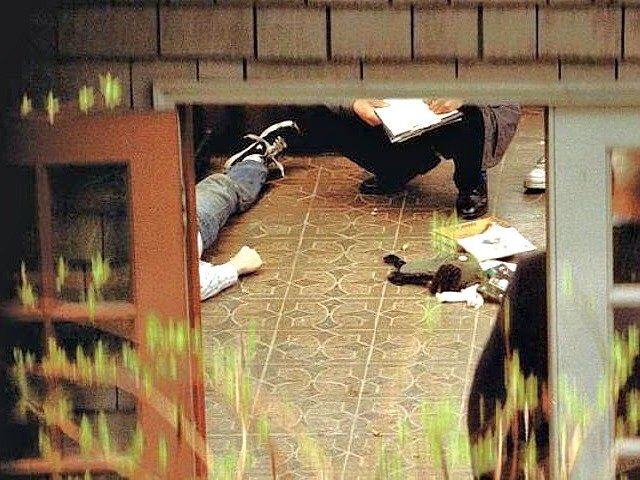
At first, he’s confused. It looks like a mannequin is lying on the floor. It’s strange, sure, but rock stars are weird people. Maybe it’s art? But then he sees the blood. A small, dark pool near the ear. He sees the shotgun resting on the chest. The reality hits him like a sledgehammer. This isn’t a mannequin. It’s Kurt.
Smith scrambled down. He called his dispatcher. Then the police. Within minutes, the quiet morning was ripped apart by sirens.
The Official Story: Case Closed?
The Seattle Police Department (SPD) arrived and assessed the scene. To them, it looked obvious. A textbook suicide. The King County Medical Examiner would later estimate that Kurt had been dead for about three days. That puts the time of death roughly around April 5th.
Here is what the authorities say happened:
Sometime on that Tuesday evening, Kurt Cobain retreated to the greenhouse. It was a secluded spot, detached from the main house. He barricaded himself inside. He locked one of the French doors. The other didn’t have a lock, so he jammed a stool against it to keep it shut. He was alone.
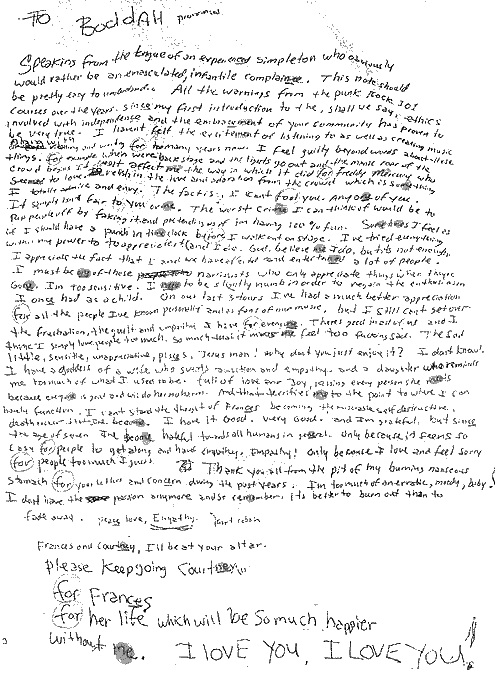
He sat down to write. A one-page note, penned in red ink. He addressed it to “Boddah,” his imaginary childhood friend. When he was done, he took a plant, tipped it over, and stuck the note into the pile of dirt so it would be seen.
Then, the ritual began. He smoked a few Camel Lights. He drank from a can of Barq’s root beer. And then, the drugs. He cooked up a “black tar” heroin kit. He injected himself with a cocktail of heroin and Valium that was powerful enough to kill a horse.
This is where the story gets clinical. He put the drug gear back in a cigar box. Neatly. He laid out two towels. He took off his brown corduroy jacket. He opened his wallet to display his driver’s license—an act of identification, presumably so there would be no confusion about who was lying there on the floor.
He grabbed the Remington Model 11 20-gauge shotgun. He lay down. He placed the barrel in his mouth, gripped the stock between his Converse-clad feet, and used his thumb to pull the trigger.
Boom. End of story. Right?
Wrong. For thousands of fans, independent investigators, and forensic experts, this was just the beginning of the questions.

The Ghost Gun: Where Were the Prints?
Let’s look closer at the weapon. This is where things start to get murky. Really murky.
The shotgun wasn’t fully processed by the Seattle Police until a month later. Why the delay? Because they had already decided it was a suicide. When they finally dusted it for prints, guess what they found?
Nothing.
Four latent prints. All unidentifiable. No prints on the barrel. No prints on the trigger. No prints on the stock.
Think about that. Kurt allegedly loaded the gun. He handled it. He positioned it. He fired it. And yet, his fingerprints were nowhere to be found. How does a man shoot himself without touching the gun?
Skeptics argue the gun had been wiped down. The police counter-argument? The “recoil” from the blast caused the gun to slide through his hands, smudging the prints. Okay, maybe. But what about the rest of the gun? Did the recoil wipe the entire weapon clean? And if he bought the gun weeks earlier, shouldn’t his old prints be on it somewhere?
Even stranger? The hands. The original police report stated there were “burn marks” on Kurt’s hands, consistent with firing a weapon. Case closed, right? Not so fast. Two years later, the police had to walk that back. They admitted that detail was a mistake. A “clerical error” added by a rookie cop. There were no marks on his hands.
So we have a dead man, a wiped gun, and a retracted police report.
The Toxicology Report: The Math Doesn’t Add Up
This is the smoking gun for many theorists. This is the detail that keeps people up at night.
The toxicology report came back with staggering numbers. Kurt Cobain had a heroin concentration of 1.52 milligrams per liter in his blood. In total, he had roughly 225 mg of heroin in his system. Plus Valium.
To put that in perspective: That is three times the lethal dose for a severe addict. For a normal person, it would kill them instantly. For a junkie with a high tolerance, it’s still a “lights out” dose.
Medical experts and forensic pathologists have argued about this for decades. With that amount of heroin hitting his brain, Kurt should have been instantly incapacitated. The needle should have been hanging out of his arm. He should have slumped over into a coma within seconds.
But look at the scene again.
According to the official story, after shooting up this massive, brain-melting dose, Kurt had the presence of mind and the physical coordination to:
- Remove the needle.
- Flush the syringe with water (it was found clean).
- Put the cap back on the needle.
- Place the spoon and needle neatly back into the cigar box.
- Close the box.
- Roll down his sleeves.
- Button his cuffs.
- Pick up a shotgun.
- Maneuver the weapon into a difficult firing position.
- Pull the trigger.
Does that sound like someone who just took a triple-lethal dose of black tar heroin? Or does it sound like a scene that was staged?
The “incapacitation theory” suggests that Kurt was injected by someone else—murdered by overdose—and then the shotgun scene was set up to look like a suicide. He would have been too high to fight back. Too high to scream. Just high enough to die.
Enter the Private Eye: Tom Grant
You can’t talk about the Cobain conspiracy without talking about Tom Grant. He isn’t some guy in a basement with a tinfoil hat. He is a former L.A. County Sheriff’s detective. And here is the kicker: He was hired by Courtney Love.
Days before Kurt’s body was found, Courtney hired Grant to find her husband. Kurt had jumped the wall at a rehab facility in Los Angeles and vanished. He flew back to Seattle, but no one could find him.
Grant was in Seattle, searching for Kurt, while Kurt was lying dead in the greenhouse. Grant has maintained for nearly 30 years that Kurt Cobain was murdered.
Why? Because things didn’t add up from day one. Grant claims Courtney was acting erratic, giving him contradictory stories. He claims she was more interested in planting stories in the press about Kurt being suicidal than actually finding him alive.
One of the biggest red flags for Grant involved Kurt’s credit card. Someone was trying to use Kurt’s credit card after he was already dead. The attempts to charge the card continued until the body was discovered. Then, they stopped. Who was trying to use that card? The police never found out. They didn’t even seem to look.
The Suicide Note… Or The Breakup Letter?
Let’s talk about the note. It’s the emotional anchor of the official story. “It’s better to burn out than to fade away.” Neil Young lyrics. Tragic.
But have you actually read it? Like, really read it?
Tom Grant and several linguistic experts argue that for the first 90% of the letter, Kurt isn’t saying goodbye to life. He is saying goodbye to the music industry. He is ranting about how he doesn’t feel the passion anymore. He talks about how he loves people too much. It reads like a retirement letter. A letter to his fans explaining why he is breaking up Nirvana.
It’s only the very end—the last four lines—where it turns dark.
“Frances and Courtney, I’ll be at your altar. Please keep going Courtney, for Frances. For her life, which will be so much happier without me. I LOVE YOU, I LOVE YOU!”
Grant points out a massive visual shift here. The handwriting changes. The letters become larger. The pressure on the paper is different. The slant is different.
The theory? Someone else wrote those last four lines. Someone took a retirement letter and turned it into a suicide note.
The police report claims the note was written by Cobain. But handwriting analysis is subjective. When the TV show Unsolved Mysteries looked into it, they found experts who couldn’t agree. One said it was Kurt. Others said it was inconclusive. They were working from photocopies, which makes it even harder. But the visual discrepancy is obvious to the naked eye. Look at the size of the letters in the main body vs. the footer. It screams “suspicious.”

The “Rome” Incident: Practice Run?
Just a month before his death, Kurt ended up in a coma in Rome. The media called it an “accidental overdose.” Courtney Love later spun it as his first suicide attempt, claiming he gobbled down 50 Rohypnol pills.
But the doctor who treated him in Rome, Dr. Osvaldo Galletta, denied this. He told the press, “Kurt Cobain did not commit suicide.” He believed it was an accidental mix of champagne and sedatives. Kurt woke up and asked for a strawberry milkshake. He didn’t look like a man who wanted to die.
Was Rome a warning? Was someone trying to kill him then?
The Darkest Theory: El Duce
If you want to go down the rabbit hole, you have to meet “El Duce.” Eldon Hoke, the singer of the shock-rock band The Mentors. He appeared in the documentary Kurt & Courtney with a terrifying claim.
El Duce claimed that Courtney Love offered him $50,000 to “blow Kurt’s head off.” He said he passed the job to a friend named “Allen.” He even passed a polygraph test regarding the claim (though polygraphs are notoriously unreliable).
Two days after that interview was filmed? El Duce was found dead. Hit by a train. Ruled an “accident.” Just another coincidence in a case full of them.
Modern Findings: The Internet Never Forgets
Years passed. The case went cold. But the internet heated up.
In 2014, on the 20th anniversary of the death, the Seattle Police decided to review the case files. They didn’t reopen the investigation, but they did develop four rolls of undeveloped 35mm film that had been sitting in an evidence vault for two decades. Why wasn’t this film developed in 1994? Good question.
The photos showed the scene in crisp color for the first time. We saw the cigar box. The sunglasses. The wallet. They confirmed the “neatness” of the drug paraphernalia. But the police stood by their conclusion. Suicide.
However, the release of these photos only fueled the online fire. Documentaries like Soaked in Bleach (2015) brought Tom Grant’s tapes to a massive new audience. We heard Courtney’s voice. We heard the inconsistencies.
Why It Matters
Why are we still talking about this? Is it just morbid curiosity? No. It’s because Kurt Cobain wasn’t just a singer. He was a symbol of authenticity in a fake world.
If he took his own life, it is a tragedy of mental health and addiction that we need to learn from. But if he didn’t? If he was silenced? Then it is one of the greatest injustices in American history.
The shotgun. The impossible dose. The wiped prints. The mismatched note. The credit card. The electrician on the roof.
Too many loose ends. Too many coincidences. As Kurt sang, “Just because you’re paranoid doesn’t mean they aren’t after you.”
What do you believe?