
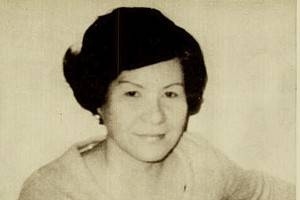
The Ghost Who Pointed Out Her Own Killer: Cracking the Teresita Basa Case
Some stories just refuse to be buried. They claw their way out of the cold ground, screaming for attention, demanding to be heard. This is one of those stories.
Chicago, 1977. The city hums with life, but in a quiet apartment building, a story is about to end in brutal, fiery violence. And then, begin again.
The murder of Teresita Basa isn’t a whodunnit. We know who killed her. We know how. The real spine-chilling question, the one that keeps this case alive in late-night forums and hushed conversations, is how the hell police ever caught him. The official story is so bizarre, so utterly unbelievable, that it sounds like something torn from a horror movie script.
They say the victim herself reached across the veil of death to point a spectral finger at her murderer. A ghost solved her own murder. Utter nonsense? Or is it proof that something waits for us on the other side… and that it sometimes holds a grudge?
A Quiet Life, A Violent End
To understand the shockwave this case sent through the city, you first have to understand the victim. Teresita Basa was not a person who courted danger. Far from it.
Who Was Teresita Basa?
Born in the Philippines, Teresita was a woman of science and music. She moved to the United States to chase a dream, eventually becoming a respected respiratory therapist at Edgewater Hospital in Chicago. She was in her late 40s, single, and lived a modest, quiet life in her apartment on North Pine Grove Avenue. Colleagues described her as gentle, a bit reserved, but dedicated to her work. She was saving money, working on a master’s degree, and playing the piano. She wasn’t involved in crime. She had no known enemies. Her life was a portrait of normalcy.
And that’s what makes what happened next so profoundly disturbing.
The Inferno in Apartment 15B
February 21st, 1977. The call came in as a routine fire. When the Chicago Fire Department smashed their way into Apartment 15B, they were met with smoke and heat. But as they fought the blaze, they found its source. A mattress, deliberately set on fire. And under it, a horror.
They found the body of Teresita Basa. She was naked, her body partially burned. Protruding from her chest was the handle of a large butcher knife. It had been plunged in with such force that it was left embedded there. An act of pure, personal rage. The scene was a chaotic nightmare, a violent desecration of a quiet life. The fire was not an accident; it was a clumsy attempt to erase the evidence. To erase Teresita.
A Case Frozen in the Chicago Winter
The investigation began, led by Detective Joseph Stachula. The initial facts were grim and offered few leads. There was no sign of forced entry, suggesting Teresita knew her killer and let him in. The sheer violence of the stabbing pointed to a crime of passion, yet the robbery—some of her jewelry was missing—suggested a different motive. Was it a robbery gone wrong? Or was the theft an afterthought to a personal vendetta?
The police were stumped. They interviewed friends, colleagues, and ex-boyfriends. They chased down rumors. Nothing. The trail went cold almost as quickly as the ashes in Teresita’s apartment. Days turned into weeks, weeks into months. The murder of the quiet respiratory therapist was fading, becoming just another unsolved file in a city full of them.
Whispers in the Hospital Halls
At Edgewater Hospital, a cloud of fear and suspicion hung over the staff. They had lost one of their own. Everyone wondered who could have done it. A stranger? Or, more terrifyingly, was it someone they worked with every day? Someone who still walked their halls, smiled in the cafeteria, and treated patients?
Among those grieving colleagues were two people who would soon be at the epicenter of this bizarre saga. One was Remy Chua, another therapist from the Philippines, a friend of Teresita’s. The other was an orderly. A man named Allan Showery. At the time, he was just another face in the crowd.
He wouldn’t be for long.
The Voice From Beyond the Veil
Months passed. The case was all but dead. And then, something extraordinary happened. The story goes that Remy Chua, deeply troubled by her friend’s unsolved murder, found herself gripped by a series of strange and terrifying experiences. It started small. A feeling of a presence in her home. A sudden chill in a warm room.
Then came the visions. She would see Teresita, standing there, sad and silent. It was terrifying, but it was about to get much, much stranger.
“Doctor, I Need Your Help…”
One evening, Remy Chua was resting when she began to drift into a trance-like state. Her husband, Dr. Jose Chua, a man of medicine and logic, was nearby. Suddenly, his wife began to speak. But the voice that came out of her mouth was not her own.
It was a different voice. A voice filled with pain and urgency. It spoke in Tagalog, a language they both knew, but with inflections and a cadence that belonged to their dead friend, Teresita Basa.
The voice spoke directly to Dr. Chua.
It told him that a man named Allan Showery had come to Teresita’s apartment to fix her television set. But that wasn’t his real intention. He attacked her. He killed her. He stole her jewelry. And then he set the fire.
Dr. Chua was stunned. Horrified. Was his wife losing her mind? Was this some elaborate, grief-induced psychosis?
The Critical Clues No One Else Knew
But the voice—the entity claiming to be Teresita—wasn’t done. Over a series of these trance sessions, it provided chillingly specific details. Details that no one outside of the killer and the police could possibly know. Or so it seemed.
The spirit of Teresita, speaking through Remy, described the exact pieces of jewelry that were stolen. A pearl and jade pendant. Other specific rings. It then revealed what Showery had done with them. He hadn’t sold them. He had foolishly given them to his common-law wife, his girlfriend, as gifts.
The voice even gave names. It named Teresita’s cousins and family members who could positively identify the jewelry if the police ever found it. This wasn’t a vague accusation. This was a supernatural police report, delivered from the other side.
Dr. Chua, a man of science, was now a believer. He knew, with a certainty that defied all logic, that his dead friend was speaking through his wife. And she was crying out for justice. He had to go to the police.
Cops, Skepticism, and a Ghost’s Gambit
Can you imagine being Detective Stachula? You’re sitting at your desk, the Basa case file collecting dust, a monument to a dead end. Then the phone rings. It’s a doctor, and he’s telling you that his wife is being possessed by the ghost of the murder victim, and the ghost has named her killer.
You’d hang up the phone. You’d assume it was a crank call. A cruel prank.
But Stachula listened. Maybe it was a slow day. Maybe it was the desperation of having zero leads. Or maybe there was something in Dr. Chua’s voice—a terrified sincerity—that made him pause. The detective agreed to meet with the Chuas.
An Interview With a Spirit
The meeting was as surreal as you’d expect. The Chuas recounted their story. The detectives listened, their faces a mask of professional skepticism. They asked to speak with Remy alone, but as they did, she allegedly slipped into another trance. The voice returned. It was “Teresita.”
The disembodied voice repeated the accusations directly to the stunned detectives. It named Allan Showery. It described the jewelry. It begged them to check on Showery’s girlfriend. It was a moment that defies rational explanation. Two hardened Chicago detectives, in a room with a woman claiming to be a channel for the dead, getting their first real lead in a murder case.
Against all odds and their own better judgment, they decided to follow the spectral trail. What did they have to lose?
The Confession: When the Dam Finally Breaks
The first thing they did was check the hospital records. And there it was. Allan Showery, an orderly, had indeed been scheduled to visit Teresita Basa’s apartment to help her with a broken television set around the time of the murder. The first piece of the ghost’s story clicked into place.
It was a thin thread, but it was enough. The detectives located Showery’s residence.
The Pearl Necklace
The moment of truth was cinematic. The detectives approached Showery’s girlfriend. They made small talk. And then they saw it. Around her neck. A distinctive pearl pendant. It matched the description given to them by a voice from a woman who was dead.
They questioned her about the jewelry. She casually confirmed it was a gift from her boyfriend, Allan. They brought in Teresita Basa’s family, the very relatives the “ghost” had named. They identified the jewelry instantly. It belonged to Teresita. There was no doubt.
They had him.
Allan Showery’s Story Crumbles
Allan Showery was brought in for questioning. He was cocky at first, denying everything. But the detectives had an ace up their sleeve. They laid out the evidence. They knew he was at her apartment. And then, the knockout blow: they told him they had found Teresita’s stolen jewelry in his possession, worn by his own girlfriend.
The color drained from his face. His confident facade shattered. Faced with undeniable physical proof—proof provided by a ghost—Allan Showery confessed. He told them everything. How he went over to fix the TV, how he attacked her, stabbed her, stole what he could, and set the fire to cover his tracks. His story matched the crime scene perfectly.
Allan Showery was arrested and charged with the murder of Teresita Basa. He would later be convicted and sentenced to 14 years in prison. Justice, of a sort, was served.
Debunking the Ghost: The Rational Explanations?
The case was closed. But the mystery was just beginning. For skeptics, the supernatural explanation is impossible. So, what *really* happened? The internet is filled with theories that attempt to drag this chilling tale back into the realm of the rational.
Theory 1: The Guilt-Ridden Witness
This is the most popular counter-argument. What if Remy Chua knew more than she let on from the beginning? Perhaps Showery, in a moment of panic or misplaced trust, confessed something to her. Or maybe she overheard him bragging or talking in the hospital. Terrified of being a witness, scared of what Showery might do to her, she kept silent.
But the guilt ate away at her. The “possession” then becomes a complex psychological coping mechanism. Her subconscious created the ghost persona as a way to release the information without having to admit she knew all along and did nothing. The ghost story was a shield, protecting her from both the killer and her own conscience. It’s a compelling idea, but it doesn’t fully explain her pinpoint accuracy regarding the jewelry.
Theory 2: The Subconscious Detective
Could Remy have solved the case without even knowing it? Think about it. She worked at the hospital. She knew both Teresita and Showery. Maybe she heard gossip that Showery was having money problems. Maybe she saw him talking to Teresita about her TV. After the murder, maybe she saw Showery’s girlfriend wearing a new necklace that looked familiar.
Her conscious mind didn’t connect the dots. But her subconscious did. It processed all these tiny, disparate pieces of information and assembled them into a coherent narrative. The dreams, visions, and trances were her brain’s way of forcing that hidden knowledge to the surface. She wasn’t possessed; she was an intuitive detective, and the ghost was a metaphor for her own buried conclusions.
Why the Ghost Story Endures
While the rational theories are plausible, they all have holes. They struggle to explain the sheer specificity of the information Remy Chua provided. How did she know the *exact* pieces of jewelry taken? How did she know Showery gave them to his girlfriend and hadn’t pawned them? How did she know the names of Teresita’s relatives who lived in America and could identify the items?
These are not small details. These are the lynchpins that hold the entire supernatural story together. Without them, the police would have never found the evidence. Without them, Allan Showery, a brutal killer, would have walked free.
The police themselves, men who had seen it all, were left shaken. While the “ghost’s testimony” was never presented in court, it is an undeniable, officially documented part of the investigation. It’s the reason they ever looked at Showery in the first place.
So what are we left with? A killer brought to justice by what can only be described as a miracle or a deeply complex psychological event. Teresita Basa, a woman of science, became the star of a paranormal drama that defies easy explanation.
The case is officially closed. Allan Showery served his time. But the mystery remains wide open, a chilling question mark hanging over the Chicago skyline. Was it all just a clever lie born of fear and guilt? Or was it something more? A final, desperate cry for justice from a woman who refused to be silenced, even by death itself.









