| Pripyat При́п’ять |
|
|---|---|
| City of regional significance | |
 |
|

 Pripyat
|
|
Pripyat
|
|
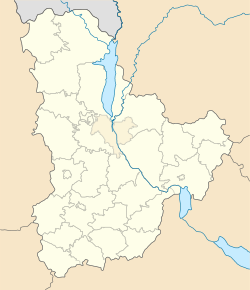
| Coordinates: 51°24′17″N 30°03′25″E | |
| Country |  Ukraine Ukraine |
| Oblast | Kyiv Oblast |
| Raion | Chernobyl Raion (1923–1988) |
| Founded | 4 February 1970 |
| City rights | 1979 |
| Government | |
| • Administration | State Agency of Ukraine on the Exclusion Zone Management |
| Population (2015) | |
| • Total | 0 |
| Time zone | EET (UTC+2) |
| • Summer (DST) | EEST (UTC+3) |
| Postal code | none (formerly 01196) |
| Area code(s) | +380 4499[1] |

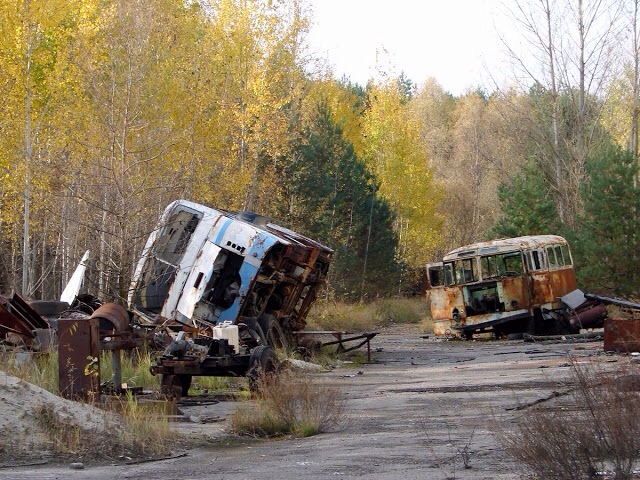
Pripyat (Ukrainian: При́п’ять, Prýp’jat́; Russian: При́пять, Pri’pyatï’  Pronunciation) is an abandoned city in northernUkraine, near the border with Belarus.
Named after the nearby Pripyat River, Pripyat was founded on 4 February 1970, the ninth nuclear city in the Soviet Union, to serve the nearby Chernobyl Nuclear Power Plant. It was officially proclaimed a city in 1979, and had grown to a population of 49,360 by the time it was evacuated, a few days after the 26 April 1986 Chernobyl disaster.
Though Pripyat is located within the administrative district of Ivankiv Raion, the abandoned city now has the status of city of oblast significance within the larger Kyiv Oblast (province), being administered directly from Kyiv. Pripyat is also supervised by Ukraine’s Ministry of Emergencies, which manages activities for the entire Chernobyl Exclusion Zone.
Contents
- 1 Background
- 2 Infrastructure and statistics
- 3 Post-Chernobyl years
- 4 Safety
- 5 Cultural references
- 6 See also
- 7 References
Background

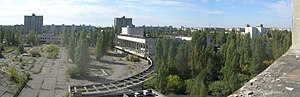
Panoramic view of Pripyat in May 2009
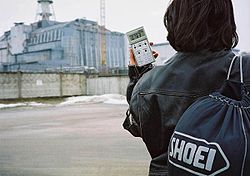
View of the Chernobyl power plant including 2003 radioactive level of 763microroentgens per hour
Access to Pripyat, unlike cities of military importance, was not restricted before the disaster as nuclear power stations were seen by the Soviet Union as safer than other types of power plants. Nuclear power stations were presented as being an achievement of Soviet engineering, where nuclear power was harnessed for peaceful projects. The slogan “peaceful atom” (Russian: мирный атом, mirnıy atom) was popular during those times. The original plan had been to build the plant only 25 km (16 mi) from Kyiv, but the Ukrainian Academy of Sciences, among other bodies, expressed concern about it being too close to the city. As a result, the power station and Pripyat. were built at their current locations, about 100 km (62 mi) from Kyiv. After the disaster the city of Pripyat was evacuated in two days.

A panorama of Pripyat, circa 2011. The abandoned Chernobyl power plant can be seen in the distance, at top center.
Infrastructure and statistics

Pripyat before the Chernobyl disaster
The following statistics are from January 1, 1986.
- Population: 49,400 before the disaster. The average age was about 26 years old. Total living space was 658,700 m2(7,090,000 sq ft): 13,414 apartments in 160 apartment blocks, 18 halls of residence accommodating up to 7,621 single males or females, and 8 halls of residence for married or de facto couples.
- Education: 15 primary schools for about 5,000 children, 5 secondary schools, 1 professional school.
- Healthcare: 1 hospital that could accommodate up to 410 patients, and 3 clinics.
- Trade: 25 stores and malls; 27 cafes, cafeterias and restaurants could serve up to 5,535 customers simultaneously. 10 warehouses could hold 4,430 tons of goods.
- Culture: 3 facilities: a culture palace, a cinema and a school of arts, with 8 different societies.
- Sports: 10 gyms, 3 indoor swimming-pools, 10 shooting galleries, 2 stadia.
- Recreation: 1 park, 35 playgrounds, 18,136 trees, 249,247 shrubs, 33,000 rose plants.
- Industry: 4 factories with total annual turnover of 477,000,000 rubles. 1 nuclear power plant.
- Transportation: Yanov railway station, 167 urban buses, plus the nuclear power plant car park of about 400 units.
- Telecommunication: 2,926 local phones managed by the Pripyat Phone Company, plus 1,950 phones owned by Chernobyl power station’s administration, Jupiter plant and Department of Architecture and Urban Development.
Post-Chernobyl years
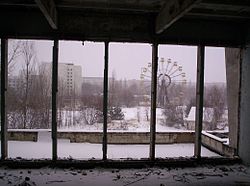
Pripyat Ferris wheel, as seen from the City Center Gymnasium

The Pripyat swimming pool was still in use by liquidators in 1996, a decade after the Chernobyl incident.

In 2009, over two decades after the Chernobyl incident, the Pripyat swimming pool shows decay after years of disuse.
In 1986 the city of Slavutych was constructed to replace Pripyat. After the city of Chernobyl, this is the second-largest city for accommodating power plant workers and scientists in the Commonwealth of Independent States (CIS).
One notable landmark often featured in photographs of the city and visible from aerial-imaging websites is the long-abandoned Ferris wheel located in the Pripyat amusement park.
Safety

The external relative gamma dose for a person in the open near the Chernobyl disaster site. The intermediate lived fission productslike Cs-137 contribute nearly all of the gamma dose now after a number of decades have passed, see opposite.

The impact of the different isotopes on the radioactive contamination of the air soon after the accident. Drawn using data from the OECD report [1] and the second edition of ‘The radiochemical manual’.
A natural concern is whether it is safe to visit Prypiat and the surroundings. The Zone of Alienation is considered relatively safe to visit, and several Ukrainian companies offer guided tours around the area. The radiation levels have dropped considerably, compared to the fatal levels of April 1986, due to the decay of the short-lived isotopes released during the accident. In most places within the city, the level of radiation does not exceed an equivalent dose of 1 μSv (one microsievert) per hour.