9/11’s Burning Question: What REALLY Hit The Pentagon?
The morning of September 11, 2001. A nation is already reeling. Two towers in New York City are burning. The sky is filled with smoke, and the airwaves are filled with confusion. Then, at 9:37 AM, another report. An explosion at the Pentagon. The heart of America’s military might has been struck.
The official story solidified within hours. American Airlines Flight 77, a Boeing 757 carrying 64 souls, had been hijacked and flown directly into the western wall of the building. A tragic, audacious act of terror.
But as the smoke cleared and the first photos emerged, a different story began to whisper through the cracks. A nagging question that refused to go away.
Where was the plane?
The Official Story: A Textbook Terror Attack
Let’s be clear about what the government and the 9/11 Commission Report tell us. They say Flight 77, a massive commercial airliner, was commandeered by five terrorists. The pilot, Hani Hanjour, took the controls. After flying undetected for over thirty minutes, he allegedly performed a high-speed, daredevil descent, spiraling 270 degrees while dropping thousands of feet to line up with the Pentagon. He flew so low and so fast that he clipped several light poles before slamming into the building’s first floor. The plane, they claim, and its 5,300 gallons of jet fuel, created an inferno that caused a section of the building to collapse 20 minutes later. A straightforward, horrifying narrative. Case closed.
Or is it?
The Hole That Defies Logic
This is where it all starts to unravel. Look at the early pictures. Before the collapse.
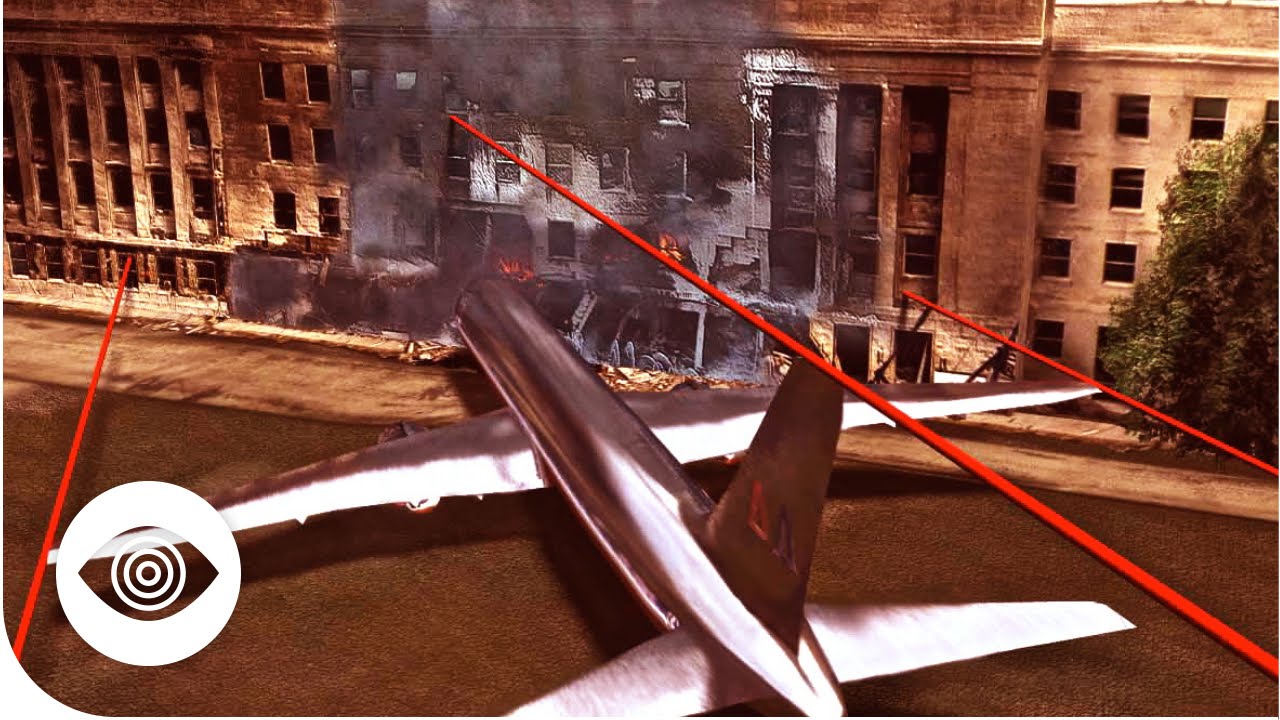
You see a hole. A neat, almost surgical puncture in the limestone facade of one of the most reinforced buildings on the planet. Initial reports put this entry hole at around 16 to 20 feet in diameter.
Stop and think about that.
A Boeing 757-200 is not a small machine. It measures 155 feet long. Its wingspan is 124 feet, 10 inches. The tail stands 44 feet high. It is, for all intents and purposes, a flying building.
So how does a 124-foot-wide aircraft, with two massive Rolls-Royce engines slung under its wings, create a tidy 20-foot hole?
Where did the rest of the plane go? Where are the marks from the wings? Where is the gash from the 44-foot-tall tail fin? The official explanation is that the wings folded back and the entire plane “flowed” into the building like liquid. A phenomenon that has never been observed in any other plane crash. Ever.
Then there’s the lawn. The photos show an almost pristine green lawn leading up to the impact point. A 55-ton aircraft hitting the ground at over 500 miles per hour should have left a massive crater. The engines, made of dense steel and titanium, should have gouged deep trenches in the earth. But there was nothing. Just a few scattered, unidentifiable pieces of metal. It doesn’t add up.
The Case of the Vanishing Debris
Every plane crash leaves a debris field. It’s a fundamental rule of physics. When a complex machine made of aluminum, steel, and titanium hits a solid object at high speed, it shatters into thousands of pieces. We have seen it time and time again.
But not at the Pentagon.
Reporters who arrived on the scene were baffled. News anchors reported it live. Jamie McIntyre, CNN’s senior Pentagon correspondent, was there. He famously said, “…from my close-up inspection, there’s no evidence of an airplane having crashed anywhere near the Pentagon.” He described small, scattered pieces of metal, so light he could pick them up. Nothing that resembled a commercial airliner.
No giant sections of the fuselage.
No tail assembly.
No wings.
Crucially, no engines.
The engines of a 757 are monstrous. Each one weighs about six tons and is made of a steel-titanium alloy designed to withstand incredible heat and pressure. They are, by far, the most durable parts of an aircraft. They should have been there, sitting on the lawn or embedded in the building. Yet, they were nowhere to be found in any of the initial photos. The government later claimed to have found parts of an engine *inside* the building, but the photographic evidence presented has been fiercely contested by independent analysts, who say the parts don’t match a Rolls-Royce RB211 engine.
So, if a 55-ton plane didn’t leave a 55-ton mess, what did?
The Missile Theory Takes Flight
This is the question that gave birth to the most explosive theory of all. If the damage doesn’t look like a plane, and the debris isn’t from a plane, maybe it wasn’t a plane at all.
Maybe it was a missile.
Suddenly, the pieces start to fit together in a chilling new way.
A cruise missile, like a U.S. Tomahawk, is small, fast, and designed to penetrate fortified targets. It would create a neat, circular entry hole, just like the one seen in the initial photos. It’s packed with a high-explosive warhead, which would explain the intense fireball and subsequent fire without needing thousands of gallons of jet fuel.
And a missile would explain the most glaring anomaly of all: the lack of debris. Because there would be no wings, no tail, no seats, and no luggage to find. The mystery of the vanishing plane is solved in an instant. It was never there.
Deep Dive: The Impossible Flight Path
Let’s talk about the pilot, Hani Hanjour. The 9/11 Commission Report paints him as the man at the controls. But flight instructors who worked with him described him as a terrible pilot. He had trouble controlling and landing a small, single-engine Cessna. One instructor refused to fly with him a second time.
Yet, we are asked to believe that this same man executed one of the most difficult aerial maneuvers imaginable. He allegedly flew a 100-ton 757 at 530 mph, just a few feet off the ground, and performed a 270-degree downward spiral to hit a 77-foot-tall building. Many veteran commercial and military pilots have gone on record stating they couldn’t have pulled off that maneuver. Not in a 757. Not at that speed. It’s a maneuver that pushes the very limits of the aircraft’s performance envelope.
Could a missile have done it? Easily. A cruise missile is designed for exactly this kind of high-speed, low-altitude, precision strike. It’s guided by GPS and internal navigation systems, making a pinpoint hit on a specific target its entire reason for being.
The Missing Tapes: What Are They Hiding?
Surely there must be video, right? The Pentagon is the most heavily surveilled building on Earth. There are cameras everywhere. And there were numerous businesses nearby with their own security systems, including a gas station and a hotel, both with a clear view of the flight path.
The FBI immediately confiscated all of them. All of them.
After years of public pressure and lawsuits, the government released a grand total of five frames of footage from one Pentagon security camera. The frames are grainy, low-quality, and show a white blur, a puff of smoke, and then a massive explosion. You cannot identify a Boeing 757 in those frames. In fact, many argue the shape of the object in the one critical frame is far more consistent with a smaller, missile-shaped object than a massive airliner.
Why not release the rest? Why not release the high-quality footage from the gas station or the hotel that would have clearly shown a 124-foot-wide airplane soaring past? The refusal to release definitive proof has only added fuel to the fire. If you have video that proves your case beyond all doubt, you release it. You don’t hide it. Unless it shows something you don’t want the world to see.
Answering the Critics (Or Trying To)
Of course, there are counter-arguments. Proponents of the official story have explanations for all these strange inconsistencies.
They say the plane vaporized. The combination of the high-speed impact and the intense jet fuel fire was so extreme that it essentially disintegrated the 55-ton aircraft. A convenient explanation, but one that seems to defy the laws of physics and the evidence from every other plane crash in history.
They point to the light poles. On its approach, the aircraft supposedly clipped five light poles. The poles were sheared and knocked over in a way that seems consistent with a large wingspan. For many, this is the “smoking gun” that proves a large plane was present. But others have questioned this, too. Could the poles have been knocked down by the explosive concussion of a missile? Could they have been staged beforehand? In the world of black operations, anything is possible.
And what about the passengers? The DNA of all passengers and crew (minus one infant) was eventually identified from remains found at the site. This is perhaps the most difficult point for missile theorists to address. How could passenger DNA be present if the plane wasn’t? This has led to even darker, more complex theories: that Flight 77 was disposed of elsewhere, and the human remains were planted at the scene to complete the narrative. A horrifying thought, but one that investigators of the conspiracy refuse to dismiss.
The Unsettling Silence
Think about the aftermath. In the days and weeks that followed, you would expect a flurry of evidence. Clear photographs of wreckage being hauled away. Interviews with hundreds of eyewitnesses who saw the plane. Clear video from one of the dozens of confiscated cameras.
Instead, we got silence. A tightly controlled narrative. And a set of lingering, haunting questions.
Why did the initial damage look so little like a plane crash?
Why was there no recognizable debris from a 55-ton aircraft?
Why was Hani Hanjour, a novice pilot, able to perform a maneuver that would challenge a Top Gun veteran?
And most of all, why won’t they release the clear videos that would end the debate once and for all?
The story of Flight 77 at the Pentagon is not just a conspiracy theory. It’s a collection of official oddities, physical impossibilities, and unanswered questions. The government gave us a simple story about a terrorist attack. But the evidence left at the scene tells a different tale. A tale of a small hole, a missing plane, and a truth that may have been buried in the rubble. Two decades have passed. The walls have been rebuilt. But the hole in the official story remains as wide as ever.