Home Weird World Strange Places Strange unexplained stone ball discovered in Bosnia

Strange unexplained stone ball discovered in Bosnia

0
56

The Silent Sentinels: Are Giant, Perfect Stone Spheres Proof of a Lost Global Civilization?

Forget what you learned in history class. Forget the neat, tidy timelines of primitive man chipping away at flint. Something else was here. Something powerful. Something with technology we still can’t explain.

And they left clues.

They left giant stone balls. All over the world. Perfectly round. Impossibly heavy. And utterly, maddeningly silent.

For decades, these oddities were dismissed as geological flukes or local curiosities. But the puzzle pieces are starting to fit together. A discovery in a remote European forest might just be the key that blows the whole story wide open. A story that the history books have tried very, very hard to keep buried.

The Bosnian Bombshell

The year is 2016. Deep in the Podubravlje forest of Bosnia, a man on a mission makes a discovery that sends shockwaves through the alternative history community. His name is Dr. Semir “Sam” Osmanagić, a figure academics love to hate and a hero to those who believe our past is far grander than we’re told.

What did he find?

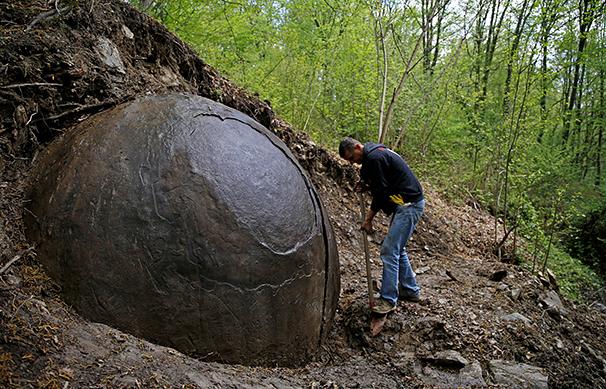
A stone sphere. Half-buried in the earth like a seed from a forgotten world.

stone ball

But this wasn’t just any rock. It was massive. A giant, almost perfectly spherical stone measuring nearly 1.5 meters in diameter. Its estimated weight? A staggering 30 tons. That’s the weight of five large elephants. Its distinct reddish-brown color hinted at a high iron content, a fact that made it even stranger. What forces of nature could possibly craft such a thing?

For Osmanagić, the answer was simple. None.

This was no geological accident. This was a message. This was a marker. This was, in his words, “proof that southern Europe, the Balkans and Bosnia in particular, were home to advanced civilisations from the distant past and we have no written records about them.”

He believes this sphere, and others like it, are remnants of a culture that understood the very fabric of the universe. They knew about energy. They knew about sacred geometry. “They had high technology, different than ours,” Osmanagić stated. “Finally, they knew the power of geometrical shapes, because the sphere is one of the most powerful shapes along with pyramidal and conical shapes.”

Is it any coincidence that Bosnia is also home to what Osmanagić claims are the largest and oldest pyramids on Earth?

Deep Dive: The Maverick Behind the Bosnian Pyramids

You can’t talk about the Bosnian sphere without talking about Semir Osmanagić. To mainstream academia, he’s a pseudoscientist. A showman. To his countless followers, he’s a modern-day Indiana Jones, battling a dogmatic establishment afraid of the truth.

For years, he has championed the theory that a series of hills in Visoko, Bosnia, are not hills at all. He claims they are man-made pyramids, far older than those in Egypt. He points to geometric alignments, excavated tunnels, and energy readings that, he says, defy conventional explanation. The scientific establishment laughs. They say the “pyramids” are natural formations called flatirons.

But Osmanagić persists. And tens of thousands of tourists and volunteers flock to the site every year, drawn by the possibility that something incredible is hidden just beneath the surface. The discovery of the giant stone sphere was, for him and his supporters, another huge piece of evidence. Another middle finger to the gatekeepers of history.

The Mainstream Strikes Back: A Convenient “Explanation”

So, what’s the official story? How do geologists explain away a 30-ton, nearly perfect stone ball?

They have a word for it: “concretion.”

The theory goes that a central piece of mineral or organic matter acts like a seed. Over millions of years, minerals in groundwater precipitate and cement themselves around this core, layer by concentric layer, sometimes forming a spherical shape. It’s a slow, natural process. A geological accident.

Case closed, right? Nothing to see here. Just a weird rock.

But the questions linger. How does this “accident” happen over and over again, not just in Bosnia, but all across the globe? And how does it produce objects of such astounding size and geometric precision? Geologists admit that large, perfectly spherical concretions are exceptionally rare. Yet, we keep finding them. The official explanation feels… thin. Too easy. Almost like a deliberate attempt to shut down the conversation before it even begins.

Connecting the Dots: The Costa Rican Enigma

The Bosnian sphere might be the latest discovery, but it’s part of a much older, global mystery. To truly understand it, we have to travel back to the 1930s and plunge into the dense jungles of Costa Rica.

Workmen for the United Fruit Company were clearing land for banana plantations. Hacking and burning their way through unforgiving terrain, they stumbled upon something that stopped them in their tracks. Stone balls. Dozens of them. Scattered through the Diquís Delta like giant’s marbles.

And these spheres were perfect.

Ranging in size from as small as a tennis ball to a mind-boggling 8 feet in diameter and weighing up to 16 tons, many were so perfectly spherical that modern engineers gasp. They were carved from granodiorite, a hard, igneous rock. The nearest quarry for this material was over 50 miles away, across mountains and through swamps. How did they move them? More importantly, how did they *make* them?

Local legends whispered that the spheres were filled with gold. Tragically, this led treasure hunters to dynamite many of these priceless artifacts, only to find solid rock inside. To this day, no one knows for sure who made them. The Pre-Columbian cultures of the area left no written records explaining their purpose.

They are clearly man-made. The precision is too great. The placement too deliberate. But the fundamental questions remain unanswered:

  • Who made them? The culture that supposedly created them had no known technology for carving hard stone with such precision.
  • How did they make them? Even with modern tools, replicating the flawless curvature of the largest spheres would be an immense challenge. How did a so-called “primitive” people achieve it?
  • Why did they make them? Were they religious symbols? Status markers for chiefs? Astronomical devices? Or something else entirely?

The mystery of the Costa Rican spheres, known as Las Bolas, is so profound that even mainstream science just shrugs. They are an Oopart—an “out of place artifact.” An inconvenient fact that doesn’t fit the established timeline of human history.

What If? The Alien Atlas Theory

When human ingenuity fails to provide an answer, our eyes turn to the stars. One of the most persistent and tantalizing theories about the stone spheres is that they are not from around here at all.

Could they be a map?

Think about it. A series of spheres, varying in size, arranged in specific patterns on the ground. Perhaps they represent the planets and moons of our own solar system, or more chillingly, a solar system from a distant star. A guide left by ancient astronauts. A welcome mat for visitors, or a warning.

Recent analysis using digital mapping has shown that some of the sphere placements in Costa Rica seem to align with major constellations. But they don’t align perfectly with the sky *as we see it now*. Could they be aligned to the sky as it was thousands of years ago? Or as it will be thousands of years in the future?

The theory gets even wilder. What if they aren’t just maps? What if they are data storage devices, like a cosmic hard drive? Some researchers in the fringe science community have proposed that the crystalline structure of the granite, combined with their perfect shape, could allow them to store vast amounts of information, readable only with a technology we have yet to develop. A library of forgotten knowledge, waiting for us to find the key.

A Web Across the World: It’s Not Just Bosnia and Costa Rica

The deeper you dig, the more you realize this isn’t a localized phenomenon. It’s global. Giant stone spheres have been found in dozens of locations, shattering the idea that these are just isolated oddities.

  • Mexico: Volcanic stone spheres in western Mexico share uncanny similarities with their Costa Rican cousins.
  • New Zealand: The Moeraki Boulders are explained away as concretions, but these massive spheres eroding out of a seaside cliff look eerily artificial. Maori legends speak of them as the food baskets of ancient gods.
  • Easter Island: Known for its giant Moai heads, the island also features a perfectly crafted stone sphere called Te Pito Kura, or “The Navel of the Light,” which is said to possess supernatural energy (mana).
  • Romania: In a small town literally named “Trovants,” strange “growing stones” appear. Locals say these spherical rocks slowly expand after it rains and can even move on their own. Geologists call them… you guessed it… concretions.

From the arctic circle to the southern seas, the pattern repeats. Advanced stonework. Impossible geometry. Unexplained origins. It’s like a single, forgotten civilization left its calling card all over the planet.

The Lost Super-Civilization Hypothesis

Maybe the answer isn’t in the stars. Maybe it’s right here, buried under the sands of time. What if there was a global, highly advanced human civilization long before the Egyptians and the Sumerians? A civilization that was wiped from the face of the Earth by a cataclysmic event, like the great flood myths that appear in almost every ancient culture.

Plato called it Atlantis. Others have called it Lemuria or Mu. A mother culture. The source of all subsequent civilizations.

If such a culture existed, they wouldn’t have used plastic and microchips. Their technology would have been different. A technology based on stone, on resonance, on manipulating the natural energies of the planet itself. Pyramids weren’t tombs; they were power plants. And what about the spheres?

Perhaps they were energy regulators. Harmonic resonators designed to stabilize the Earth’s electromagnetic field. Or perhaps they were nodes in a global wireless power grid, an ancient technology that Nikola Tesla was trying to rediscover.

In this view, the Bosnian sphere isn’t an isolated artifact. It’s a missing piece of a worldwide machine. A machine that we are only now, blindly, beginning to rediscover.

The Internet’s Verdict: Modern Eyes on an Ancient Puzzle

Today, the mystery of the stone spheres has found new life online. Forums, subreddits, and YouTube channels are buzzing with new theories and analyses that were impossible just a few decades ago.

Using Google Earth, amateur archaeologists are finding new potential alignments and patterns in the placement of these spheres across continents. Some claim that if you draw lines between the major sphere sites, they form a perfect geometric grid across the planet, intersecting at key energy points or ley lines.

Other theories suggest the spheres were sonic devices, designed to create specific frequencies for healing, construction (levitation?), or communication. Modern experiments with cymatics show how sound vibrations can organize matter into precise geometric patterns. Could an ancient civilization have mastered this on a colossal scale, using sound to shape stone?

The conversation is no longer controlled by a handful of academics. It’s global. It’s open-source. And while the mainstream continues to peddle the “it’s just a rock” narrative, a generation of digital detectives is uncovering a story that is far more complex, and far more exciting.

The spheres remain silent. For now.

They sit in jungles, erode on beaches, and lie half-buried in European forests, guarding their secrets. They are a profound challenge to our understanding of the past. They suggest that we are a species with amnesia. That our history is not a straight line of progress, but a cycle of incredible heights and devastating falls.

Are they natural formations? The product of a lost human civilization? Or waypoints left by visitors from another world? The answer is still out there, waiting. But one thing is certain: they are not just rocks.

Originally posted 2016-05-04 07:25:02. Republished by Blog Post Promoter