The Bell in the Coal: A 300-Million-Year-Old Message from a Lost World?
History is a story we tell ourselves. A neat, tidy timeline. Stone. Bronze. Iron. Us. It’s a straight line, we’re told. A predictable progression from caves to skyscrapers.
But what if it isn’t?
What if the line isn’t straight at all? What if it’s a tangled, knotted mess, with forgotten peaks of civilization buried so deep in the past that their existence shatters everything we think we know? What if, lying dormant in the Earth, are whispers of a world that came before ours? A world that rose, flourished, and fell long before the first dinosaurs walked the planet.
This isn’t a movie plot. It’s a question posed by a small, simple object. An object that should not exist.
It’s the story of a bell.
An Ordinary Day, An Impossible Discovery
The year is 1944. World War II rages across the globe, but in the quiet hills of Upshur County, West Virginia, life moves at a different pace. Ten-year-old Newton Anderson is in his basement, doing a chore he’s done a hundred times before: shoveling coal into the furnace. It’s dusty, thankless work.
He scoops up another load. A large, dark lump tumbles from the pile, heavier than the others. It lands on the hard concrete floor with a strange, hollow crack. It splits open.
Something falls out.
It’s not another piece of rock. It’s metallic. It has a shape. A form. Newton bends down, his curiosity piqued. He picks it up, wiping away a hundred million years of black dust.
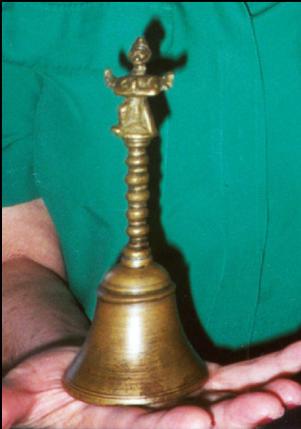
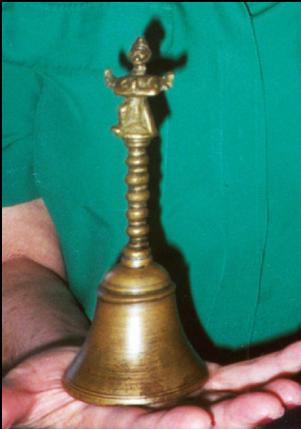
He’s holding a small, ornate bell.

It’s made of a strange, brassy alloy, with an iron clapper still inside. Perched atop the bell is a bizarre, winged figure, its arms clasped to its knees. Its face is ancient, almost demonic. It stares out with an ageless expression that seems to mock the very concept of time.
Newton Anderson knew where the coal came from. It was mined locally, from the bituminous seams that ran deep beneath West Virginia. Seams that geologists confidently dated to the Carboniferous Period.
300 million years ago.
Let that sink in. This wasn’t just a bell. This was a paradox. A manufactured object, complete with a complex alloy and an intricate design, found embedded in a solid lump of coal that was formed 100 million years *before* the first dinosaurs. It was an artifact from a time when, according to our textbooks, the most advanced life on land was giant dragonflies and primitive amphibians slithering through immense, swampy forests.
Who, or what, was casting bells in those ancient jungles?
Deep Dive: The Carboniferous Conundrum
To grasp the sheer impossibility of this find, you have to understand what the world was supposedly like 300 million years ago. Forget humans. Forget mammals. Forget birds. The Carboniferous Period was a hothouse planet, dominated by colossal ferns, 100-foot-tall scale trees, and swamps that stretched for thousands of miles.
The air was thick with oxygen, allowing insects to grow to horrifying sizes—spiders as big as your head, dragonflies with the wingspan of an eagle. This was the world that created our coal. For 60 million years, these massive forests lived, died, and sank into the swampy muck. Over eons, the pressure and heat from layers of sediment piled on top cooked this organic sludge into the black rock we burn for fuel today.
It’s a slow, brutal, natural process. There’s no room in that process for a finely crafted brass bell. It’s like finding a smartphone inside a T-Rex fossil. It breaks the timeline. It breaks everything.
This is what investigators of the strange and suppressed call an OOPArt. An “Out-of-Place Artifact.” It’s an object of advanced technology or artistry found in a geological or archaeological context where it simply has no business being. And the Upshur Bell, as it came to be known, might just be the king of them all.
A Nuclear Fingerprint on an Ancient Relic
For years, the bell was a family curiosity. But a story this strange can’t stay quiet forever. It eventually came to the attention of the Institute for Creation Research, a group keen to find evidence that challenges the standard geological timescale. They took the bell seriously. So seriously, in fact, that they submitted it for analysis at the University of Oklahoma’s lab.
The scientists there performed a nuclear activation analysis, a sophisticated method used to determine the exact elemental composition of an object. The results only deepened the mystery.
The bell was not simple brass. It was a complex and bizarre alloy. A strange cocktail of metals that, according to researchers, was different from any known modern or historical alloy. It contained the expected copper and zinc, but also tin, arsenic, and more puzzlingly, traces of iodine and selenium.
Why were those last two in there? They serve no obvious purpose in bell-making. Was it a side effect of a lost, ancient smelting process? Or were they added intentionally, for reasons our modern science can’t comprehend? The metal itself seemed to be a technology we don’t understand, from a time we don’t recognize.
The analysis proved one thing: this wasn’t some cheap, mass-produced trinket from the 20th century. Its very chemical makeup was an anomaly.
The Antediluvian Theory: A World Before the Flood
If the bell wasn’t made by us, and it wasn’t made by cavemen, then who made it? For many, the answer lies not in geology, but in theology. In a lost chapter of human history. The world before the Great Flood.
Norm Sharbaugh, in his book Ammunition, classifies the bell as an “antediluvian” artifact. This theory proposes a radical rethinking of our timeline. The coal isn’t 300 million years old. Instead, it was formed rapidly during the cataclysmic flood described in the Book of Genesis.
Think about it. A global flood would have been an event of unimaginable violence. It would have ripped up the entire world’s biosphere—trillions of tons of vegetation, animals, and entire cities—and buried it all under miles of sediment. The immense pressure and geothermal heat could have, according to this theory, formed coal seams in a matter of years or decades, not eons.
Suddenly, the bell isn’t 300 million years old. It’s maybe 4,500 years old, belonging to a forgotten civilization that was wiped from the face of the Earth.
The Bible itself hints at such a world. Genesis 4:22 speaks of a man named Tubal-Cain, a descendant of Cain, who was “an instructor of every artificer in brass and iron.” This wasn’t the Stone Age. This verse describes a society that had already mastered metallurgy. They were working with complex alloys long before the flood. What other technologies did they possess? What wonders did they build?
When their world ended, the bell—perhaps a ritual object, a toy, or a simple household item—was swept away with the wreckage of their civilization, buried with a continent’s worth of trees, and sealed in a tomb of coal, waiting for a ten-year-old boy to set it free.
Who is the Figure on the Bell?
And what about the strange figure perched on top? It’s often described as a demon, but its features are ambiguous. With its wings and humanoid form, some researchers have compared it to ancient figures like the Hindu god Garuda or the Mesopotamian demon Pazuzu. Could it be a depiction of a “god” from that lost world? A being they worshipped, or perhaps, a being they feared? The figure adds another layer of profound, unsettling mystery to an already impossible object.
The Skeptic’s Corner: Is There a Simpler Answer?
Of course, mainstream science doesn’t buy the ancient civilization or flood geology theories for a second. So, what are the rational explanations? Is this all just a misunderstanding?
Theory 1: It’s a Modern Bell that Fell in the Coal
This is the simplest explanation. The bell is just a bell. It could have been dropped by a miner, fallen into a crevice in the mine shaft, or even gotten mixed in with the coal during transport or in the Anderson’s own basement. Over time, moisture and coal dust could have formed a hard crust around it, making it *look* like it was embedded in a solid lump.
Plausible? Maybe. But does it explain the bizarre, unique alloy? And would a simple crust of coal dust really be mistaken for the solid, layered structure of a 300-million-year-old piece of bituminous coal?
Theory 2: The Concretion Mistake
A slightly more scientific debunking involves something called a concretion. A concretion is a hard, compact mass of mineral matter that forms when minerals in water precipitate around a nucleus—like a fossil, a pebble, or in this case, maybe a metal bell. These can form much, much faster than coal. The theory goes that the bell was the nucleus, and a lump of coal-like material formed around it, making it look like it was inside the coal. The problem? Concretions typically look very different from coal seams, and firsthand accounts insist the bell was in a genuine piece of mined coal.
Theory 3: The Missing Evidence
Here’s where it gets murky. The story is fantastic. But where is the hard proof? Where is the original lab report from the University of Oklahoma? Who were the scientists? Why wasn’t it published in a peer-reviewed journal? The narrative is almost entirely controlled by creationist organizations, making it difficult for outside researchers to verify the claims. The chain of custody is weak, and the documentation is practically non-existent. For a skeptic, this lack of evidence is the biggest red flag of all.
A Pattern of Impossible Artifacts
If the Upshur Bell were a one-off event, it would be easy to dismiss. A hoax. A mistake. But it’s not alone. It’s part of a disturbing pattern of meticulously crafted objects found in places they could not possibly be.
- The Morrisonville Gold Chain: In 1891, Mrs. S.W. Culp, a farmer’s wife in Morrisonville, Illinois, was breaking a large lump of coal for her kitchen stove. It cracked open, and a small, intricately woven 8-carat gold chain, about 10 inches long, fell out. The coal, like the lump in West Virginia, was also dated to the Carboniferous Period. The chain was paraded as a marvel, its craftsmanship undeniable, its origin a total mystery.
- The Thomas Iron Pot: In 1912, at a municipal electric plant in Thomas, Oklahoma, workers breaking up large chunks of coal found a solid cast iron pot inside one. The coal was from the Wilburton mines, estimated to be over 312 million years old. The pot is now housed at the Creation Evidence Museum, a silent testament to a manufacturing industry that existed in the age of giant swamps.
One object is an anomaly. Two is a coincidence. Three is a pattern. How many more are there, dismissed by their finders or quietly acquired by museums and hidden away in dusty archives, too paradigm-shattering to ever be put on public display?
The Final Question: What Does the Bell Mean?
So we are left with this small, brass object. A relic that whispers of an impossible history. A history that could rewrite everything.
What if they’re all real? The bell, the chain, the pot. What does it mean?
It means we are not the first. It means that another intelligence, perhaps human, perhaps something else entirely, built cities, mastered metallurgy, and created art on this planet in a time so ancient our minds can barely grasp it. It suggests a cyclical nature to history, where great civilizations can rise, fall, and be so completely erased by time that the only things left are a few impossible trinkets sealed in rock.
Is this the secret the scientific establishment is so desperate to keep? Is it easier to label these things as hoaxes than to admit that the entire foundation of modern geology, anthropology, and evolutionary biology might be fundamentally wrong?
The bell sits today in the Genesis Park collection. It doesn’t talk. It doesn’t reveal its secrets. It just exists, a silent rebuke to our comfortable, linear history.
Is it a simple piece of misidentified metal? A geological fluke? Or is it a key? A message from a drowned world, a warning from a civilization that disappeared so completely that 300 million years of rock and time were not enough to hide their final echo.
The bell was found in coal. What other secrets are still buried, waiting for the rock to break?
Originally posted 2013-10-10 21:38:37. Republished by Blog Post Promoter
![bell_from_coal[1]](https://coolinterestingnews.com/wp-content/uploads/2013/10/bell_from_coal1.webp)