They Sent a Car to Mars… But What Were They REALLY Looking For?
Forget what they taught you in science class. Forget the sterile press conferences and the neatly packaged NASA animations. The official story is that the Curiosity rover—a one-ton, nuclear-powered science lab on wheels—was sent to Mars to poke at some rocks and look for signs of ancient, long-dead microbes.
It’s a nice story. A safe story.
But it’s not the whole story. Not even close.
When that rover touched down in Gale Crater on August 6, 2012, it wasn’t just the beginning of a scientific mission. It was the beginning of one of the greatest and most silently orchestrated cover-ups in human history. They were looking for something. Something they suspected was there all along. And the breadcrumbs they’ve let slip over the past decade? They don’t point to tiny fossils. They point to something much, much bigger.
So buckle up. We’re going to pull back the curtain on what Curiosity *really* found on the Red Planet. The truth is stranger, more profound, and infinitely more unsettling than you can imagine.
The Seven Minutes of Terror: A Perfect Landing… Or Something Else?
It all started with the landing. NASA called it the “Seven Minutes of Terror.” The entry, descent, and landing sequence was a white-knuckle ballet of hypersonic physics and automated precision. A heat shield glowing like the sun. A supersonic parachute. A jet-powered sky crane that hovered like a UFO, lowering the rover to the surface on a set of cables before flying off to crash-land a safe distance away.
It was insane. It was brilliant. And it worked. Perfectly.
A little too perfectly, some might say.
Think about it. We’re talking about a multi-billion-dollar machine, flying through the cosmos for months, hitting a paper-thin atmosphere at 13,000 miles per hour, and executing a landing sequence so complex that a single misplaced line of code would have turned it into a crater. All of this was done autonomously, millions of miles from any human intervention. We cheer at the engineering marvel. Of course we do. But we never stop to ask the bigger question: Why was such an impossibly risky system necessary?
A Deep Dive: Why Gale Crater?
The official line is that Gale Crater was chosen because of Mount Sharp, the 3-mile-high mountain of layered sediment at its center. A perfect place, they said, to read Mars’s geological history like the pages of a book. It sounds logical.
But Mars is covered in craters and geological wonders. So why this one? For years, fringe researchers and satellite-image analysts pointed to strange, repeating patterns and unnatural-looking formations within Gale Crater. Formations that looked less like geology and more like… archaeology. Rectilinear shapes. Grid-like patterns buried under the dust. Was Curiosity sent to this specific spot not to study rocks, but to quietly investigate—or debunk—rumors of buried ruins?
They would never admit it. Admitting it would open a Pandora’s box they’ve spent half a century trying to keep shut.
NASA’s Photo Album: Pixels of Truth or Digital Deception?
Almost immediately after landing, the images started flowing back. Thousands of them. And that’s when things got weird.
The internet went into a frenzy. People with no astronomical training, just a keen eye and a healthy dose of skepticism, began scanning the raw images NASA was publishing. And they started finding things. Things that shouldn’t be there.
- The “Mars Rat”: One of the first and most famous anomalies. Tucked between two rocks is a shape that looks uncannily like a rodent, complete with an eye, nose, and distinct body shape. NASA’s explanation? Pareidolia. The human brain’s tendency to see familiar patterns in random shapes. A convenient, catch-all excuse they would use again. And again.
- The “Thigh Bone”: An object that looks for all the world like a fossilized femur, lying on the Martian sand. It’s so convincing that NASA had to issue a special press release, again blaming pareidolia and “wind or water erosion.” But the shape is undeniable. Is it just a rock? Or a shred of evidence from a world that was once teeming with complex life?
- The “Floating Spoon”: A bizarre, elongated shape with a distinct spoon-like head that appears to hover above the ground, casting a shadow. Again, a “geological formation.” A trick of the light. Nothing to see here.
- The “Traffic Light”: A rock with three perfectly circular, vertically aligned holes that bears a striking resemblance to a modern traffic signal. Coincidence? Maybe. But on a planet of mysteries, how many coincidences can you accept before they form a pattern?
The list goes on and on. Shiny, metallic-looking objects. Geometrically perfect spheres. Shapes that look like carved statues or mechanical debris. Each time, the official explanation is the same: It’s just a rock. It’s a trick of light and shadow. You’re just seeing things.
But are we? Or is NASA engaged in a form of psychological warfare? They release thousands of images, knowing the public will find these anomalies. They then calmly debunk them one by one, making anyone who questions the official narrative look like a fool. It’s a brilliant strategy. Drown the real evidence in a sea of “false positives” until everyone gives up looking.
Whispers in the Red Dust: The Methane Enigma
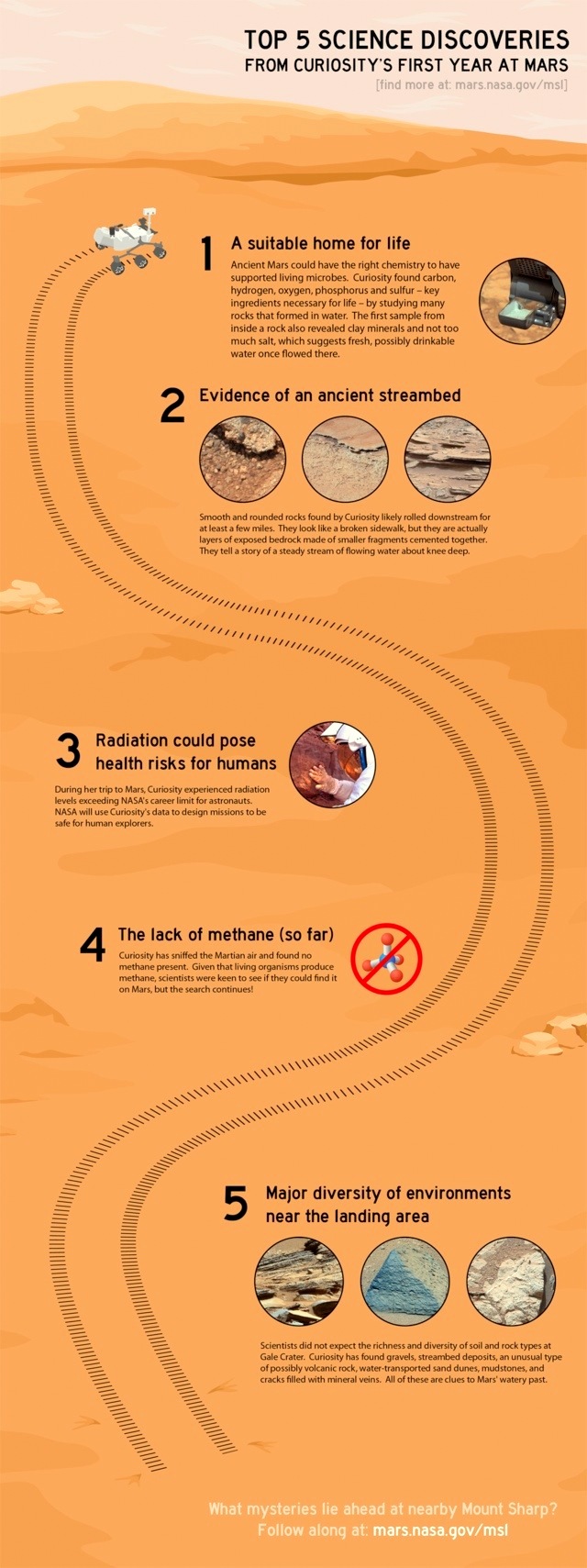
This is where the story goes from strange to deeply profound. For a long time, scientists debated whether Mars had methane in its atmosphere. It’s a big deal. On Earth, over 90% of atmospheric methane is produced by living organisms. Finding it on Mars would be a potential game-changer.
Curiosity’s onboard laboratory, SAM (Sample Analysis at Mars), was designed to sniff out even trace amounts of gases. And it found it.
In 2013, the rover detected a sudden, massive spike in methane. The background level was around 0.7 parts per billion, but for a period of about 60 Martian days, it jumped tenfold. Then, just as mysteriously as it appeared, it vanished. Gone.
What Does It Mean?
NASA scientists were baffled, at least publicly. They offered two possibilities. One was geological: methane trapped underground for eons could be released through fissures in the rock. The other… was biological. A colony of microbes, perhaps living deep underground to escape the harsh surface radiation, could be “exhaling” methane in cycles. Waking up when conditions are right, then going dormant.
They presented it as an open question. A fun little mystery.
But what if it wasn’t a mystery to them at all? What if Curiosity drove right over a source? A vent. A pocket of life. What if the sudden disappearance of the methane wasn’t natural, but because the source—whatever it was—detected the rover and shut down? What if something on Mars is not only alive, but intelligent enough to hide?
Consider the implications. A machine from another world rolls into your neighborhood, sniffing and drilling. What do you do? You hunker down. You go silent. You wait for it to leave. The methane spikes didn’t just tell us something *might* be alive on Mars. They might have been the first evidence of something on Mars trying to avoid us.
The Missing Data and Convenient Glitches
Every conspiracy needs a smoking gun, and on Mars, that gun often takes the form of missing data. Throughout Curiosity’s mission, there have been periods of unexplained blackouts and “safe mode” events. The official reasons are always plausible: a powerful solar flare disrupted communications; a software glitch required a system reboot; a computer memory issue needed to be resolved.
It all sounds very technical and reasonable. But the timing is often… curious.
These glitches sometimes happen just as the rover is approaching a particularly interesting or anomalous area. One day, we’re getting stunning images of a bizarre rock formation, and the next? Radio silence for a week while engineers “fix a problem.” When the feed comes back online, the rover has often moved on, the anomaly left unexamined in the dust.
Was it really a solar flare? Or did Curiosity’s cameras capture something so undeniable, so world-changing, that the feed had to be cut? Did someone on a seven-second delay at Mission Control in Pasadena see an image pop up on their screen and immediately hit the kill switch? We’ll never know. The logs will say “corrupted data.” The official report will mention “cosmic ray interference.”
But the questions remain. What did they see? A structure? A movement? A light? The truth isn’t in the data they show us. It’s in the gaps. The missing minutes. The convenient computer crashes.
A Deep Dive: The Viking Lander Precedent
This isn’t new. We have to look back to 1976. The Viking 1 and 2 landers were the first machines to have a dedicated life-detection experiment. One of them, the Labeled Release experiment, got a positive result. A stunningly positive result.
When a nutrient solution was added to a sample of Martian soil, something in the soil metabolized it and released a radioactive gas—exactly what you’d expect microbes to do. The experiment’s lead scientist, Dr. Gilbert Levin, was convinced he had found life. But NASA overruled him. They claimed it was a non-biological chemical reaction, an explanation that many scientists still find unconvincing to this day. They declared Mars sterile.
Why? Was the world not ready for the truth in 1976? Was Curiosity sent, in part, to manage the narrative that Viking almost blew wide open? To find evidence, yes, but to release it slowly, carefully, in a way that wouldn’t cause a global panic.
The Mission Creep: From Geology to… Something Else
Curiosity was supposed to last for two years. It’s been operating for over a decade. Its mission has been extended again and again. It has driven farther, climbed higher, and drilled more holes than ever planned. Why keep this aging, expensive machine running?
Because the job isn’t done. The real job.
The arrival of the Perseverance rover in 2021, with its helicopter Ingenuity, isn’t a replacement. It’s an escalation. Perseverance landed in Jezero Crater, the site of an ancient river delta. An even better place to look for signs of life. It’s collecting rock samples to be returned to Earth on a future mission.
Think about that. They’re planning on bringing pieces of Mars back home. You only do that if you are absolutely certain of what you’re going to find. Curiosity wasn’t the final exam; it was the study guide. It was the scout. It mapped the area, sniffed the air, and identified the prime targets. It did the dangerous, initial reconnaissance. Now, Perseverance is going in to collect the prize.
The story they are building, piece by agonizingly slow piece, is one of a planet that *was* once habitable. A planet that *could* have had life. It’s a way of easing us into the final revelation.
But what if they’re wrong about one tiny detail? What if the life isn’t in the past tense?
The final mystery of Curiosity isn’t about a single rock or a puff of methane. It’s about the entire mission. We sent a robot to search for life. Maybe, just maybe, it succeeded on its very first day. And they’ve been spending every day since trying to figure out how to tell us.