Home Weird World Photo Galleries Strange Clouds: amazing pictures

Strange Clouds: amazing pictures

0
59

The Sky Is Lying to You: Why “Lenticular Clouds” Might Be the Ultimate Cosmic Camouflage

Look up. Right now. Go to a window, step onto your porch, and just stare at the sky for a minute. What do you see? Fluffy white cotton balls drifting lazily? A grey blanket of rain? Or do you see something… else? Something that feels too symmetrical, too perfect, and just a little bit wrong?

For decades, we’ve been told to ignore our instincts. We see a perfect disc hovering over a mountain range, motionless while the wind tears through the valley below, and we freeze. The hairs on the back of our necks stand up. Our primal brain screams, “Danger. Predator. Watch out.” But then we turn on the news, or we open a textbook, and the experts pat us on the head. “Relax,” they say. “It’s just water vapor. It’s just a trick of the light.”

They call them Lenticular Clouds. Altocumulus lenticularis, if you want to get fancy with the Latin. And sure, science has an explanation. It always does. But does that explanation actually satisfy you? Or does it feel like a convenient cover story for something much, much stranger?

We are going to rip apart the “official narrative” surrounding these disc-shaped anomalies. We are going to look at the history, the weird coincidences, and the terrifying possibility that the best place to hide a spaceship isn’t behind the moon—it’s right in front of your face, wrapped in a blanket of moisture.

The Official Story: What “They” Want You to Believe

Before we go down the rabbit hole, we have to understand the textbook definition. It’s the shield the skeptics use to deflect any questions. According to meteorology, these saucer-shaped clouds are created by gravity waves. No, not the space-bending gravity waves from a black hole. Simple atmospheric waves.

Here is the setup: You have a mountain. You have stable, moist air flowing toward that mountain. As the air hits the obstacle, it gets pushed up. It cools down. The moisture condenses into a cloud. Then, as the air flows over the peak and dips back down, it warms up, and the cloud evaporates.

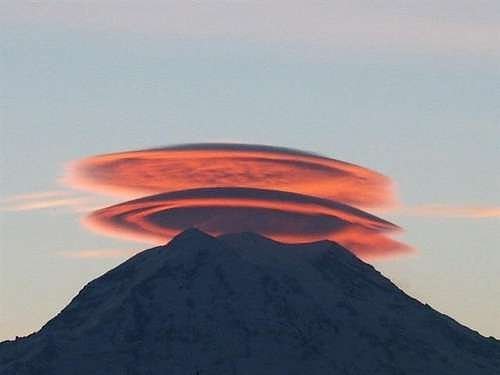
The result? A standing wave. The air is moving through the cloud like water through a hose, but the cloud itself—the visible part—stays perfectly still. It hovers. It spins. It looks like a polished shield or a stack of pancakes. It looks exactly like the classic 1950s flying saucer.

Convenient, isn’t it?

It’s almost too perfect. Nature is chaotic. Trees aren’t perfect cylinders; rivers don’t flow in straight lines. Yet we are expected to believe that wind and water randomly conspire to create distinct, hard-edged, metallic-looking discs that can hover in place for hours? Just water vapor? Maybe. Or maybe that “standing wave” provides the perfect parking spot for something that needs to recharge.

The 1947 Connection: Where It All Began

Let’s rewind the clock. June 24, 1947. This is the birthday of the modern UFO phenomenon. A pilot named Kenneth Arnold is flying near Mount Rainier in Washington State. He sees nine high-speed objects weaving around the mountain peaks. He describes their movement as “like a saucer if you skip it across the water.”

The press coined the term “Flying Saucer.” The world changed forever.

But here is the detail most people miss. Mount Rainier? It is one of the most famous factories for lenticular clouds on Earth. The skeptics immediately jumped on this. “Oh, poor Kenneth,” they said. “He just saw some clouds and got confused.”

But Arnold was an experienced pilot. He knew what clouds looked like. He estimated their speed at over 1,000 miles per hour—supersonic speeds that no aircraft of that era could touch. Could a cloud move that fast? No. Could a cloud weave in formation? No.

So, we have two possibilities here.

Option A: Kenneth Arnold, a man who staked his life on identifying aerial hazards, mistook a stationary cloud for a fleet of supersonic craft.

Option B: The entities piloting those craft knew that Mount Rainier generated these formations. They used the area as a base. They used the cloud cover as camouflage. Arnold just happened to catch them when the “cloaking device” was turned off.

Think about it. If you were an alien species visiting a primitive planet, where would you hide? The ocean? Sure, that’s good. But if you need to monitor the surface, you hide in the sky. And the best way to hide in the sky is to look like the sky.

The Cloaking Theory: Hiding in Plain Sight

This brings us to the most popular theory on the dark corners of the internet: Cloud Cloaking. The idea is simple. We assume UFOs are shiny metal ships, right? Chrome, steel, lights. But that’s human thinking. We build things out of metal.

An advanced civilization might use organic materials. Or, they might use force fields that bend light and gather moisture. Imagine a ship that generates an electromagnetic field so intense it instantly condenses the water vapor around it. It essentially wraps itself in a cloud cocoon.

To the naked eye on the ground, it’s just a cloud. Maybe a weird-looking one, but a cloud nonetheless. But inside? There is structure. There is intelligence.

Have you ever watched a lenticular cloud time-lapse video? While the other clouds drift and dissolve, the lenticular cloud sits there. Watching. Waiting. Sometimes, they stack up—one on top of another. Meteorologists call this a “pileus” formation. UFO hunters call it a “mothership refueling a scout craft.”

Look at the photo above. Really look at it. The edges are sharp. Defined. Clouds are usually diffuse, wispy things. This thing has architecture. It has a rim. It casts a shadow that seems almost solid. If that isn’t a solid object draped in mist, then nature has a very twisted sense of humor.

Mount Shasta: The Portal to Elsewhere

We cannot talk about these “clouds” without talking about Mount Shasta in Northern California. If Rainier is the grandfather of the UFO mystery, Shasta is the crazy uncle who knows magic.

Shasta is constantly capped by massive, swirling lenticular clouds. They look like giant turbans or stacked plates. The local indigenous tribes have always considered the mountain sacred, a place where the spirit world touches the physical world.

In modern conspiracy lore, Shasta is believed to be the home of the Lemurians—an ancient, advanced civilization living inside the mountain in a crystal city called Telos. The legends say they fly ships in and out of the mountain peak.

How do you fly a ship out of a volcano without being seen? You generate a cloud. The massive lenticular formations over Shasta aren’t weather; they are the garage door opening. Witnesses have reported seeing lights flashing inside these clouds. Not lightning—rhythmic, colored lights. Others have reported the clouds disappearing instantly—not fading away, but vanishing in a blink, as if a switch was flipped.

Is it a portal? A Stargate? Or just high-tech parking?

The “Nope” Scenario: Are They Alive?

Recently, a new theory has gained traction, fueled by pop culture and disturbing biological speculation. What if the ship isn’t a ship? What if the cloud isn’t a cloud?

What if it is a predator?

Historically, we look for “nuts and bolts” craft. But the universe is full of life in forms we can’t comprehend. There are jellyfish in the deep ocean that look like drifting plastic bags until they sting you. Why couldn’t there be atmospheric jellyfish?

Jean Jacket. That was the name of the entity in the movie Nope. It hid in a stationary cloud, not moving for months. It wasn’t a ship carrying little green men. The saucer was the animal. It ate. It digested. It screamed.

This aligns with the “Atmospheric Beast” theory, which dates back to the early 20th century. Researchers like Charles Fort suggested that the sky is essentially a jelly-like sea, filled with transparent or semi-transparent organisms. When they get dense enough, or when they die, they become visible. We call them clouds. We call them UFOs. But they might be grazing on our atmosphere, or maybe… grazing on us.

Look at this second image. It’s dense. Opaque. It doesn’t look like water vapor; it looks like tissue. It looks like something you could poke with a stick and it would bleed. When you see a cloud that stays still while the wind howls, ask yourself: Is it hovering? Or is it hunting?

Government Projects: HAARP and the Weather Wars

We can’t let the aliens have all the fun. We have to look at human interference. If these aren’t aliens, they might be something even scarier: Us.

We know the government has dabbled in weather modification. Operation Popeye in the Vietnam War proved that the US military could extend monsoon seasons to wash out enemy supply lines. That was the 1960s. That was over 50 years ago. Imagine what the tech looks like today.

Enter HAARP (High-frequency Active Auroral Research Program). Officially, it’s for studying the ionosphere. Unofficially? Conspiracy theorists have pinned everything from earthquakes to mind control on this antenna array in Alaska.

One specific theory suggests that HAARP can heat specific parts of the atmosphere to create artificial plasma lenses or high-pressure domes. These could manifest as perfect, saucer-shaped clouds. Why do this? Maybe it’s a shield against missile attacks. Maybe it’s a way to reflect radar. Or maybe it’s a psychological operation (PSYOP).

Project Blue Beam is the ultimate conspiracy theory involving holograms and fake alien invasions. If you wanted to fake an invasion to unite the world under a New World Order, you would need ships. But building thousands of fake ships is expensive. Making clouds that look like ships? That’s free. You just need to heat the air in the right spot.

So, when you see a lenticular cloud over a city that isn’t anywhere near a mountain? Run. That’s not natural. That is man-made, and whatever they are testing, you don’t want to be the lab rat underneath it.

Pareidolia: The Skeptic’s weapon

We have to address the elephant in the room. The brain is a liar. It is wired to find patterns. We see faces in toast. We see rabbits in the moon. This is called Pareidolia.

Skeptics love this word. They use it to dismiss everything. “You didn’t see a craft,” they say. “You saw a cloud and your brain filled in the gaps because you watched too much Star Trek.”

And to be fair, they have a point. Sometimes a cigar is just a cigar, and a cloud is just a cloud. The gallery of images we are looking at today features some stunning examples of nature being weird. It is entirely possible that wind shears and thermal layers just happened to create a perfect circle.

But here is the problem with relying entirely on the “Pareidolia” excuse. It assumes that witnesses are passive observers. It ignores the radar data. It ignores the pilots who say, “I saw the cloud, and then the cloud chased me.”

Pareidolia doesn’t show up on thermal imaging. Pareidolia doesn’t disable nuclear warheads (which has happened in incidents involving disc-shaped aerial phenomena). When the “cloud” starts interacting with technology, the “it’s all in your head” argument falls apart.

How to Spot a Fake Cloud

So, you’re a truth-seeker. You want to know if that thing above your house is water or a Warp Drive. Here is a quick checklist for the field investigator:

  • Movement vs. Wind: Look at the lower clouds. Are they moving fast? If the wind is blowing at 20mph but the disc cloud is locked in place like a stone, pay attention.
  • The Edges: Natural clouds usually have wispy, uneven edges. If the cloud looks like it was cut with a laser or has a perfectly smooth rim, be suspicious.
  • Lighting: Does the cloud glow from the inside? Does it reflect sunlight differently than the clouds around it? Some “cloudships” have been reported to have a metallic sheen, almost like dirty pewter, rather than pure white fluff.
  • The Sound: Clouds are silent. If you hear a low-frequency hum or feel a vibration in your chest while looking at one, get your camera rolling.
  • Disappearance: Clouds fade. They dissipate slowly. They don’t blink out of existence. If it vanishes instantly, you just saw something leave our dimension.

The Final Verdict

We live in a world that is stranger than fiction. We are surrounded by mysteries that we are trained to ignore. The education system, the media, the government—they all want you to look down at your phone, pay your taxes, and stop asking questions.

But the truth is up there.

These images might be beautiful examples of atmospheric physics. They might be the result of air currents hitting mountain peaks. But every time you see one, there is that tiny sliver of doubt. That “what if.”

What if the pilot of that craft is looking down at you, laughing, amazed that their camouflage works so well? What if the invasion already happened, and we just thought it was a cloudy day?

Next time you see a lenticular cloud, don’t just shrug and walk away. Watch it. Wait. See if it blinks. Because one day, the clouds are going to drop the disguise, and we are going to find out exactly who has been watching us all this time.

Keep your eyes on the skies.

Originally posted 2016-03-11 12:27:50. Republished by Blog Post Promoter