The Mars Crab: NASA’s Smoking Gun Photo of Alien Life?
They told us Mars was dead. A silent, rust-colored tomb spinning through the void. For decades, that’s been the official story. We send our billion-dollar rovers, our technological marvels, to poke at dust and analyze rocks. They send back postcards from a dead world.
But sometimes, just sometimes, they send back something else.
Something that doesn’t fit the narrative. Something that makes the hair on your arms stand up. Something that looks… alive.
This is that story. It’s the story of a single photograph, buried in a mountain of data, that could change everything we think we know about the universe. It’s the story of the Mars “crab.”

A Glitch in the Matrix?
Imagine you’re a digital archaeologist. You spend your days sifting through the visual feed from the Curiosity rover, NASA’s six-wheeled science lab crawling across the Gale Crater. It’s a slow, methodical process. Rock. Dust. More rock. The landscape is majestic but brutally monotonous.
Then you see it.
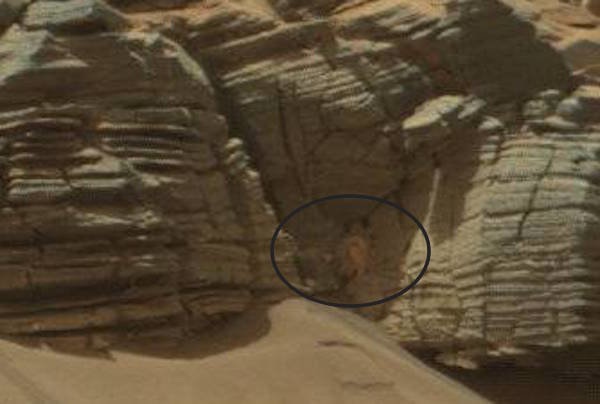
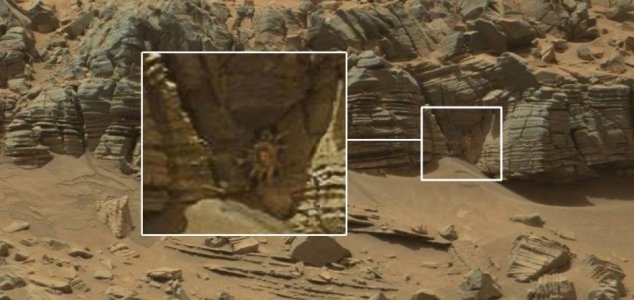
Tucked away in a dark recess of a Martian cliffside, something stares back. It’s not a rock. Rocks are random, chaotic, broken. This is different. This has structure. It has symmetry. It appears to have… legs.
When this image, taken on Martian day (or “Sol”) 1089 of Curiosity’s mission, first hit the web, the reaction was electric. UFO forums, paranormal blogs, and late-night Reddit threads exploded. People weren’t just seeing a weirdly shaped rock. They were seeing an organism. A creature. A multi-limbed thing that looked suspiciously like a crab or a spider, peeking out from its cave.
Look at it. Really look. You can see a central body, a shell-like dome. You can see spindly appendages clinging to the rock face, casting their own distinct shadows. It doesn’t look like it was carved by wind or water. It looks like it *belongs* there. Like it’s waiting for something. Or hiding.
The Official Explanation: Your Brain is Lying to You
Almost as quickly as the “discovery” went viral, the scientific establishment rolled out its explanation. It’s a word you’ll hear a lot when it comes to Martian anomalies: Pareidolia.
Seth Shostak, a senior astronomer at the SETI Institute, is the go-to guy for pouring cold water on these kinds of fires. He’s seen it all before. He says he gets emails like this about once a week.
“Those that send them to me are generally quite excited, as they claim that these frequently resemble SOMETHING you wouldn’t expect to find on the rusty, dusty surface of the Red Planet,” he explained. “It’s usually some sort of animal, but occasionally even weirder objects such as automobile parts. Maybe they think there are cars on Mars.”
The culprit, he insists, is our own programming. Pareidolia is a psychological phenomenon where our brains find familiar patterns in random noise. It’s why we see faces in clouds, a man in the moon, or Jesus on a piece of toast. It’s not a flaw; it’s a feature of human evolution.
“Far from being a vision defect, pareidolia has a lot of survival value if you need to quickly spot predators in the jungle, for instance,” Shostak wrote. Our ancestors who could instantly spot the shape of a tiger in the tall grass were the ones who survived to pass on their genes. Our brains are hardwired to find order in chaos, to see signals in the static. Even when they aren’t there.
So, according to science, the Mars Crab is just a cosmic Rorschach test. A trick of light and shadow on an unusually shaped bit of geology. Case closed. Move along, nothing to see here.
But is it really that simple?

Deep Dive: When Rocks Look Back
The argument for pareidolia is strong. And the Mars Crab is hardly the first time we’ve seen something familiar on the Red Planet. Mars has a long history of showing us things that shouldn’t exist.
It started with the “Face on Mars.” In 1976, NASA’s Viking 1 orbiter snapped a picture of a region called Cydonia. In the grainy, low-resolution photo, a massive mesa looked uncannily like a human face, complete with eyes, a nose, and a mouth, staring up into space. For decades, it was the poster child for ancient alien theorists who believed it was a monument built by a long-dead Martian civilization.
Years later, NASA’s Mars Global Surveyor took a much higher-resolution photo. The “face” dissolved into a heavily eroded, naturally formed mountain. Just a trick of light and shadow. Or so they say.
The list goes on. The rovers have sent back pictures of:
- The Mars Rat: A shape nestled between two rocks that looks exactly like a rodent, complete with an eye, nose, and ear.
- The Thigh Bone: An elongated rock that looks so much like a fossilized femur, NASA had to issue a press release explicitly stating, “It’s not a bone.”
- The Floating Spoon: A bizarre, long rock formation with a spoon-like cup at the end, seemingly hovering over the ground due to the strange way its shadow fell.
- The Martian Doorway: A perfectly rectangular, clean-cut opening in a rock face, discovered by Curiosity in 2022. It looks for all the world like an entrance to an underground bunker or tomb. Geologists say it’s just a natural shear fracture.
With every single one of these discoveries, the pattern is the same. The internet erupts with speculation, and NASA calmly follows up with a perfectly reasonable, perfectly boring geological explanation. Wind erosion. Natural fractures. Light and shadow.
But what if the pattern isn’t the discovery? What if the pattern is the denial?
Analyzing the “Crab”: A Case Against Coincidence
Let’s dismiss the official explanation for a moment. Let’s look at the evidence with open eyes and ask the hard questions. What if it’s *not* a rock?
First, consider its structure. Unlike the “Face on Mars,” which falls apart under higher resolution, the “Mars Crab” holds up. The object appears to have a distinct, almost pearlescent sheen, different from the matte texture of the surrounding rock. Its “legs” seem to be arranged with a startling degree of biological symmetry. They aren’t just random shards.
Second, think about location. It’s not just sitting out in the open. It’s nestled within a small cave or alcove, a place that would offer protection from the brutal Martian radiation and savage dust storms. This is exactly where a living organism might seek shelter. It’s defensive positioning. It’s tactical.
Now, let’s get weirder. We search for life based on what we know: carbon-based, water-dependent life like us. But what if Martian life evolved differently? Scientists have long theorized about the possibility of silicon-based life. Such creatures might not be soft and fleshy. They could be crystalline, with rock-like exoskeletons. They might metabolize minerals directly from the ground. They might move incredibly slowly, perhaps only inches over a lifetime.
To our cameras, a creature like that would look… exactly like a rock. Until you looked closer. Until you saw the unnatural symmetry. Until you noticed it was clinging to a wall instead of lying on the ground.
We know Mars wasn’t always a wasteland. Billions of years ago, it had a thick atmosphere, flowing rivers, vast lakes, and maybe even oceans. It had all the ingredients for life to begin. What if it did? What if, as the planet died and its atmosphere was stripped away, life didn’t just vanish? What if it adapted? What if it went underground, or evolved hard shells, learning to survive in the harshest environment imaginable?
Maybe we’re not seeing a rock that looks like a crab. Maybe we’re seeing a creature that evolved to look like a rock. The ultimate camouflage.
The NASA Conspiracy: A Policy of Silence?
This brings us to the elephant in the room. If NASA found something, would they even tell us?
It sounds like a paranoid question, but it’s rooted in history. In 1960, the Brookings Institution, a respected think tank, prepared a report for NASA called the “Proposed Studies on the Implications of Peaceful Space Activities for Human Affairs.”
Buried deep inside this report was a chilling section. It warned that if humanity were to discover evidence of intelligent extraterrestrial life, it could lead to the complete collapse of society. Religions would crumble. The scientific consensus would be shattered. Widespread panic could destabilize global politics. The report suggested that it might be better to conceal such a discovery from the public.
Has this recommendation become unofficial policy?
Consider the strange things that happen with NASA’s images. Many photos are released in false color, which NASA claims helps geologists, but also has the convenient side effect of making the planet look more alien and hostile. The Martian sky, which probes have shown can often be a pale, Earth-like blue, is almost always rendered as a sickly butterscotch-orange.
Then there are the accusations of airbrushing. Researchers poring over the image archives have found numerous instances of blurry patches, smudged-out areas, and stitching errors that seem suspiciously convenient, often obscuring objects that look out of place. NASA blames cosmic ray interference and data compression glitches. But could it be a deliberate attempt to scrub the data, to hide things that are too controversial to explain?
Are they hiding a fossil? A piece of technology? A living creature hunkered down in a cave? They tell us it’s pareidolia. But it’s a convenient excuse, a perfect psychological scapegoat that puts the blame on our own “faulty” brains, not on their data.
The Verdict is Still Out
So where does that leave us? Trapped between two impossible truths.
On one hand, you have the rational, scientific explanation. Our brains are pattern-seeking machines, and in the infinite chaos of a planetary landscape, we are bound to find things that look familiar. The Mars Crab is a geological oddity, a one-in-a-billion coincidence of erosion and shadow, and nothing more.
On the other hand, you have the tantalizing, world-altering possibility that this is real. That we are staring at the first confirmed picture of an alien life form. A creature that survived the death of its world, a silent testament to the tenacity of life. If this one exists, how many others are there? What else is hiding in the shadows, just beyond the rover’s gaze?
The problem is, we may never know for sure. The rover has moved on. It will never go back to that specific cliff face. That dark corner of Mars will likely never be seen by human or robotic eyes again. The “crab” will keep its secret.
But the pictures remain. The questions linger. Every time NASA releases a new panorama of that dusty, silent world, thousands of us will be there, scanning, zooming, looking for another glitch in the matrix. Looking for another rock that looks back.
Because they told us Mars was dead. But the pictures tell a different story.
Originally posted 2015-08-10 15:36:30. Republished by Blog Post Promoter