Thursday, July 9, 2026
HomeWeird WorldPhoto GalleriesStrange Abandoned Communist Party Headquarters in Bulgaria

Strange Abandoned Communist Party Headquarters in Bulgaria

What is This Alien Structure on a Bulgarian Mountaintop?

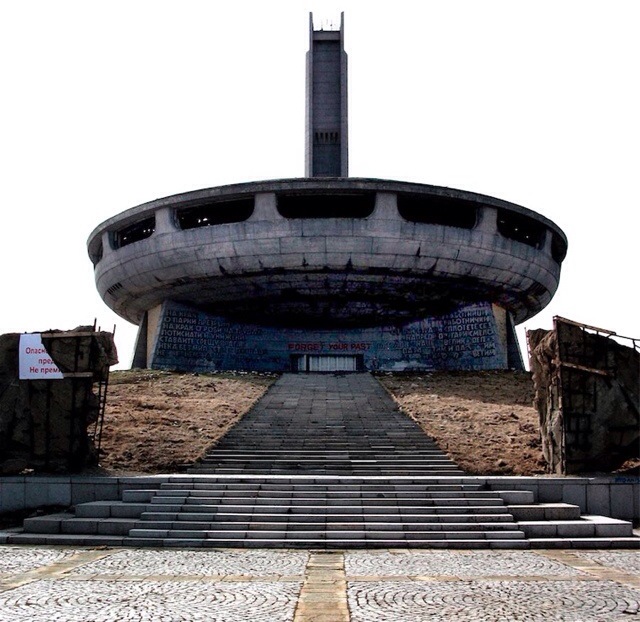
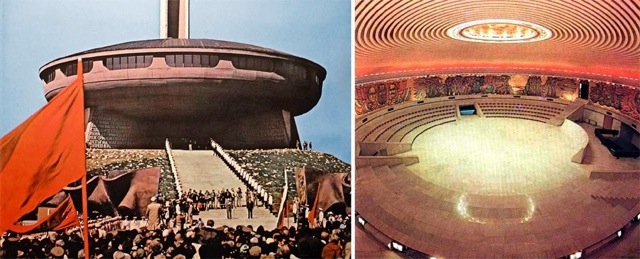
You’ve seen the pictures. They haunt the corners of the internet, looking like stills from a forgotten 1970s sci-fi epic. A massive concrete saucer, cracked and weather-beaten, sits silently atop a remote mountain peak. It looks like a UFO that ran out of fuel and was simply left to rust. A silent invader. An artifact from a future that never happened.

But this isn’t a movie set. And it’s not from another world.

It’s real.

This is the Buzludzha Monument in Bulgaria. And its story is stranger, more epic, and far more controversial than any alien invasion tale. It’s a story of revolution, ideology, immense ambition, and a spectacular, crashing fall from grace. It’s the ghost of a fallen empire, and its concrete shell has secrets to tell.

Forget everything you think you know about abandoned buildings. This isn’t just a derelict factory or a crumbling hospital. This was a temple. A shrine built to a political god. And today, it’s one of the most magnificent ruins on the entire planet. So, how did this “communist UFO” get here? And why was it left to die in the brutal Balkan winds?

A Deep Dive: The Blood and Beliefs That Built Buzludzha

To understand the concrete saucer, you first have to understand the ground it stands on. This isn’t just any mountain. Buzludzha Peak is hallowed ground, soaked in the blood of patriots and the dreams of revolutionaries. Its story didn’t begin with concrete and steel in the 20th century. It began with swords and cannons in the 19th.

The Battle That Birthed a Nation

Picture it. August 1877. The nearby Shipka Pass is a blizzard of gunfire and chaos. A small, desperate force of Bulgarian volunteers and Russian soldiers are making a last stand. They are holding the pass against the overwhelming might of the Ottoman Empire. For 500 years, Bulgaria had been under Ottoman rule, a nation without a state. This battle, part of the wider Russo-Turkish War, was the final, bloody push for freedom.

The defenders were outnumbered, outgunned, and running out of water. They fought with bayonets, with rocks, with the bodies of their fallen comrades. It was a brutal, heroic, and almost suicidal defense. But they held. Their impossible stand at Shipka Pass became the stuff of legend, a foundational myth for the modern Bulgarian nation that would be born just a year later. That spirit of sacrifice, of fighting against impossible odds, seeped into the very soil of these mountains.

A Sacred Peak for a New Ideology

Fast forward just 13 years. 1891. The nation is free, but new ideas are storming across Europe. On this same peak, a group of thinkers and radicals led by a man named Dimitar Blagoev gathered in secret. In the wind and fog, they held the founding congress of the Bulgarian Social Democratic Workers’ Party. The seed of Bulgarian communism was planted right there, on the same mountain range that had seen the birth of the nation.

For the communists who would later rule Bulgaria, this made Buzludzha Peak a doubly sacred place. It was the nexus of both national and ideological liberation. A place of pilgrimage. A spot that simply *had* to be crowned with a monument so grand, so powerful, that it would declare their victory to the world for a thousand years.

Forging a Concrete God: The Monument’s Grand Design

By the 1970s, Bulgaria was firmly behind the Iron Curtain, led by the long-ruling strongman Todor Zhivkov. The communist party was at the height of its power. They decided the time had come to finally build that ultimate monument on their sacred peak. This would not be some humble statue. Oh no. This was to be a statement.

20140106-220209.webp

The project was handed to architect Georgi Stoilov. His vision was a fusion of futurist architecture and brutalist might. It was meant to symbolize a flying saucer—a nod to the technological promise of the socialist future—combined with the laurel wreath of victory. Beside it, a colossal 70-meter (230-foot) pylon would stand, representing a banner. At its top, two gigantic red glass stars, each 12 meters wide, would be illuminated from within, visible for miles. They were, at the time, the largest in the world. A red star burning over the Balkans.

Construction began in 1974. It was a Herculean task. The peak is nearly 1,500 meters high, and its weather is notoriously savage. Using TNT, they literally blew the top off the mountain to create a stable, level platform. More than 6,000 people—soldiers, artists, and so-called “volunteers”—worked on the project. Over 70,000 tons of concrete, 3,000 tons of reinforced steel, and 40 tons of glass were hauled up the treacherous mountain roads.

The project cost a fortune. The official figure was over 16 million Bulgarian Levs. In today’s money, that’s well over $35 million, but some estimates put the true cost much, much higher. A staggering sum for a country that wasn’t exactly rolling in wealth.

Was it REALLY Built by Volunteers?

The official line was that the monument was paid for by the people. “Voluntary donations” were collected, and stamps were sold to raise funds. Thousands of people gave their labor for free, driven by patriotic and ideological fervor. That’s the story, anyway.

But dig a little deeper, and a different picture emerges. Whispers from that era, which have grown louder in modern times, suggest that “donations” were often deducted directly from people’s salaries without their consent. Being a “volunteer” wasn’t always a choice. The state had ways of making you see the glory in hauling concrete up a frozen mountain. While genuine pride certainly existed for many, the project was also a demonstration of the Party’s absolute power to command the resources—and the people—of an entire nation for a single, ideological goal.

20140106-220221.webp

Inside the Belly of the Beast: A Tour of a Lost World

After seven years of relentless work, the House-Monument of the Bulgarian Communist Party was opened in 1981. Imagine being there for the inauguration. You would have walked up a grand ceremonial staircase, passing poetic verses etched into the concrete walls. You would enter the saucer through heavy bronze doors. And then you would gasp.

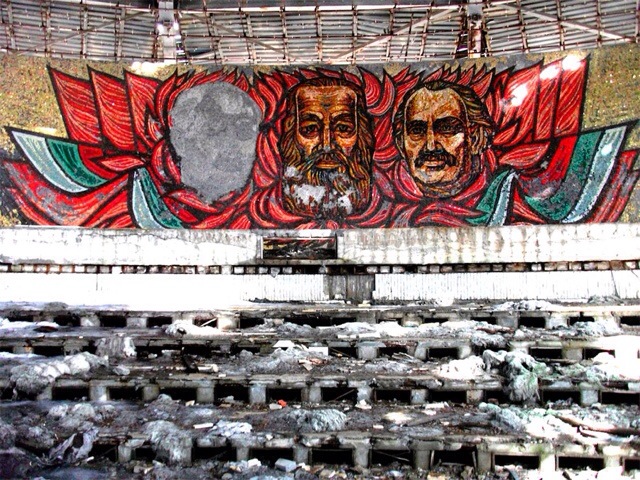
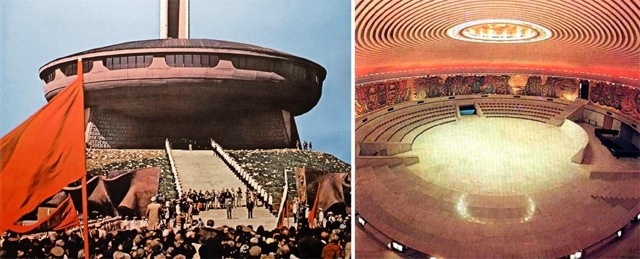
The main hall was a circular, cathedral-like space designed to awe you into submission. The entire inner wall was covered in a breathtaking mosaic stretching over 550 square meters. It depicted the struggles and triumphs of the Communist Party. You’d see peasants and workers rising up, heroic soldiers, andcosmonauts blasting into space. Presiding over it all were the holy trinity of communism: Marx, Engels, and Lenin. Across from them, a massive portrait of the Bulgarian leader, Todor Zhivkov, whose face was later scrubbed from the wall in a panic after he fell from power.

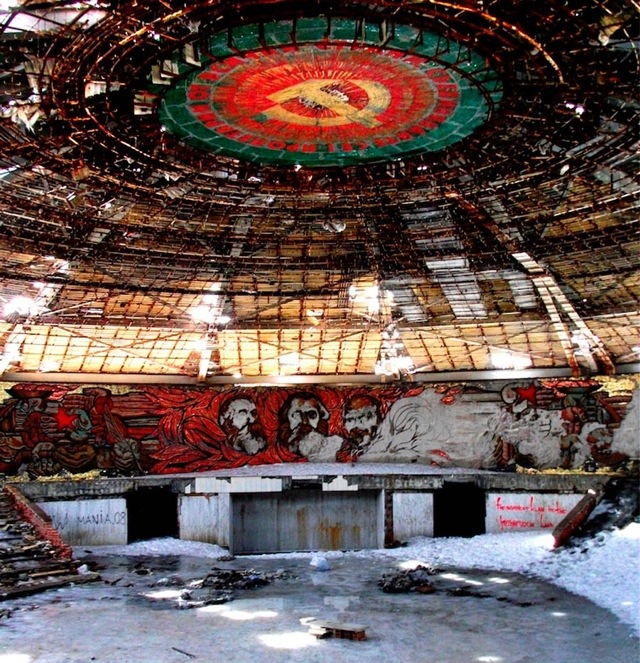
Above, the ceiling was a masterpiece. In the center, a huge hammer and sickle emblem was surrounded by quotes from “The Communist Manifesto.” And set into the very apex of the dome was a glowing, 2-ton star made of precious ruby glass, a red sun shining down on the believers below.

The sound would have been incredible. The acoustics were designed to amplify a speaker’s voice, turning a single man’s words into the booming voice of the state. It was a propaganda machine built of concrete and art, designed to host grand state ceremonies, to indoctrinate the young, and to stand as an eternal testament to the power of the Party.

For eight years, it did just that.

The Great Collapse: Why Was a Masterpiece Left to Die?

Eight years. That’s all it got.

In November 1989, the Berlin Wall fell. The shockwave tore across Eastern Europe. Todor Zhivkov was ousted. The People’s Republic of Bulgaria was dissolved. Communism collapsed. And almost overnight, the Buzludzha Monument went from being a sacred temple to a toxic symbol of a despised past. A monument to a god that was now dead.

The new democratic government wanted nothing to do with it. The maintenance costs were astronomical, and who would pay to maintain a shrine to their former oppressors? The property was handed over to the successor of the Communist Party, the Bulgarian Socialist Party. They were broke. They couldn’t afford to keep the lights on, let alone protect a massive concrete structure on a remote mountaintop from the fiercest winters in the Balkans.

So they locked the doors. And walked away.

And then the vultures descended. The stripping began almost immediately. Anything of value was plundered. The entire copper roof, a masterpiece of engineering, was torn off and sold for scrap. The electrical wiring was ripped from the walls. The precious ruby glass star in the ceiling? It was smashed to pieces by people shooting at it from the floor below, the shards scavenged like fallen jewels. The giant stars on the outer pylon were also targeted, their red glass shattered by rifle fire.

Once the shell was breached, nature took over. Rain, snow, and ice poured in, accelerating the decay. The beautiful mosaics began to crumble. The concrete began to crack under the relentless freeze-thaw cycle. And a new kind of visitor started to arrive.

Buzludzha Today: A Playground for Ghosts and Explorers

The main entrance is sealed shut. Warning signs are posted everywhere. But for urban explorers, graffiti artists, and thrill-seekers from around the world, Buzludzha is a holy grail. Finding a way in is part of the challenge, a modern-day treasure hunt.

Inside, it’s a post-apocalyptic cathedral. The silence is deafening, broken only by the wind whistling through shattered windows and the drip-drip-drip of water echoing through the massive hall. The once-grand mosaics are a heartbreaking puzzle of missing pieces, yet what remains is still stunningly beautiful. The faces of Marx and Lenin stare out from crumbling walls, their ideological certainty mocked by the decay all around them.

20140106-220229.webp

Graffiti covers every surface. The most famous piece, scrawled in giant red letters above the main entrance, reads “FORGET YOUR PAST.” It’s a defiant scream from a new generation. But other, newer graffiti has appeared beside it, one adding the words “NEVER.” The building itself has become a canvas for a debate about history and memory.

Modern Legends and Internet Whispers

The internet has given Buzludzha a second life. Its otherworldly appearance has made it a viral sensation. It has starred in music videos for bands like the Arcade Fire and singer Rita Ora. It’s been a location in action movies and a model for levels in video games. It’s a backdrop for fashion shoots and a magnet for drone pilots.

This online fame has also fueled new conspiracies. Is the strange saucer shape just a coincidence? Some forums whisper that its design was based on recovered alien technology, a secret Soviet project to understand otherworldly propulsion. Others claim it was a massive Cold War listening post, its circular shape designed to capture faint signals from NATO countries. Or perhaps a psychic energy amplifier? The theories get wilder and wilder, but they all speak to the structure’s incredible power to fire the human imagination.

The Fight for Buzludzha’s Soul: Ruin or Rebirth?

Today, the monument is at a crossroads. For years, the debate has raged in Bulgaria. Should it be demolished? Wiped from the landscape as a painful reminder of a totalitarian past? Or should it be left to crumble, a picturesque ruin and a powerful warning against hubris?

But a third option is gaining ground. A movement, led by Bulgarian architect Dora Ivanova and her Buzludzha Project Foundation, is fighting to save it. Their argument is compelling: you don’t have to agree with the ideology to recognize the building’s historical and architectural importance. It is a masterpiece of late-modernist design, one of the most significant of its era.

They don’t want to restore it to its former communist glory. Instead, they envision a new purpose. To stabilize the structure, conserve the remaining mosaics, and turn the building into a museum and interpretation center. A place where people can learn about the complete, complex, and often contradictory history of Bulgaria—from the Ottoman era to the socialist period to the present day. A place for art, for debate, for memory. Not for celebration.

Their efforts are starting to pay off. They’ve secured grants, including a significant one from the American Getty Foundation, to begin the critical work of preserving the mosaics. The fight is far from over, but for the first time in thirty years, there is a glimmer of hope for the concrete saucer on the mountain.

So what is Buzludzha? A monument to tyranny? A work of architectural genius? A crashed UFO? A Cold War secret? Or a blank canvas for the future? Maybe it’s all of these things. It remains a powerful, silent giant, a concrete question mark on the Bulgarian skyline, waiting for us to decide its final answer.

Amit Ghosh
Amit Ghoshhttps://coolinterestingnews.com
Aloha, I'm Amit Ghosh, a web entrepreneur and avid blogger. Bitten by entrepreneurial bug, I got kicked out from college and ended up being millionaire and running a digital media company named Aeron7 headquartered at Lithuania.
RELATED ARTICLES
- Advertisment -

Most Popular

Recent Comments

Warren Pan Abbott on The legend of the Devil Monkey !
chris davies on The McPherson Tape Mystery
Reed Reedly on ET has Internet!
Bea Houseoffashion on Proof Of Time Travellers – Gallery
Marcus2012 on ET has Internet!
Reed Reedly on ET has Internet!
LaughsAtConspiracyNuts on The 9/11 Conspiracy – Myths and Facts
Alex Sliverman on Did the ancients fly?
Doctor Wholigan on Time Traveler in 1938 film
chris davies on The McPherson Tape Mystery
Archie1954 on 10 secret UFO hideouts
chris davies on Ghosts of flight 401
Marcus2012 on ET has Internet!
jason Macdonald on Proof of Time Travel? – China
chris davies on Long-Lost Pyramids Found?
Reed Reedly on ET has Internet!
Milkman on Connected Universe
Tenmiles on Baigong Pipes Mystery
Simon Foster on Sirius – The Documentary
From the 1st April on 2013 – Alien Contact date ?
SkyWatcher on Is ET ignoring us?
I Come From The Future on Obama to make UFO Alien disclouser soon ?
ÛñK?øWn on 2013 – Alien Contact date ?
Just another person on 2013 – Alien Contact date ?
Malcolm Windowcleaner on The strange case of Rudolph Fentz
Mason Servio on Strange Things on Mars
Marke Wisdom Seeker on What will we find as arctic melts?
Andrea A Elisabeth Levyne on Aliens Captured in Varginha, Brazil
Mitch Grouyeki on Amazing Space Shuttle pictures