Friday, April 10, 2026
HomeWeird WorldSpaceSpace Missions - A history, Apollo 14

Space Missions – A history, Apollo 14

The Apollo Missions You Never Hear About: What REALLY Happened After Armstrong?

Everyone knows the words. “That’s one small step for man…”

Everyone knows the movie. “Houston, we have a problem.”

Apollo 11 was the triumph. Apollo 13 was the disaster-turned-miracle. They are etched into our collective memory, monumental pillars of the 20th century. But what about the missions that followed? What about the men who flew them? They went further, stayed longer, and drove cars on the Moon. They were the true deep explorers.

And their stories are far stranger, more dangerous, and more compelling than the official histories let on.

After the near-fatal explosion on Apollo 13, the entire space program hung by a thread. The public was nervous. Congress was tightening the budget. The missions that came next weren’t just routine follow-ups; they were desperate gambles to prove that the dream of Apollo was still alive. These are the stories of Apollo 14, 15, and 16—the forgotten voyages that pushed humanity to its absolute limit on an alien world.

Apollo 14: The Terrifying Comeback and the Psychic Astronaut

Imagine the pressure. You’re next in line after a mission that almost killed three national heroes. The world is watching. One more mistake, and the Moon is closed for business. Forever.

This was the burden on the shoulders of the Apollo 14 crew. And its commander was a legend back from the dead.

Alan Shepard. The first American in space. Grounded for years by a debilitating inner-ear disorder that caused crippling vertigo. He was a NASA ghost, an office-bound administrator watching his friends fly to the stars. Unwilling to accept his fate, he underwent a risky, experimental surgery—in secret. It worked. And now, at 47, he was the oldest astronaut in the program, clawing his way back for one last shot. His shot. A shot at the Moon.

His crewmates were the stoic Stuart Roosa, orbiting overhead in the command module Kitty Hawk, and a deeply intellectual rookie, Edgar Mitchell, who would pilot the lunar module Antares. Mitchell was no ordinary pilot. He was a doctor of science from MIT, fascinated by the mysteries of human consciousness. A fact that would become very, very interesting later.

Deep Dive: The Landing That Almost Failed

Nothing about Apollo 14 was easy. The mission was plagued by glitches that felt like a curse left over from Apollo 13.

Hours from the Moon, a faulty switch sent an ABORT signal to the lander’s computer. An abort signal. The one command you never want to see. If it fired again after they started their descent, the computer would automatically blast the ascent engine, sending them hurtling away from the Moon, mission over. A young MIT programmer on the ground, Don Eyles, had to frantically figure out a workaround, feeding lines of new code to the astronauts to type into their computer. It was a software patch invented in mid-flight, millions of miles from home. It was insane.

They bypassed the abort command. But the gremlins weren’t done.

As they descended toward the rugged Fra Mauro highlands—the very target Apollo 13 had failed to reach—their landing radar refused to lock onto the surface. Without it, the computer had no idea how high they were. They were flying blind. Mission rules were clear: no radar, no landing. With only seconds to spare, the radar suddenly blinked to life. Shepard, the old pro, took manual control and threaded the needle, landing Antares on the most tilted piece of ground of any Apollo mission. The sigh of relief in Mission Control could have powered a city.

20130526-210858.webp

Lost in an Alien Land

Shepard and Mitchell’s main goal was to reach the rim of Cone Crater, a massive impact site they believed held some of the oldest material on the Moon. But the Moon plays tricks on you. Distances are deceptive. There’s no atmosphere to haze the horizon. And the rolling, crater-pocked landscape looked the same in every direction.

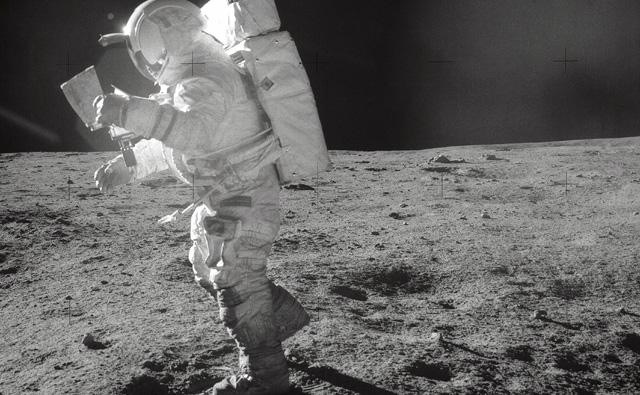
They didn’t have a high-tech rover. Instead, they had the Modular Equipment Transporter (MET), a glorified two-wheeled handcart that they nicknamed “the rickshaw.” And it was a nightmare to pull through the deep lunar dust.

For two hours, they trudged uphill, their heart rates soaring into the danger zone. They were exhausted. They were disoriented. They were lost. Listen to the mission transcripts and you can hear the growing panic in their voices, the heavy breathing against the microphone. They were looking at their maps, but nothing matched the landscape. The crater they were hunting was nowhere to be found. With their oxygen supply dwindling, Mission Control had to make the call. Turn back. They had failed.

It was only later, when analyzing orbital photographs, that they realized how agonizingly close they were. They were likely less than 100 feet from the rim when they gave up. A soul-crushing discovery.

But the strangest part of Apollo 14 happened in silence.

What if? The Secret ESP Experiment

Edgar Mitchell had a secret. Before the flight, he had arranged a private experiment with friends on Earth. During his rest periods on the journey to and from the Moon, he would concentrate on a series of symbols—a classic ESP test—and try to telepathically transmit them across the void. He did this without NASA’s knowledge or permission.

The results, he later claimed, were statistically significant. A success.

Think about that. An Apollo astronaut, a man of science, was conducting psychic experiments from lunar orbit. It blows the official narrative of the mission wide open. If he was doing that, what *else* might have been happening that didn’t make it into the public press releases? Was there a deeper, unacknowledged purpose to these missions?

And then there was the golf. Famously, Shepard unfolded a makeshift six-iron and hit two golf balls. He claimed one went for “miles and miles and miles.” It was a moment of pure, joyful rebellion. A human gesture in an inhuman place. But it was also a perfect piece of television, a distraction that has largely overshadowed the terror, the frustration, and the bizarre psychic undertones of the mission that saved Apollo.

Apollo 15: The Scientists Unleashed (And a Scandal Was Born)

If Apollo 14 was about survival, Apollo 15 was about ambition. This was the first of the “J-Missions.” No more quick trips. No more frantic dashes on foot. This was a full-blown scientific expedition. The crew—Commander David Scott, Lunar Module Pilot James Irwin, and Command Module Pilot Alfred Worden—were going to stay for three days.

And they were bringing a car.

The Lunar Roving Vehicle, or LRV, changed everything. A masterpiece of engineering, this electric dune buggy folded up like origami to fit in the side of the lander. It was NASA’s ultimate gamble. If it failed to deploy, Scott and Irwin would be stuck within walking distance of their lander, Falcon. But if it worked? The Moon was theirs to explore.

Deep Dive: The Most Spectacular Scenery in the Solar System

Apollo 15 targeted a location that made previous landing sites look like parking lots: Hadley Rille. They landed at the foot of the massive Apennine Mountains, with peaks rising more than 15,000 feet from the lunar plains. Next to them was a canyon—the Rille—a mile wide and a thousand feet deep, a channel carved by ancient rivers of lava.

The moment Scott and Irwin drove the LRV to the edge of that canyon is one of the most awe-inspiring moments in human exploration. The video is breathtaking. You can hear the sheer wonder in their voices. They weren’t just astronauts anymore. They were geologists on the field trip of a lifetime.

And they found the holy grail.

On their second day, Scott spotted a peculiar white rock sitting on a pedestal of darker soil. He stopped the rover. “Guess what we just found,” he called out to Mission Control, his voice electric with excitement. “I think we found what we came for.” It was a piece of anorthosite, a rock composed almost entirely of the feldspar mineral that formed the Moon’s primordial crust. They nicknamed it the “Genesis Rock,” a sample from the very birth of the Moon, over 4 billion years old.

The Darker Side of the Mission

Apollo 15 was a stunning scientific success. But a shadow hung over it.

Unbeknownst to NASA, the crew had struck a private deal to carry hundreds of unauthorized postal covers (stamped envelopes) to the Moon. The plan was to sell them to a German stamp dealer after the mission for a huge profit. When the scandal broke, it was a major embarrassment. The astronauts were reprimanded and never flew again. It was a sad end to a magnificent mission.

But for conspiracy theorists, it’s a tantalizing thread to pull. If they were willing to secretly smuggle stamps for personal gain, what other information or even objects might they have brought back—or left behind—for other reasons? The official story is rarely the whole story.

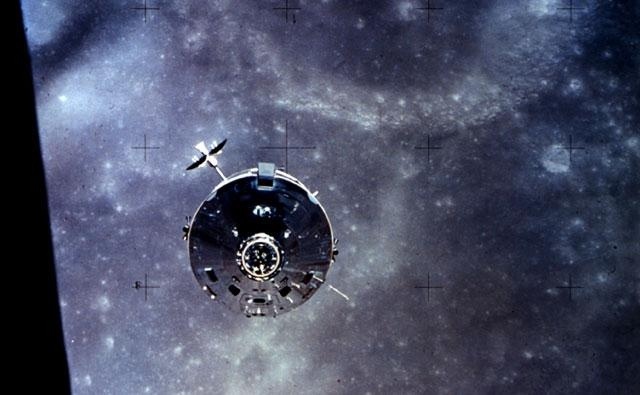
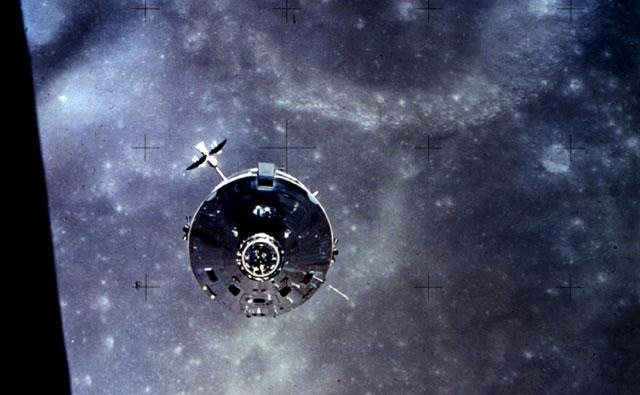
While his crewmates drove on the surface, Alfred Worden experienced something else entirely. Alone in the command module Endeavour, he was the most isolated human being in existence. He performed the first-ever deep-space EVA, a spacewalk conducted 196,000 miles from Earth to retrieve film canisters from the side of his craft. He saw the full disc of the Earth and the full disc of the Moon. A perspective no one has had since.

Apollo 16: The Mission That Proved Everyone Wrong

By April 1972, the public’s fascination with the Moon was waning. The missions were starting to feel… routine. But Apollo 16 would prove that the Moon still held shocking surprises.

The crew was a mix of veteran and rookie. Commander John Young was a space legend, a stoic engineer on his fourth flight. Ken Mattingly, the Command Module Pilot, had been famously bumped from the Apollo 13 crew at the last minute due to measles exposure; this was his redemption. And Charlie Duke, the Lunar Module Pilot, was known for his unbridled enthusiasm—he had been the capcom who guided Apollo 11 down to its landing.

They were headed to a place unlike any other: the Descartes Highlands. Geologists on Earth were convinced this was a region of ancient, smooth volcanic plains. They sent Young and Duke to find and sample volcanic rocks to prove their theory.

There was just one problem. The theory was completely wrong.

20130526-211145.webp

A Violent, Shattered World

As soon as Young and Duke stepped out of their lander, Orion, they knew something was off. There were no smooth volcanic flows. The ground was a chaotic jumble of white soil and sharp, angular rocks cemented together. Everywhere they looked, they saw breccia—rocks shattered and fused together by violent meteorite impacts.

The scientists in Houston were baffled. For three days, they pushed Young and Duke to find just one piece of volcanic rock. The astronauts searched tirelessly, driving their rover up the side of Stone Mountain, but found nothing. The Descartes Highlands weren’t formed by fire from within, but by cataclysmic bombardment from without. The entire mission was based on a false premise.

But this “failure” was actually a monumental discovery. It revealed that the Moon’s early history was far more violent than anyone had imagined. It reshaped our understanding of how planets form.

John Young, ever the character, provided some of the most memorable moments on the surface. He drove the LRV like a rally car, setting the unofficial lunar speed record. He tripped over his own feet. He complained about the gas from the orange juice he was drinking. And he was caught on a hot mic expressing his true feelings about his work: “I’m not going to complain, but I’ll tell you one thing. In the C-130, you don’t have to do all this chickens**t.”

The Conspiracy Corner: Flashing Lights and Hidden Structures?

Of course, no Apollo mission is complete without its share of high strangeness. And Apollo 16 has a few doozies.

While orbiting alone in the command module Casper, Ken Mattingly reported seeing a flashing object that he tracked for some time. He even drew a picture of it for the debriefing. The official explanation is that it was likely a piece of equipment from the lunar module, but the description has fueled decades of speculation among UFO researchers. What did a veteran pilot, a trained observer, actually see in the silent blackness?

Then there’s the photographic evidence. A particular image from the surface, AS16-107-17446, has become famous online. In the far distance, behind a lunar hill, some observers claim to see a massive, artificial-looking structure. A dome? A tower? Skeptics dismiss it as a lens flare or a flaw on the film emulsion. But to others, it’s a tantalizing hint that we weren’t being shown everything.

The Echoes of Apollo

These missions—the comeback, the expedition, and the surprise—were far from being simple footnotes to Apollo 11. They were the heart of the program. They were where the real, dangerous, and groundbreaking exploration took place. They were missions of human error and human genius, of greed and of breathtaking discovery.

They took us from the brink of failure at Fra Mauro, to the majestic canyons of Hadley Rille, to the shattered highlands of Descartes. They taught us more about the Moon’s true history than we could have ever imagined. They also left us with nagging questions, strange stories, and mysterious images that continue to fuel debate to this day.

Now, as the Artemis generation prepares to go back, they are building on the legacy of these forgotten giants. What new secrets will they find waiting in the lunar dust? And what mysteries from these missions of the past will they finally solve?

Amit Ghosh
Amit Ghoshhttps://coolinterestingnews.com
Aloha, I'm Amit Ghosh, a web entrepreneur and avid blogger. Bitten by entrepreneurial bug, I got kicked out from college and ended up being millionaire and running a digital media company named Aeron7 headquartered at Lithuania.
RELATED ARTICLES
- Advertisment -

Most Popular

Recent Comments

Warren Pan Abbott on The legend of the Devil Monkey !
chris davies on The McPherson Tape Mystery
Reed Reedly on ET has Internet!
Bea Houseoffashion on Proof Of Time Travellers – Gallery
Marcus2012 on ET has Internet!
Reed Reedly on ET has Internet!
LaughsAtConspiracyNuts on The 9/11 Conspiracy – Myths and Facts
Alex Sliverman on Did the ancients fly?
Doctor Wholigan on Time Traveler in 1938 film
chris davies on The McPherson Tape Mystery
Archie1954 on 10 secret UFO hideouts
chris davies on Ghosts of flight 401
Marcus2012 on ET has Internet!
jason Macdonald on Proof of Time Travel? – China
chris davies on Long-Lost Pyramids Found?
Reed Reedly on ET has Internet!
Milkman on Connected Universe
Tenmiles on Baigong Pipes Mystery
Simon Foster on Sirius – The Documentary
From the 1st April on 2013 – Alien Contact date ?
SkyWatcher on Is ET ignoring us?
I Come From The Future on Obama to make UFO Alien disclouser soon ?
Just another person on 2013 – Alien Contact date ?
Malcolm Windowcleaner on The strange case of Rudolph Fentz
Mason Servio on Strange Things on Mars
Marke Wisdom Seeker on What will we find as arctic melts?
Andrea A Elisabeth Levyne on Aliens Captured in Varginha, Brazil
Mitch Grouyeki on Amazing Space Shuttle pictures