Home Weird World Strange Places Mysterious lines show up in the Caspian Sea

Mysterious lines show up in the Caspian Sea

0
73

The Caspian Sea’s Alien Scars: What Is Gouging the Bottom of the Ocean?

Stop what you’re doing. Look closer at that image. Stare at it until your eyes hurt.

From 438 miles up, floating in the cold, silent vacuum of space, our world can look serene. Peaceful. But sometimes, our orbital watchmen, our satellites, capture something that shatters the calm. Something that just doesn’t make sense.

This is one of those times.

Caspian Sea

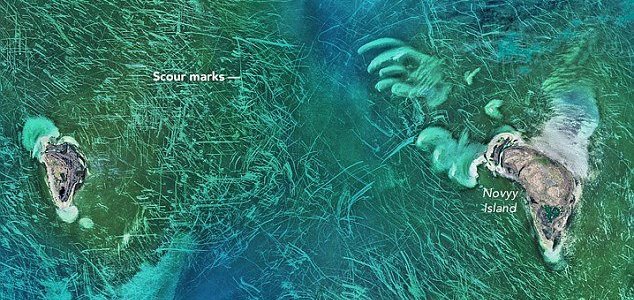
What are you looking at? It’s the northern Caspian Sea, specifically the Tyuleniy Archipelago near a place called Novyy Island. But that’s just geography. That’s not what you’re *seeing*. You’re seeing a wound. A vast, chaotic network of scars clawed into the skin of the Earth. It looks like a cosmic-sized Brillo Pad was used to scrub the seabed clean of… something. Or, perhaps, to write something.

A message? A warning? The remnants of a forgotten battle?

When scientists at NASA’s Goddard Space Flight Center first saw this image from the Landsat 8 satellite, they were, in their own words, perplexed. That’s a powerful word for NASA. They deal with exploding stars and black holes. Perplexing them takes work. And these lines, these impossible, crisscrossing gouges, did the job.

The internet, of course, exploded. And for good reason. The official explanations started to trickle out, but did they really hold water? Or were they just a convenient way to close the book on a mystery that cuts a little too deep?

Let’s peel back the layers. Because the easy answer is almost never the whole truth.

Theory 1: A Message from the Deep (Or the Stars)

Before we get to the “official story,” let’s entertain the ideas that send a shiver down your spine. The ones that feel more… significant. Could these lines be intentional?

Think about it. We send messages into space, hoping someone is listening. The Arecibo message. The Golden Record. We draw patterns in our own deserts, the Nazca Lines of Peru being the most famous example, their purpose still fiercely debated. What if we’re not the only ones who think in symbols and patterns?

Could these Caspian marks be a form of communication? Not for us, perhaps. Not meant to be seen from above. Maybe it’s a message from one underwater intelligence to another. Or worse, a marking. A territory claim. A “Keep Out” sign on a planetary scale. The sheer scale is mind-boggling. The chaotic overlap suggests a message written, erased, and rewritten over centuries. Millennia, even.

The patterns aren’t quite random, are they? Look for yourself. You can see parallel lines. Strange, almost geometric intersections. It feels like a language that operates on principles we can’t begin to comprehend. A language written not with ink, but with force, dragging something immensely heavy across the floor of the world’s largest inland sea.

What if It’s a Landing Grid?

Another popular theory floating around online forums is that this isn’t a message, but a mechanism. A navigational grid. Or the foundation for a massive underwater structure. In the world of ancient astronaut theorists, a common idea is that extraterrestrial visitors would need massive, easily identifiable landmarks to navigate our planet. Could this be one of them? A kind of submerged landing strip, its energy signature visible only to technologies we don’t possess?

The chaos could be the result of countless arrivals and departures over eons, each one leaving its own unique scar on the seabed. It’s a wild thought. But when you’re looking at something this bizarre, are any thoughts truly off the table?

Theory 2: The Scars of a Sunken Civilization

Maybe the answer isn’t in the stars, but buried beneath the waves. The Caspian Sea isn’t a static, unchanging body of water. Its history is violent and unpredictable. Water levels have risen and fallen dramatically over the ages, swallowing entire coastlines and the cities built upon them.

Is it possible we’re not looking at scratches, but at the ghost of a city? The faint outlines of an ancient, submerged metropolis? A Caspian Atlantis.

Deep Dive: The Shifting Ghost of the Caspian

To understand this, you need to know a little about the Caspian’s insane history. It’s a world unto itself. Geologists call it an “endorheic basin,” a fancy term for a closed body of water that doesn’t flow out to the ocean. This means its water level is a brutal tug-of-war between river inflow (mostly from the Volga River) and evaporation.

In the 20th century alone, the water level dropped by nearly 10 feet. But go back further, and the changes are catastrophic. We’re talking swings of hundreds of feet. Entire regions of the northern Caspian, which are incredibly shallow today, were once dry land. Fertile plains, perfect for settlement. And before that, they were deep underwater. This cycle has repeated over and over.

Ancient historians like Herodotus wrote of civilizations around the Caspian. Legends persist in the region of sunken fortresses and flooded cities. The legendary underwater realm of Sadko in Russian folklore, or the submerged fortress of Sabayil, partially visible off the coast of Baku only during periods of low water. These aren’t just fairy tales; they’re cultural memories of a changing world.

So, what if these lines are the remnants of such a place? Not the buildings themselves, but the agricultural patterns. The irrigation canals. The foundational grids of a massive settlement, scoured and distorted by millennia of currents and, yes, ice. But the original pattern, the “unnatural” geometry that still peeks through, could be the last will and testament of a civilization we never knew existed.

Theory 3: Secret Wars and Sunken Machines

Let’s get modern. The Caspian Sea is a hotbed of geopolitical tension. It’s bordered by Russia, Iran, Kazakhstan, Turkmenistan, and Azerbaijan. That’s a lot of military power and a lot of oil, all crowded around one big lake.

During the Cold War, this was Soviet territory. A black box of secrets. Submarine pens, naval bases, and weapons testing sites were scattered across its shores, many of them still off-limits today. The stories of Soviet “Ekranoplans” – massive, bizarre sea-skimming ground-effect vehicles – are real. They looked like something from science fiction, and they were tested right here, on the Caspian.

Could these marks be the result of something similar? The tracks of some colossal, secret underwater machine? A seabed dredger searching for resources? Or perhaps the scars from dragging massive arrays of listening devices or anti-submarine nets across the bottom?

The chaotic pattern could represent decades of secret military drills, a silent underwater training ground hidden from prying eyes and spy satellites, until one day the water was clear enough, and the Landsat 8 was in the right place at the right time. The secrecy of the Soviet era and the continued military presence in the area makes this a chillingly plausible scenario. Something big was happening on the Caspian floor. And maybe it still is.

The Official Story: What “They” Say Is Happening

Alright. After all that, NASA and the scientific community did offer an explanation. One that is neat, tidy, and feels… a little too simple.

They call it “ice gouging” or “ice scour.”

The story goes like this: The northern Caspian is absurdly shallow. In the area of the photograph, the water is only about 10 feet deep. That’s less than the deep end of a public swimming pool. In the winter, the sea surface freezes over, but the ice is also relatively thin, maybe a foot and a half thick.

Now, this isn’t a smooth, perfect sheet of ice like a skating rink. Wind and currents break it up, push it around, and pile it into jagged, chaotic formations. The pressure can force some pieces of ice to rotate and jut downwards, creating a kind of icy keel. These jagged underwater ice formations are called “hummocks.”

When a big hummock’s keel is deep enough to touch the seabed, and the wind and currents are strong enough to keep pushing the massive ice floe on the surface, that icy tooth gets dragged across the muddy bottom. One storm might create a few gouges. A whole winter of storms, with ice floes moving back and forth, turning and grinding, could theoretically create the dense, overlapping pattern we see.

But Does It Really Add Up?

On the surface, it makes sense. It’s a known phenomenon. We see it in the Arctic. We see it in other shallow, icy waters. But is it the *whole* story here?

This is where the digital detectives of the internet come in. People who spend hours pouring over satellite data have raised some uncomfortable questions.

First, the sheer density. The entire area looks like it’s been rototilled. Can wind and currents, which are generally regional and directional, create such a perfectly chaotic, non-directional mess? Many patterns seem to double back on themselves in ways that defy simple A-to-B movement.

Second, the intricacy. Some of the lines appear remarkably parallel for long stretches. Others intersect at almost perfect right angles. While nature can produce geometric shapes, this level of complexity has caused many to argue it looks more “organized” than the random drift of ice would suggest.

Third, the location. Why is this specific spot in the Tyuleniy Archipelago so intensely scarred, while other shallow areas of the Caspian are not? Is there something unique about the seabed composition here? Or something *under* the seabed that is interacting with the ice above?

The official explanation feels like it answers the “how” but completely ignores the “why.” Why this incredible, artistic-looking chaos here and nowhere else? It closes the case, but it doesn’t satisfy the soul. It feels like explaining away the Mona Lisa by just listing the chemical compounds in the paint.

The Verdict Is Still Out

So where does that leave us? We have a stunning, mysterious image beamed down from space. We have a collection of wild, fascinating theories involving aliens, ancients, and secret armies. And we have a neat, scientific explanation that feels… incomplete.

The truth is, the Caspian Sea keeps its secrets well. It is an ancient and enigmatic place, a cradle of civilizations and a graveyard of empires. It has swallowed cities and hidden the strange experiments of a superpower.

Maybe the answer is exactly what they say it is. Just ice. A simple, elegant, natural process that, under the right conditions, can create something that looks profoundly unnatural to our pattern-seeking human brains.

Or maybe… just maybe… we stumbled upon something we weren’t supposed to see. The faded blueprint of a lost world. The landing coordinates for visitors from another. Or the silent evidence of a war fought in the murky depths, far from human eyes.

The lines are still there, etched into the mud at the bottom of the Caspian Sea. They are not going anywhere. And as long as they remain, the questions will too. The official story is written. But the mystery is far from solved.

Originally posted 2016-05-04 22:00:33. Republished by Blog Post Promoter