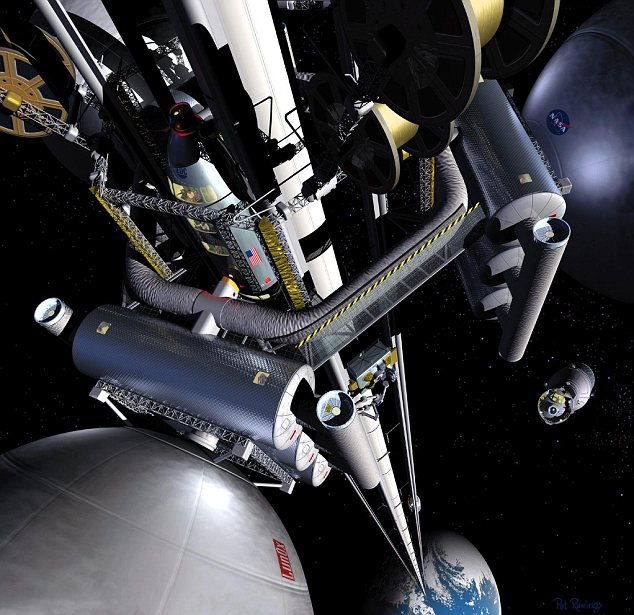
The Elevator to the Moon: The Suppressed Sci-Fi Dream We Could Build Today
Forget rockets. Forget the fire, the fury, the astronomical cost of blasting a metal can through the atmosphere. I want you to consider a different idea. An idea so audacious, so profoundly simple, it sounds like pure science fiction.
What if we could just… ride to space?
In an elevator.
A quiet, electric-powered car climbing a ribbon of impossible strength, stretching from the ground to the stars. A cosmic highway. A permanent bridge to the heavens. It’s a concept that has lived in the pages of novels for decades, but what if I told you a group of renegade NASA engineers tried to make it a reality? What if I told you the technology isn’t the problem? The problem might be something else entirely.
Something they don’t want you to know.

This isn’t just a fantasy. This is the story of LiftPort Group, a tiny company with a titanic vision, and their wild plan to build an elevator… on the Moon.
The Gravity Prison: Why Getting to Space is So Hard
Before we get to the Moon, you have to understand the fundamental problem. Earth is a prison. A very pleasant prison, but a prison nonetheless. And the warden is gravity.
Every single space mission in history, from Sputnik to SpaceX, has been a violent, brute-force prison break. The concept is called a “rocket equation,” and it’s a tyrant. To get a tiny payload to orbit, you need a mountain of fuel. To lift that fuel, you need *more* fuel. It’s an exponential nightmare of controlled explosions. Over 90% of a rocket’s weight is just the propellant needed to get it off the ground.
Think about that. It’s like using a stick of dynamite to push a feather across a room.
It’s inefficient. It’s dangerous. It’s unbelievably expensive, costing thousands of dollars for every single pound sent to orbit. This is the single biggest barrier to humanity becoming a true spacefaring species. The gravity well is deep, and climbing out of it is a battle.
But what if you didn’t have to fight?
What if you could just… climb?
Deep Dive: The Nuts and Bolts of a Cosmic Elevator
So how does this impossible machine even work in theory? It’s surprisingly elegant.
Picture a string with a ball tied to the end. When you spin it around, the ball pulls outward. That’s centrifugal force. Now imagine that string is incredibly long and strong. One end is anchored to the Earth’s equator. The other end, far out in space—over 22,000 miles up—is attached to a massive counterweight, maybe a captured asteroid or a heavy space station.
The Earth rotates once a day. Because the cable is anchored to the equator, it rotates too. The counterweight at the top is flung outwards by this rotation, pulling the cable taut. Perfectly taut. It becomes a rigid, stationary track stretching from the surface into geosynchronous orbit.
An invisible sky-hook, hanging in the sky.
Once the ribbon is in place, you send up “climbers.” These are essentially robotic elevator cars, powered by electricity beamed up from the ground or by massive solar panels. They would clamp onto the ribbon and just… crawl. Up and down. Quietly. Efficiently. Carrying cargo, supplies, and eventually people, from Earth to a space station for the cost of an electric bill.
It would change everything. The cost to get to orbit would plummet from thousands of dollars per pound to maybe just a few dollars. It would be a freight train to the solar system.
The “Unbreakable” Rope: The Dream’s Achilles’ Heel?
There’s always a catch, right? For the space elevator, it’s the rope. The ribbon. The cable.
The material required to withstand the immense tension of being stretched from Earth to space simply hasn’t existed. Not on a commercial scale. Steel? Snaps. Kevlar? Snaps. Any normal material would collapse under its own weight long before it reached orbit.
You need something magical. Something with the tensile strength of science fiction. For years, the great hope was carbon nanotubes. Rolled-up sheets of single-layer carbon atoms, theoretically stronger than any material ever conceived. Then came graphene. The potential was there, but manufacturing a flawless, 22,000-mile-long ribbon of it was another story.
The official line is that we’re still decades away from solving the material science problem. It’s the reason the whole concept remains on the drawing board.
Or is it?
This is where our story takes a turn. Because a group of forward-thinkers realized they were trying to solve the problem on the hardest possible level. They decided to change the game, to pick an easier starting point.
They decided to go to the Moon first.
Enter LiftPort: The Mavericks Who Saw a Lunar Shortcut
In the early 2000s, a former NASA engineer named Michael Laine founded the LiftPort Group. He and his team were true believers in the space elevator. They built robotic climbers. They tested miles of carbon tethers suspended from balloons. They were pushing the boundaries. But they kept hitting the same brick wall: the sheer, brutal gravity of Earth.
So they pivoted. Their logic was brilliant.
If Earth is a “Level 10” difficulty problem, what’s a “Level 2” version? The Moon.
In 2012, they launched a Kickstarter campaign. It wasn’t to fund a full-blown lunar elevator, but to fund the very first step: a feasibility study and the development of the core tech here on Earth, using high-altitude balloons to test a 2km-high “elevator.” The ultimate goal was to build the Lunar Space Elevator. A permanent ribbon connecting the surface of the Moon to a space station orbiting above it.
And here’s why that’s not nearly as crazy as it sounds.
Why the Moon is the Perfect Cosmic Test Lab
Building an elevator on the Moon solves almost every major problem that plagues the Earth-based version. It’s an almost perfect shortcut.
- The Gravity is a Joke: The Moon’s gravity is only one-sixth of Earth’s. This is a game-changer. The strain on the elevator ribbon would be massively reduced. So much so that you wouldn’t need a mythical, unobtainable material. According to their studies, a lunar elevator could be built with materials that *already exist*, like a super-strong polymer called Zylon. The biggest roadblock? Gone.
- No Pesky Atmosphere: Earth’s atmosphere is a nightmare. You have wind, storms, lightning, and corrosive oxygen. In the vacuum of the Moon, the ribbon is perfectly stable. There’s no weather to worry about. No wind shear to rip the climbers apart.
- Slower Spin, Stable Anchor: The Moon rotates much slower than Earth, and it’s tidally locked. This makes the physics of anchoring a ribbon far simpler. The ideal anchor point wouldn’t even be in orbit, but at a gravitationally stable spot between the Earth and Moon called the L1 Lagrange Point. A station there would just hang in place, providing the perfect counterweight.
The plan was shockingly plausible. First, land a robotic anchor on the Moon’s surface. Then, a spacecraft at the L1 point would lower the spool of Zylon ribbon down to it. The anchor grabs on. The ribbon is pulled taut. And just like that, you have a highway.
Robotic, solar-powered climbers could start hauling equipment, building materials, and supplies from the lunar surface to the spaceport. It would open the Moon up in a way we can’t even imagine. Mining for rare resources like Helium-3 to power fusion reactors on Earth? Building massive radio telescopes on the far side, shielded from Earth’s noise? Establishing a permanent, self-sustaining human colony?
It all becomes possible. Not just possible, but economically viable.
So… Where Is It? The Silence and the Conspiracy
LiftPort’s Kickstarter was a modest success. They raised some money, did some research, and continued their work on high-altitude platforms. But the grand lunar dream? It faded from the headlines.
The official story is the usual one: lack of funding. The world wasn’t ready. The big aerospace players, with their billions invested in traditional rockets, had no interest in a disruptive technology that would make their entire business model obsolete.
But the whispers online tell a different story.
Is it possible they got too close? Is it possible the material science problem *was* solved, decades ago, within the shadowy confines of black budget military projects?
Think about it. An elevator to space would democratize it. It would make it cheap and accessible. Corporations, universities, even private citizens could gain access to the high frontier. This is a nightmare for any group that currently holds a monopoly on space access. A technology this revolutionary doesn’t just get ignored because of “funding issues.” It gets controlled. Or it gets buried.
What if the technology is already in use? Part of a secret space program we’re not supposed to know about? A quiet, undetectable way to move massive amounts of material to clandestine bases on the Moon or Mars. It sounds like a movie plot, but every year, more and more credible whistleblowers come forward with stories that make you wonder.
The Spinoff Tech: A Clue in Plain Sight?
Part of LiftPort’s plan involved developing Earth-based applications for their technology. They talked about their 2km high balloon-suspended platforms acting as cheap communication towers, providing internet to remote areas. They could monitor forest fires, watch over crops, or provide an eye-in-the-sky after a natural disaster.
A noble cause, certainly.
But it’s also the perfect cover. A persistent, high-altitude platform that can stay in one place for months is an incredible tool for surveillance. It’s a “poor man’s satellite” with applications far beyond rural Wi-Fi. Could the development of this “spinoff” tech have been the real prize for certain three-letter agencies?
The dream of a lunar elevator might just be the public-facing story for a much deeper, more classified reality.
The Dream Isn’t Dead, It’s Just Waiting
The concept of the space elevator hasn’t gone away. Other companies and even national space agencies continue to research the idea. The physics works. The engineering is sound. The only barrier—the “official” barrier—is the material.
But the LiftPort saga serves as a powerful reminder. A reminder that sometimes the most elegant solutions are overlooked. That the direct path isn’t always the smartest. Their lunar-first approach was a stroke of genius, a way to sidestep the impossible and achieve the incredible with the tools we already have.
It forces us to ask the hard questions. Are we really stuck in this gravity well because of a materials problem? Or are we being held back by a system that profits from the status quo? A system that prefers its rockets loud, expensive, and exclusive?
The next time you look up at the Moon, don’t just see a cratered, lifeless rock. See a construction site. See the anchor point for a highway to the rest of the solar system. The elevator is coming. The only real question is who will get to ride it, and whether the first one hasn’t already been built in secret.
The ribbon is out there. The climbers are ready. The journey to the stars might be a quiet hum, not a deafening roar.
Originally posted 2016-03-26 20:27:57. Republished by Blog Post Promoter