Home Weird World Collapse: toppled apartment building in Shanghai

Collapse: toppled apartment building in Shanghai

0
78

The Skyscraper That Laid Down for a Nap: Shanghai’s Unbelievable Building Collapse

Picture it. Shanghai. A city that screams “future,” a forest of steel and glass piercing the clouds. You’ve just sunk your life savings into a brand-new apartment in a gleaming residential complex. Your dream home. You’re weeks, maybe days, away from moving in.

Then you get a call.

There’s been an… incident. A problem. You rush to the site, and you see it. Your building, a 13-story monument to modern living, is no longer standing. It’s not a pile of rubble like you see in disaster movies. No, it’s something far stranger. Far more chilling.

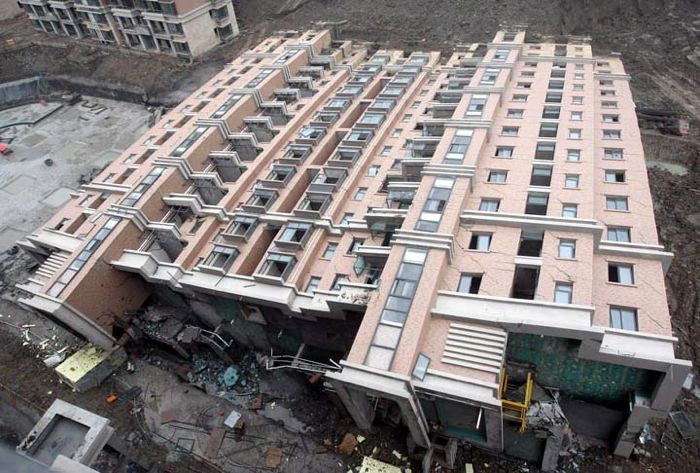
It’s lying on its side. Perfectly intact. As if a giant child simply got bored and tipped it over.

This isn’t a hypothetical nightmare. This is exactly what happened on June 27, 2009, in the Minhang district of Shanghai. One of the strangest, most surreal structural failures in modern history. The official story is a tidy little tale of dirt, water, and bad planning. But when you dig deeper, the neat explanations start to crack, revealing a much darker story of greed, corruption, and a disaster that was almost infinitely worse.

So, how does a 13-story building just… fall over?

Shanghai

The Day the Giant Fell

The morning of June 27th started like any other. The “Lotus Riverside” (莲花河畔景苑) complex was a hive of activity. Block 7, the building in question, was nearly finished. The skeleton was up, the windows were in. It was a concrete ghost, waiting for life to fill its halls.

Around 5:30 AM, the earth moved.

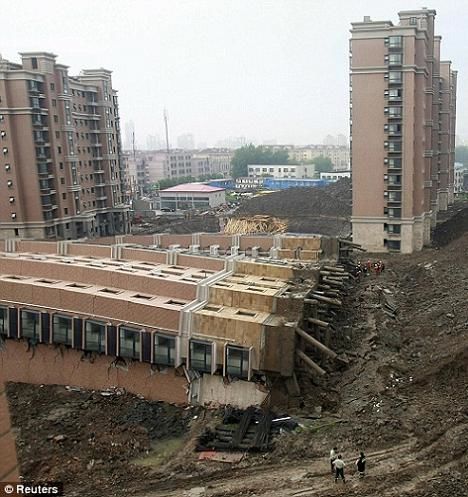
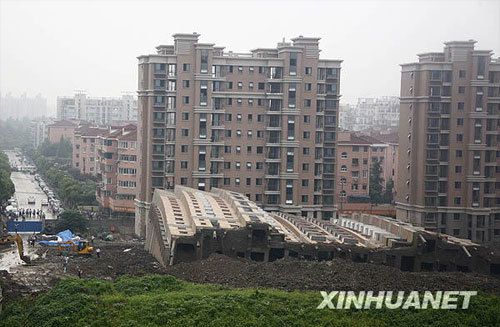
There wasn’t a Hollywood explosion. Just a groan. A sickening shift. Then, with a sound that witnesses described as a low, drawn-out thunder, the entire building began to pivot. Slowly, then all at once, it toppled over towards the south, its concrete foundation piles snapping like dry twigs. It landed with a cataclysmic thud, kicking up a tidal wave of mud and debris.

Miraculously, the building itself didn’t shatter. It remained eerily whole, a fallen giant at rest. But the human cost, while not what it could have been, was still tragic. A single construction worker, a 28-year-old man named Xiao, was killed. He had reportedly finished his shift but ran back into the doomed structure to retrieve his tools. A final, fatal act of diligence.

The real miracle? The building was empty. Over 480 apartments had already been sold. Hundreds of families were preparing to start new lives there. Had this happened just a few months later, the death toll would have been catastrophic, a national tragedy. Instead, it became a national spectacle. A symbol of something deeply wrong.

The Official Story: A Tale of Dirt and Water

The authorities scrambled. The images were already going viral on the nascent Chinese internet. The government needed an explanation, and they needed it fast. Within days, the official investigation delivered a verdict that seemed almost comically simple.

It was all about a hole and a hill.

Deep Dive: The Physics of a Toppled Tower

Here’s the breakdown, the official version of events. It’s a lesson in how simple mistakes, amplified by massive weight and pressure, can lead to total disaster.

First, the hole. On the south side of Block 7, workers were excavating a massive underground parking garage. They dug down 4.6 meters (about 15 feet), creating a huge pit right next to the building’s foundation. This removed a massive amount of soil that was helping to support the building from that side.

Second, the hill. Where did all that excavated dirt go? They didn’t haul it away. No, to save time and money, they piled it up on the *other* side of the building, the north side. They created an artificial hill of soil, 10 meters (over 30 feet) high.

See the problem? They created a massive imbalance of lateral pressure.

  • On the south side: A deep pit. No pressure pushing back against the foundation. A vacuum of support.
  • On the north side: A 30-foot mountain of heavy earth. Immense pressure pushing *on* the foundation.

The building was being squeezed from one side and left unsupported on the other. Then came the final ingredient: water. Days of heavy rain saturated the giant dirt pile, making it even heavier. The nearby Dianpu River swelled, raising the water table and turning the ground to mush. The pressure became unbearable. The foundation piles, the concrete stilts driven deep into the earth that held the whole thing up, were subjected to forces they were never designed to withstand.

They buckled. They snapped. And the whole building pivoted over the breaking point, falling into the very hole the workers had dug.

Shanghai 2

A Deeper Problem: The “Tofu-Dreg” Epidemic

Case closed, right? A simple, tragic construction error. But for millions of Chinese citizens, and for watchers around the world, this explanation felt too convenient. It blamed the *process*, but it didn’t touch on the deeper sickness that many believed was the real cause: China’s rampant “Tofu-Dreg” culture.

“Tofu-dreg projects” (豆腐渣工程, dòufuzhā gōngchéng) is a scathing Chinese term for shoddy, poorly-built public works. The name comes from the mushy pulp left over after making tofu—something that looks solid but crumbles at the slightest touch. It’s a phrase used to describe bridges that collapse, roads that crack, and schools that fall down in earthquakes while government buildings next door remain untouched.

The Lotus Riverside collapse happened at the peak of China’s construction frenzy. The country was urbanizing at a speed never before seen in human history. Cities exploded overnight. And in the mad rush to build, build, build, corners were cut. Inspections were pencil-whipped. Bribes were paid to officials to look the other way. It was a gold rush, and safety was often an afterthought.

Was the Lotus Riverside collapse just a simple mistake? Or was it an inevitable symptom of a system that valued speed and profit above all else? The public certainly thought so. The hundreds of families who had bought homes in the complex were furious, not just at the developer, but at the government they felt had failed to protect them.

Beyond the Official Report: Whispers from the Web

While the official story dominated the news, a different narrative was taking shape online. In forums and on early social media platforms, citizen investigators and angry homeowners began asking the questions the government didn’t want to answer. The neat story of a hole and a hill just wasn’t enough.

Conspiracy Theory #1: The Phantom Piles

The official report blamed the immense pressure that snapped the foundation piles. But what if the piles themselves were garbage? The photos of the upturned foundation showed surprisingly short and thin concrete pilings. Were they built to the proper specifications? Rumors flew that the developers had used substandard concrete, perhaps mixed with cheaper sea sand which corrodes steel, or simply not enough steel rebar inside. Some even whispered that the construction company faked the geological surveys, sinking the piles into soft mud instead of driving them all the way down to bedrock to save money. If the foundation was “tofu-dreg” from the start, the dirt pile was just the final push, not the sole cause.

Conspiracy Theory #2: The Domino Effect Cover-Up

Look at the photos. Block 7 didn’t exist in a vacuum. It was one of nearly a dozen identical buildings in the complex. They were all built by the same developer, using the same methods, on the same plot of land. If Block 7’s foundation was a ticking time bomb, what about Block 6? Block 8? The entire complex?

This is where the story gets truly terrifying. Subsequent investigations, pushed by the furious homeowners, revealed that the *other buildings were also compromised*. Cracks were found. Some were reportedly tilting. The collapse of Block 7 wasn’t a freak accident; it was a warning shot. The only thing that prevented a dozen buildings from eventually collapsing and killing thousands was that one of them fell down first. Was the “simple mistake” narrative pushed so hard to prevent a full-blown panic and a housing market crash in the entire district?

Shanghai 3

Conspiracy Theory #3: A Deliberate Demolition?

This one is on the fringes, but it’s too strange not to mention. Some online theorists, pointing to the incredible intactness of the fallen building, suggested the collapse was too… clean. They proposed that perhaps the developers discovered a fatal, unfixable flaw in the building’s core structure. Rather than report it and face financial ruin and jail time, they used the ongoing excavation work as a cover. Could they have deliberately destabilized the ground, hoping to trigger a “controlled” collapse that could be blamed on a simple mistake? It sounds like something out of a movie, but in a world of massive corruption, people wondered if anything was off the table.

The Fallout: A Ghostly Landmark and Broken Trust

In the aftermath, the government had to act. Heads rolled. Six people, including the property developer and the construction supervisor, were arrested and eventually sentenced to prison. The furious homeowners, after staging public protests, were offered refunds and some compensation, though many felt it wasn’t enough for the fraud and terror they had endured.

For months, the fallen building remained where it lay. It became a bizarre tourist attraction, a pilgrimage site for architects, engineers, and morbidly curious onlookers. It was a horizontal skyscraper, a monument to a mistake, a warning written in 13 stories of concrete and steel. Eventually, the silent giant was broken apart and hauled away, leaving an empty space where a community was supposed to grow.

The story of the Lotus Riverside collapse is more than just a weird anecdote. It’s a chilling parable for our modern age. It shows how the relentless pursuit of progress can ignore the fundamental laws of physics. It reveals how a system that lacks transparency can allow small acts of greed and negligence to snowball into a potential catastrophe.

We see the shocking pictures and think, “That could never happen here.”

But could it?

Every time a regulation is weakened, every time an inspector is bribed, every time a company chooses the cheapest materials over the safest ones, a little bit of dirt is moved from one side of the foundation to the other. And you never know which rainstorm will be the one to send the whole thing toppling over.

The ghost of Block 7 still haunts Shanghai. And it asks a terrifying question: How many other buildings, in how many other cities, are just waiting for the right push?

Originally posted 2016-03-15 18:54:18. Republished by Blog Post Promoter