Japan’s “Space Cannon”: The Cosmic Heist That Changed Everything We Thought We Knew
Forget what they taught you in school. Forget the neat, tidy diagrams of the solar system. The real story of our origins isn’t written in textbooks. It’s floating out there, in the cold, silent dark. And sometimes, to read it, you have to blast it open with a cannon.
That sounds like science fiction. It’s not.
Back in 2013, a quiet announcement rippled out from Japan’s space agency, JAXA. They had successfully test-fired a “space cannon.” A device designed for one, mind-bending purpose: to shoot a metal slug at an asteroid hundreds of millions of miles away. The official story was about searching for the origins of the universe. A noble goal, to be sure. But as always, the official story is just the surface layer. The beginning of the rabbit hole.
What they were really launching was the most ambitious cosmic heist in human history. A mission to steal a secret. A secret locked inside a 4.5-billion-year-old rock. A secret that could rewrite our very identity.
And the craziest part? It worked. The story is no longer about what they planned to do. It’s about what they found. And what they found is more shocking, more profound, than anyone dared to imagine.
More Than a Mission: A 300-Million-Mile Gamble
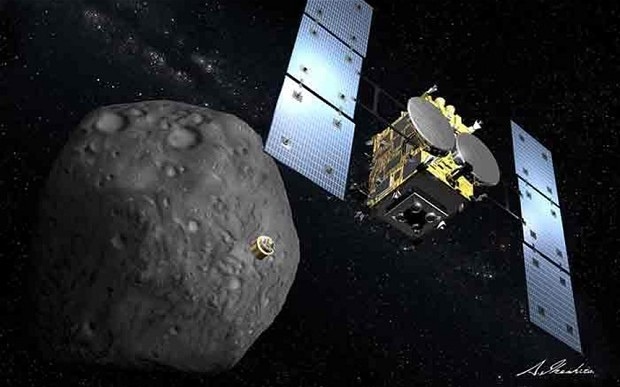
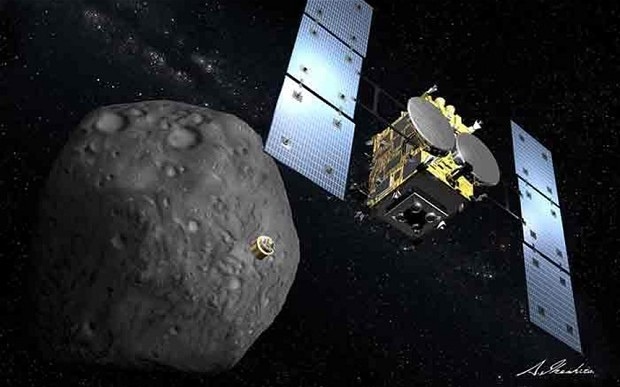
The probe was called Hayabusa-2. A name that means “Peregrine Falcon” in Japanese. A predator. Its target was a tiny speck of cosmic debris known then as 1999JU3. It was a simple plan on paper, and an insanely complicated one in reality. Launch in 2014. Travel for four years across the empty void between Earth and Mars. Arrive at the asteroid in 2018. And then, the real action would begin.
This wasn’t a gentle fly-by. It wasn’t a passive observation. JAXA was sending a falcon to hunt. And it was bringing its own ammunition.

The plan was audacious. Once it reached the asteroid, Hayabusa-2 would release its weapon: the Small Carry-on Impactor (SCI). A space cannon. This device would then, remotely, fire a 4-pound copper projectile straight into the face of the ancient rock. Why? Because the surface of an asteroid is old news. It’s been battered by solar winds, cosmic rays, and radiation for billions of years. It’s a weathered, sun-bleached ruin. The real treasures, the pristine materials from the dawn of time, are buried just beneath.
They wanted to create a fresh, artificial crater. To expose the asteroid’s core material. Then, the mothership would swoop down, collect the debris, and bring it home. A smash and grab on a planetary scale.
The Target: A Spinning Diamond of Primordial Secrets
So, what was this rock, this 1999JU3? JAXA later gave it a much more fitting name: Ryugu. Named after a mythical undersea dragon palace from a Japanese folktale, where a fisherman finds a mysterious box he is told never to open. How perfect.
Ryugu is tiny, only about 3,000 feet across. And it’s shaped like a spinning top, or a rough-cut diamond. But its shape isn’t what makes it special. Ryugu is a “C-type” asteroid. The ‘C’ stands for carbonaceous. Think of it as a cosmic charcoal briquette, packed with carbon, organic molecules, and water. These are the very ingredients for life itself.
This isn’t just a rock. It’s a time capsule. A fossil from the solar system’s baby pictures, a leftover piece of the same primordial cloud that formed our sun, our Earth, and everything on it. It has been drifting, virtually unchanged, for 4.5 billion years. While Earth was being pummeled, melted, and reformed, Ryugu just floated. Waiting.
Why This Specific Rock in the Void?
Of all the millions of rocks hurtling through space, why Ryugu? Because it was the perfect target. It was close enough to reach. Its orbit was well understood. But most importantly, it was one of the darkest objects in our solar system, reflecting very little light. That darkness hinted at its carbon-rich composition. It hinted that Ryugu was a vessel, carrying the raw, uncorrupted building blocks of life.
The official JAXA statement said studying it could “revolutionise our understanding” of planet formation and the emergence of life. A stunningly bland way of saying it could tell us where we come from. For real.
DEEP DIVE: Deconstructing the Cosmic Shotgun
Let’s talk more about this “space cannon.” It wasn’t some laser blaster from a movie. It was a far more elegant, and brutal, piece of engineering. The Small Carry-on Impactor was essentially a shaped charge. An explosive lens designed to focus all its energy into propelling a copper lump at over 4,400 miles per hour.
Copper was chosen specifically because it’s a material not expected to be found on the asteroid, ensuring any copper detected in the crater later would be from the impactor itself, not the sample.
But the true genius was in the deployment. Firing a cannon in space creates recoil. It would have sent the Hayabusa-2 probe tumbling. So, they couldn’t fire it directly from the spacecraft. Instead, they had to release the entire cannon assembly, let it drift to its position, and then fire it remotely.
A Calculated Act of Cosmic Violence
The mission’s most dramatic moment was pure chaos. After releasing the SCI, the main Hayabusa-2 spacecraft had to perform a high-speed maneuver to *hide behind the asteroid*. It had to get out of the way. Fast. Because the impact would send a cone of high-velocity shrapnel and dust flying out from the surface, a deadly cloud that would have shredded the delicate probe.
Imagine it. A lonely robot, 300 million miles from home, drops a bomb and then frantically hides behind its target to survive the explosion. The level of risk was astronomical. So many things could have gone wrong. A miscalculation in timing, a failure in the thrusters, an unexpected fragmentation pattern… any of it would have doomed the entire multi-year, billion-dollar mission.
You have to ask yourself: why go to such violent, risky lengths? What could possibly be worth that gamble? What were they so desperate to find that they needed to blast their way in?
The Official Story… And the Questions They Don’t Want You to Ask
The public-facing goals were simple: learn about the solar system, test technologies for planetary defense (learning how to nudge a killer asteroid), and pave the way for future space exploration. All true. But they are also the perfect cover for a much deeper search.
This is where we peel back the layers.
What If They Found Evidence of Panspermia?
Panspermia. It’s the theory that life, or at least its core components, did not originate on Earth. That it came from space, hitching a ride on asteroids and comets that seeded our young, sterile planet. For a long time, it was fringe science. Now, it’s becoming disturbingly mainstream.
What if Hayabusa-2 wasn’t just looking for simple amino acids? What if they were looking for something more? Complex organic structures? Fossilized microbial life? If they found definitive proof that the building blocks of life came from space, it would shatter the foundations of biology and religion overnight. It would mean that life isn’t a fluke unique to Earth. It would mean the universe is hard-wired for it. That we are, all of us, aliens. Would they tell us? Or would a discovery that monumental be deemed too disruptive for public consumption?
An Ancient Alien Artifact?
Let’s push it further. The internet, of course, has its own theories. We live in an age where odd-shaped celestial objects like ‘Oumuamua are seriously discussed by top astronomers as potential alien probes. Ryugu is a 4.5-billion-year-old object. Could some of these C-type asteroids be more than just rocks?
Could they be dormant, ancient machines? Probes sent by a long-dead civilization, waiting for a sign? It sounds crazy, until you consider the logic. If you wanted to send a message or a seed of life across galactic timescales, you wouldn’t build it out of shiny metal. You’d disguise it as a common asteroid. You’d give it a carbon shell to protect it from radiation. You’d let it drift for eons. Maybe shooting it is the only way to get its attention. A long shot? Absolutely. But is it impossible? In a universe as vast and strange as ours, “impossible” is a dangerous word.
Firing the Starting Gun on a Trillion-Dollar Space Rush?
There’s another, far more pragmatic and cynical angle. The official JAXA statement mentions using “asteroid resources to facilitate human exploration.” That’s the tip of the iceberg.
These asteroids aren’t just full of carbon and water. They are loaded with platinum-group metals. A single, small asteroid could contain more platinum than has ever been mined in human history. We’re talking about figures in the trillions of dollars. Not billions. Trillions.
Was Hayabusa-2’s cosmic heist a scientific mission, or was it industrial espionage? A prospecting mission to analyze the purity of the ore and the feasibility of extraction. Was JAXA firing the first shot in a new, silent Cold War for the resources of the solar system? A cosmic gold rush that will make the millionaires of today look like paupers.
UPDATE: The Heist Succeeded. The Truth is More Shocking Than We Imagined.
Here’s where the story gets really good. This isn’t speculation anymore. The original post you read was from 2013, when this was all just a plan. But we are living in the future. The mission is over. And it was a staggering success.
The space cannon fired. The crater was formed. The brave little probe swooped down, not once, but twice, to collect samples. And in December 2020, a tiny capsule detached from the main craft and streaked through Earth’s atmosphere, a man-made shooting star landing safely in the Australian outback.
They got the treasure. They brought it home.
Black Dust from a Distant World
When scientists at JAXA finally opened the capsule, they found it. Just 5.4 grams of dark sand and dust. But it was the most precious 5.4 grams on the planet.
The results that have been trickling out since are nothing short of world-changing. The material is darker than any rock found on Earth. It’s almost perfectly black, absorbing nearly all light that hits it. A piece of the void itself.
And inside that black dust? They found what they were looking for. And so much more.
They confirmed the presence of liquid water trapped inside crystals. Water from the dawn of the solar system. Then came the bombshell. They discovered more than **20 different types of amino acids**. Let me repeat that. The fundamental building blocks of proteins, of life as we know it, were found on this random rock. Not just the simple ones. Complex ones.
But the final blow to our Earth-centric view was the discovery of Uracil. Uracil is one of the four nucleobases that make up RNA, a cousin to DNA that is critical for building proteins from the genetic code. Finding it, pristine and untouched, on an asteroid is as close to a smoking gun for panspermia as you can get without finding an actual alien waving at you.
The New Asteroid Race is On, and We’re Not Being Told Why
Japan isn’t alone. Just as Hayabusa-2 was wrapping up, NASA’s OSIRIS-REx mission was doing its own smash-and-grab at another C-type asteroid, Bennu. It, too, successfully collected a sample and returned it to Earth in 2023. China is planning its own asteroid sample-return mission. Suddenly, every major space-faring nation is obsessed with grabbing pieces of these dark, ancient rocks.
Is this a coincidence? Is this just friendly scientific competition? Or did the results from Ryugu send a shockwave through the world’s intelligence agencies? Did they find something so profound that a silent, urgent race began to secure more samples, to confirm the findings, or to search for something even more exotic?
What Comes Next?
The analysis of the Ryugu and Bennu samples will take decades. The official discoveries will be published in scientific journals, filtered through press releases, and presented in carefully managed statements. It’s the perfect mechanism to slowly acclimate the public to a new reality. A reality where Earth is not the cradle of life, but merely one of its many gardens.
The space cannon on Hayabusa-2 wasn’t just a tool. It was a statement. It was humanity banging on the door of the universe, demanding answers. The door creaked open. They brought back a handful of dust that proves we are not just from Earth, but from the stars. The question now is, what else is in that dust that they haven’t told us about yet?
They shot an asteroid and brought a piece of it back. They opened the dragon’s mysterious box. The secrets are now here, on Earth, sitting in a sterile lab. And we may only be seeing the beginning of the truth they unleashed.
![20131028-213949[1]](https://coolinterestingnews.com/wp-content/uploads/2013/10/20131028-2139491.webp)