They Lied To Us About Snakes: The 90-Million-Year-Old Secret in the Skull
Look at a snake. Really look. It’s an animal defined by what it *lacks*. No arms. No legs. No eyelids. Just pure, streamlined, primal form. It’s a creature that has haunted human nightmares and mythology for millennia. But what if the story of how they came to be is completely wrong?
For decades, the “official story” was simple, neat, and tidy. Snakes, they told us, came from the sea. Their ancestors were giant marine lizards, mosasaurs and their kin, who decided the ocean life was for them. The legs, useless in the water, simply withered away over millions of years, leaving the slithering form we see today. It made sense. It fit a narrative. The undulating motion of a serpent in the grass mimics a swimmer in the waves. Case closed.
But that story is falling apart.
New evidence, pried from the stone heart of a 90-million-year-old fossil, doesn’t just challenge this theory. It shatters it. The truth is stranger, darker, and far more interesting. Snakes didn’t lose their legs to conquer the oceans. They sacrificed them to master the world beneath our feet.

The Old Tale: Serpents of the Sea
Let’s go back. Before this new bombshell dropped, the scientific consensus was anchored in the water. The argument was compelling. During the Cretaceous period, the oceans were ruled by colossal marine reptiles. Among them were the mosasaurs, powerful aquatic lizards that could grow to terrifying sizes. Some scientists looked at the long, flexible spines and reduced limbs of these sea monsters and saw the blueprint for a snake.
The logic followed a straight path. A lizard-like ancestor ventures into the water. Swimming becomes its primary mode of movement. The tail flattens, becoming a powerful paddle. The body elongates. And the legs? They just get in the way. They create drag. Over countless generations, they shrink, becoming useless vestiges before disappearing entirely. It’s a classic evolutionary tale. Adapt or die.
Fossils with tiny, shrunken back legs, like *Pachyrhachis*, were found in marine sediments, seeming to cement the idea. This was the snake’s origin story, printed in textbooks and featured in documentaries. A story of a triumphant return to the sea.
But some things never quite added up. The skulls didn’t perfectly match. And a few renegade researchers kept pointing to a different possibility. A world not of water, but of dirt and darkness.
A Fossil’s Whisper from Patagonia
The key to blowing this whole mystery wide open wasn’t found in some ancient seabed. It was found in the dusty plains of Patagonia, in Argentina. Its name: Dinilysia patagonica.
Don’t let the scientific name fool you. This is the Rosetta Stone of snake evolution. Living around 90 million years ago, this creature was a two-meter-long reptile with a body plan that put it tantalizingly close to the common ancestor of all modern snakes. It wasn’t a direct grandpa, but maybe a great-uncle. It was close enough to hold the answers.
For years, the fossil sat in a museum, its biggest secrets locked away inside its stony skull. Its exterior was too fragile, too precious to risk breaking apart for a closer look. So the mystery remained. But then, a technology that was once the stuff of science fiction changed everything.
Deep Dive: The Digital Autopsy
You’ve heard of CT scans. They let doctors peer inside your body without a single incision. Paleontologists realized they could do the same thing with fossils. They could conduct a digital autopsy on a creature that had been dead for tens of millions of years. This is exactly what a team led by Dr. Hongyu Yi from the University of Edinburgh did.
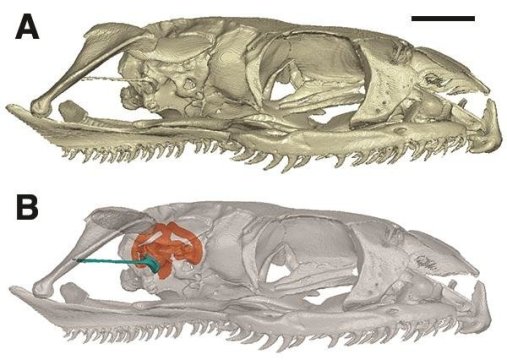
They took the skull of Dinilysia patagonica and blasted it with X-rays from every conceivable angle. A powerful computer then stitched these thousands of two-dimensional slices into a perfect, high-resolution 3D model. For the first time, they could fly *through* the fossilized bone. They could explore every nook, every channel, every hidden chamber.
And they weren’t looking for a brain. They were looking for an ear.
Specifically, the inner ear. Tucked deep inside the skull, this delicate, bony labyrinth is the body’s gyroscope. It controls balance, orientation, and hearing. And its shape is exquisitely tuned to an animal’s environment and lifestyle. A bird that soars in the sky has a different inner ear from a mole that lives underground. It’s an evolutionary fingerprint.

Modern snake skull, with inner ear shown in orange. Credit: Hongyu Yi
The team built 3D models of the inner ears of dozens of modern lizards and snakes. Water snakes. Tree snakes. Desert snakes. And, most importantly, burrowing snakes. They created a library of evolutionary blueprints. Then, they compared them to the digital ghost they had resurrected from the skull of Dinilysia.
The result was a jaw-dropper. A smoking gun.
The Verdict: The Burrower’s Blueprint
The inner ear of Dinilysia patagonica was not the ear of a swimmer. Not even close. It was a nearly perfect match for one specific group: modern snakes that live and hunt in burrows.
Bingo.
The evidence was a distinctive structure, a large, spherical vestibule inside the ear. This feature is absent in aquatic animals. It’s absent in animals that live on the surface. But in creatures that spend their lives underground? It’s their superpower.
This unique inner ear acts like a highly sensitive seismic detector. It’s tuned to pick up the faint, low-frequency vibrations that travel through sand and soil. It allows a burrowing snake to feel the scurrying of prey overhead or the heavy footfalls of a predator approaching. In the pitch-black world underground, where sight is useless, this kind of “hearing” through solid ground is the difference between eating and being eaten.
Dinilysia had it. The conclusion was inescapable.
This ancient relative of snakes was not a sea serpent. It was a master of the underworld. The largest burrowing snake ever known. And if *it* was a burrower, then its ancestors, the very first “proto-snakes,” almost certainly were too.
The entire “sea serpent” origin story went up in smoke.
What If? The Pressure Cooker of the Cretaceous
So, why? Why abandon a life on the surface, with legs to run, for a life of darkness and dirt? To understand, you have to picture the world these creatures lived in. 90 million years ago, the surface was Dinosaurland. It was a terrifying place for a small, lizard-like animal. You had Tyrannosaurs and other massive theropods stomping around, looking for a quick meal. The competition was brutal. The danger was constant.
So what do you do when the world above is a nightmare? You go down.
The ancestors of snakes, likely small, scurrying lizards, found a refuge beneath the earth. A whole new ecosystem awaited them. A world of insects, worms, and small, primitive mammals that were also hiding from the giants above. It was a new frontier, ripe for the taking.
But this new world had its own rules. In the tight, constricting confines of a burrow, legs are not an asset. They are a liability. They snag on roots. They get in the way. They slow you down. A streamlined, limbless body, on the other hand, is the perfect tool. It can slide through the smallest gaps. It can press itself against the tunnel walls for leverage. It is the ultimate adaptation for a subterranean life.
Evolution is often a story of addition by subtraction. To gain the underworld, the proto-snakes had to lose their limbs. It was a trade. A sacrifice that paid off spectacularly. They didn’t just survive the age of dinosaurs; they thrived, spreading across the globe, hidden in plain sight, right beneath the feet of the planet’s rulers.
The Ghost in the Genome
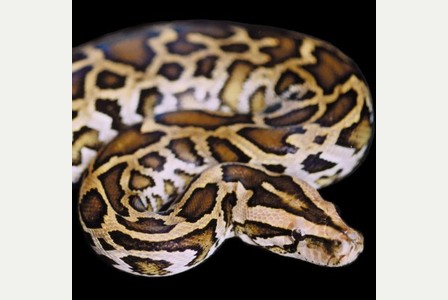
Think this is just a wild theory based on one fossil? The proof is alive and well today, slithering in jungles and deserts all over the world. Look no further than pythons and boa constrictors.
If you look closely at the rear of one of these “primitive” snakes, you’ll find something incredible. Two tiny, claw-like spurs, one on each side of their vent. What are they? They are the ghosts of hind legs. They are vestigial limbs. The anatomy confirms it; they are connected by small, remnant pelvic and thigh bones buried deep within the snake’s body.
The genes remember what the body has forgotten.
These tiny spurs are the last evolutionary echo of a four-legged past. They are irrefutable, living proof that snakes descended from creatures with legs. For millions of years, the DNA has carried the instructions for building legs, but other genes now step in and say, “Stop. We don’t need those anymore.” In some species, these ancient relics have even found a new purpose, used by males to grip and stimulate females during courtship.
The fossils told us the “how.” Modern snakes show us the leftovers.
The Textbooks Are Wrong. What Else Are They Lying About?
This isn’t just a fun fact about animal evolution. This is a fundamental rewrite of a major chapter in the history of life. And it was made possible because scientists were willing to question a long-held belief and use new technology to look at old evidence in a completely new way.
It begs the question: what other “settled science” is just waiting for the right fossil or the right technology to be turned on its head? The story of the snake is a powerful reminder that our understanding of the past is constantly shifting, constantly being updated. The truth is rarely a straight line. It’s a twisting, turning path, much like the creature itself.
“How snakes lost their legs has long been a mystery to scientists, but it seems that this happened when their ancestors became adept at burrowing,” said Dr. Hongyu Yi, the lead scientist who cracked the case. “The inner ears of fossils can reveal a remarkable amount of information, and are very useful when the exterior of fossils are too damaged or fragile to examine.”
Mark Norell of the American Museum of Natural History, who participated in the study, put it even more bluntly: “This discovery would not have been possible a decade ago—CT scanning has revolutionised how we can study ancient animals.”
The snake’s story was never about the sea. It was always about the soil. It’s a story of retreat, survival, and specialization. A story of giving up the world of the sun to become the undisputed master of the dark. By losing their legs, they didn’t become lesser; they became something new. Something powerful. Something that would outlast the dinosaurs and spread to every corner of the globe.
The next time you see a snake, don’t just see a legless reptile. See a survivor. A creature whose ancestors made a radical choice in a world of monsters, sacrificing their limbs to conquer a hidden kingdom. The evidence was there all along, not in the waves, but locked in the silent stone of the earth.
Originally posted 2015-12-01 15:59:08. Republished by Blog Post Promoter