Home Weird World Strange Stories Slender Man Mystery – Slender Suits Documentary

Slender Man Mystery – Slender Suits Documentary

0
67

The Tall Man in the Trees: Is the Slender Man an Internet Hoax or an Ancient Evil?

You’ve felt it, haven’t you?

That prickling sensation on the back of your neck when you’re walking alone at night. The sudden, gut-twisting certainty that you are being watched from the dark woods that line a suburban street. You turn. Nothing. Just the wind rustling the leaves. But the feeling doesn’t go away. It follows you home.

A shadow that’s too tall. Too thin. A distortion at the edge of your vision.

Most people shake it off. An overactive imagination, they say. But for those who have seen him, even for a split second, there is no shaking it off. They know his name. They whisper it. The Slender Man.

The official story tells you he’s a work of fiction. A ghost story born on the internet, a campfire tale for the digital age. But what if that’s only part of the truth? What if the internet didn’t *create* him, but simply… remembered him? What if this faceless phantom in a black suit is an ancient terror that has stalked humanity for centuries, and we’ve only just given him a new name?

The Photo That Launched a Thousand Nightmares

Let’s get the “official” story out of the way first. June 10th, 2009. A user named Eric Knudsen, going by the screenname “Victor Surge,” posts on the Something Awful forums. The contest was simple: take ordinary photographs and photoshop something paranormal into them. Create a story.

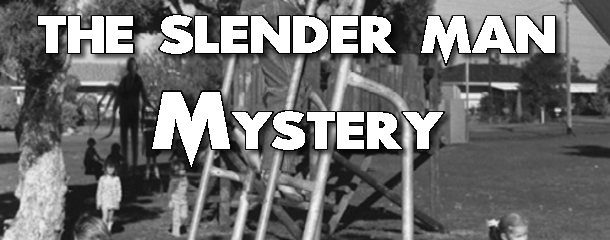
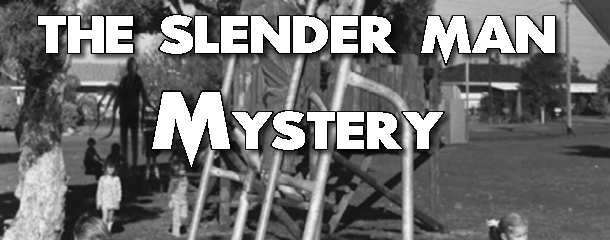
Knudsen uploaded two black-and-white photos of children playing. They were grainy, faded, and unsettlingly authentic. And in the background of each, lurking near the trees, was a tall, unnaturally thin figure in a black suit.

He added snippets of text. Captions that were more terrifying than the images themselves.

“we didn’t want to go, we didn’t want to kill them, but its persistent silence and outstretched arms horrified and comforted us at the same time…”

And then:

“One of two recovered photographs from the Stirling City Library blaze. Notable for being taken the day which fourteen children vanished and for what is referred to as ‘The Slender Man’. Deformities cited as film defects by officials. Fire at library occurred one week later. Actual photograph confiscated as evidence.”

It was lightning in a bottle. It was perfect. The images were subtle. The story was a tantalizing fragment. It didn’t explain everything. It left holes. And the internet, as it always does, rushed in to fill them.

Within days, others were adding their own photos, their own stories, their own “recovered documents.” The Slender Man mythos wasn’t written by one person. It was built, piece by piece, by a global community. It was the first great folklore of the digital age. A crowdsourced monster.

Slender-Man-mystery

Anatomy of a Specter: What Does He Look Like?

So what did this collective consciousness create? What are the agreed-upon features of this thing?

He is tall. Impossibly tall. Maybe eight feet. Maybe fifteen. His limbs are long, slender, and jointed in ways that feel wrong. Like a spider trying to pretend it’s a man.

And the suit. Why a black suit? It’s the uniform of the G-man, the undertaker, the faceless authority that comes to your door with bad news. It’s completely out of place in the playgrounds and forests where he is most often seen. That’s what makes it so terrifying. It’s an intrusion of a cold, sterile order into the chaos of nature and the innocence of childhood.

But his most disturbing feature is his face. Or, more accurately, the lack of one. Reports differ. Some say it’s a pale, blank oval of skin, completely devoid of features. Others claim it’s wrapped in white gauze or cloth, like a burn victim. The most chilling theory? That his face is a psychic mirror, showing you whatever you fear most. Or maybe you just can’t process what you’re seeing. A human brain isn’t built to look upon it.

Then there are the tentacles.

Yes, tentacles. Writhing, black tendrils are said to erupt from his back. Are there four? Six? Eight? No one agrees. Some photos show them, some don’t. This has led to the belief that he can extend and retract them at will. They are not for show. They are tools for intimidation, for movement through the dense woods, and for snatching his victims.

The Hunt and the Sickness

The Slender Man doesn’t just appear and attack. That would be too simple. Too merciful. His method is a slow, agonizing psychological burn. A campaign of terror.

It starts with a feeling. You become paranoid. You feel watched. You might catch a glimpse of him at the far end of a street, or standing motionless among the trees on your drive home. Then, the evidence starts to appear. A child’s drawing of a tall man with no face. A distorted figure in the background of a family photo you took just last week.

Victims report what has become known as “Slender Sickness.” It begins with nosebleeds and nightmares. Then comes the amnesia—losing track of hours, or even days. A persistent, dry cough follows. They become withdrawn, scribbling strange symbols in notebooks. They are being broken down, mentally and physically.

He seems to enjoy the stalk. He wants you to know he’s there. He wants you to be afraid. Fear, it seems, is what he feeds on.

His chosen prey? Overwhelmingly, children. He is a dark Pied Piper, luring the innocent away from the safety of their homes. Photographs, both real and fabricated, often show him in the background, observing children on a playground. Always watching. Always waiting. But he also hunts those who get too close to his secret. Researchers, investigators, and anyone who becomes obsessed with finding him soon find themselves becoming the hunted.

And what happens when he finally catches you? No one knows. There are never any bodies. No evidence. Just an open window, an empty bed, and a family left to wonder for the rest of their lives. Does he kill them? Absorb them? Or does he simply take them somewhere else… a silent, gray dimension where the trees have no leaves and the sky has no sun?

Deep Dive: Has He Always Been Here?

This is where the story gets really strange. The official timeline says the Slender Man was born in 2009. But dig a little deeper, and you find whispers of a tall, faceless man in folklore and history stretching back for centuries. Are these just coincidences? Or did Eric Knudsen tap into a primal archetype that has haunted humanity forever?

Der Großmann: The Tall Man of Germany

Let’s travel to 16th-century Germany, to the dark and foreboding Black Forest. Legends speak of a creature called Der Großmann, or “The Tall Man.” He was a fairy, an elf, a monster—the stories changed, but the description was shockingly consistent. An impossibly tall man with distorted, multi-jointed limbs who lived deep in the woods. He was a boogeyman used to scare children into behaving. “Be good, or Der Großmann will come and carry you off into the forest.” Sound familiar?

Alleged 16th-century woodcuts have surfaced online showing a skeletal figure with extra-long arms spearing children in the woods. While most of these have been convincingly debunked as modern fakes created *after* the Slender Man mythos began, the question remains. Is it a hoax, or was someone trying to connect the dots to a genuine folk tale that shares a terrifying number of similarities?

Fear Dubh & The Takkenmann: The Celtic and Dutch Phantoms

The echoes don’t stop in Germany. In Scotland, they tell tales of the Fear Dubh, or “The Dark Man.” A figure associated with bad omens, often seen at funerals, who was described as unnaturally tall and dressed in black. He was a harbinger of death.

Meanwhile, Dutch legends contain the Takkenmann, or “Branch Man.” This was a more monstrous entity, a boogeyman whose arms looked like the branches of a tree and who would snatch naughty children who wandered too far from home. A tall man. Long arms. A connection to the woods. The pattern is undeniable.

The Modern Connection: Men In Black

Let’s not forget a more modern parallel: The Men In Black. Not the fun-loving Will Smith version. I’m talking about the sinister, emotionless figures from UFO lore who show up to silence witnesses. They are often described as being strangely tall, pale, with awkward movements, and wearing pristine black suits. They are otherworldly. They are not quite human. Could the Slender Man and the MIB be different manifestations of the same strange phenomenon? One stalks UFO witnesses, the other stalks the woods. Both are agents of a terrifying, unknown agenda.

When The Myth Becomes Murder

For years, the Slender Man was a ghost story. A thrilling, collaborative horror project. A game. Then, on May 31, 2014, the game stopped being fun. The digital nightmare bled into the real world with horrifying consequences.

In Waukesha, Wisconsin, two 12-year-old girls lured their friend into the woods and stabbed her 19 times. When they were caught, their motive shocked the world. They said they did it to become “proxies” of the Slender Man. They believed he was real, and that by committing a murder in his name, he would spare their families and take them to his mansion in the forest.

Suddenly, this was no longer just an internet story. It was the centerpiece of a national tragedy. The incident raised terrifying new questions. What happens when a story becomes so powerful, so pervasive, that people start to believe it’s real? That they are willing to kill for it?

This leads us to a fascinating, and deeply unsettling, paranormal theory: the concept of an egregore, or a tulpa. This is the idea that if enough people focus their collective thought, belief, and emotional energy onto a single concept, that concept can take on a life of its own. It can become a non-physical entity that exists on the psychic plane. Did the millions of people reading, writing, and fearing the Slender Man accidentally create him? Did the internet act as a massive psychic engine that gave a thoughtform real power? Did this digital ghost become something more, something that could whisper in the ears of two impressionable young girls?

It’s a wild theory. But in a world where a fictional character inspired a real-world tragedy, maybe the wild theories are the only ones that make any sense.

The Undying Legend of the Static Man

The Slender Man’s popularity has faded from its peak. The moral panic has subsided. But he hasn’t gone away. He can’t. Because he represents a new kind of monster, a new kind of folklore perfectly suited for our age.

He is open-source terror. He has no single author, no official canon. He belongs to everyone and no one. He can be anything we need him to be: a woodland monster, an interdimensional being, a government experiment, or a psychic manifestation of our collective anxiety.

He is the fear of the unknown, dressed up in a suit and tie. He is the static on the screen, the corruption in the data, the stranger standing just out of focus in the background of your life.

So, is he just a story? Probably. But the next time you’re walking alone, and the trees seem to groan, and you see a flicker of movement from the corner of your eye—a shadow that is just too tall and too thin—ask yourself. Does it really matter?

He is in your head now. And that might be where he wanted to be all along.

Originally posted 2013-09-26 21:28:56. Republished by Blog Post Promoter