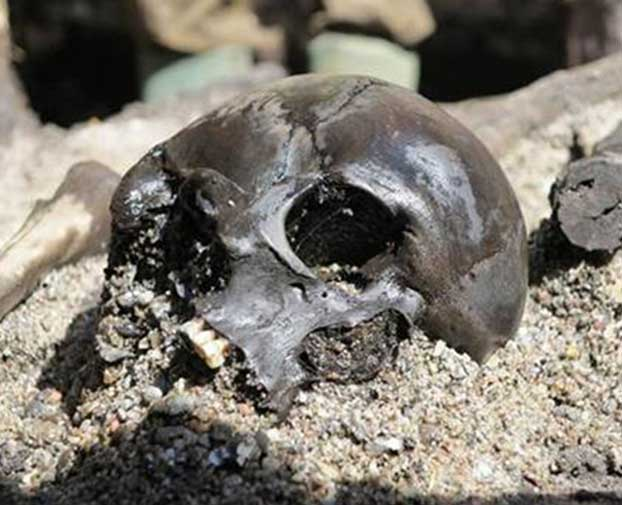
Denmark’s Lake of the Lost: The 2,000-Year-Old Mystery of the Sacrificed Army
Something is wrong in the wetlands of Alken Enge.
Deep in the heart of Denmark, near the placid waters of Lake Mossø, the peat bog holds a dark secret. A secret it kept for two millennia. For centuries, farmers worked the land. Children played nearby. Life moved on. But beneath their feet, something waited. An entire army, silenced and submerged, their bones tangled in the mud and reeds.
Then, the bog began to speak.
What archaeologists found here wasn’t just a forgotten battlefield. It was something else entirely. Something colder. More deliberate. They found the remains of hundreds upon hundreds of warriors, their skeletons telling a story of such unbelievable violence and bizarre ritual that it challenges everything we thought we knew about Europe’s Iron Age. This wasn’t a burial. It was a statement. A brutal, terrifying message left by an unknown victor.
They call it the Ghost Army. And its story is a nightmare.
The Grisly Scene at Alken Enge
Imagine the scene. It’s just after the time of Christ. The Roman Empire is pushing its borders, but here, in the wild north, Germanic tribes clash in a chaotic, violent dance for power. An army, far from home, marches into hostile territory. They are young, strong, and ready for a fight.
They never march out.
Fast forward 2,000 years. Archaeologists, initially drawn to the site by stray bone finds, begin a systematic excavation. What they unearth is staggering. It’s a mass grave on an industrial scale. The remains of at least 200 individuals were found in the initial digs, but later, more extensive work suggests the final number could be well over a thousand. An entire military force, wiped from the face of the earth.
The injuries are horrific. A skull, split open with the force of an axe blow. A thighbone, bearing a deep, slicing cut that could only have come from a razor-sharp blade. Another skull with a massive, unhealed puncture wound, likely from a spear. These men died hard. They fought and they lost, catastrophically. The sheer concentration of bodies in one small area of the bog points to a single, devastating event. A day of absolute carnage.
But the real horror story begins *after* the battle was over.
More Than a Battlefield: A House of Ritual Horror
If this was just a battle, the bodies would be different. They’d be scattered, fallen where they stood. They might have been hastily buried to prevent disease. That is not what happened at Alken Enge.
No. Something else occurred here.
The evidence suggests the dead lay on the battlefield for months. Perhaps a whole winter. Scavenging animals, like wolves and foxes, left their teeth marks on the bones, a grim testament to the passage of time. The victors let their enemies rot in the open. A show of utter dominance.
But they weren’t finished.
When the time was right, they returned to the field of slaughter. They gathered the bones. What they did next transforms this from a war grave into a scene of chilling ritual.
The Evidence for a Disturbing Ceremony
The bones weren’t just collected; they were processed. Meticulously. Many show signs of being scraped clean of any remaining flesh. They were sorted and bundled by type. A pile of femurs here, a collection of skulls there. This wasn’t a burial; it was a clearing house of the dead.
The most unsettling discovery? Four pelvic bones, carefully detached from their skeletons, were found threaded onto a long, sharpened tree branch. The branch was then thrust into the lake bed, a grotesque totem pole of human remains. A trophy. A sacrifice. What kind of mind conceives of such a thing? What message were they trying to send?
The sheer number of weapons found alongside the bones—spears, clubs, axes, and shields—adds another layer. These weren’t just the weapons of the fallen. The victors seem to have offered their *own* weapons to the bog as well, deliberately breaking swords and bending spearheads in a symbolic act of sacrifice. This place wasn’t just where their enemies died. It was a holy site. A sacred, hungry place that demanded payment in blood and iron.
Deep Dive: Who Were These Lost Warriors?
So, who were these men? And who—or what—did they fight?
Modern science has given us some shocking answers. By analyzing the strontium isotopes in the teeth of the fallen, researchers determined that these warriors were not local. Not even close. Their dental chemistry points to origins far from this Danish bog. They were an invading force, a foreign army that traveled a great distance to meet its doom.
This wasn’t a local skirmish between neighboring villages. This was an organized, large-scale invasion. A foreign power tried to assert its will on the people living near Lake Mossø, and they failed in the most spectacular way imaginable.
And the victors? We don’t know their name. They left no written records. All they left was their handiwork: a lake filled with the bones of their enemies and a terrifying warning that echoed through the mud for two thousand years. They were a local force with an iron will, a deep connection to their land, and a belief system that demanded the total and absolute humiliation of their foes, both in this life and the next.
What If? Unraveling the Conspiracy of the Bog
When you stare into a mystery this deep, the official explanations can feel… unsatisfying. The evidence is so strange, so extreme, that it pushes us to ask bigger questions. To look at the shadows of history and wonder what else might be hiding there.
A Warning Shot to the Roman Empire?
Let’s consider the timing. This massacre happened around the turn of the first millennium. Right around the same time, the mighty Roman Empire was suffering one of its most infamous defeats. In 9 AD, in a dark German forest, three entire Roman legions—up to 20,000 men—were ambushed and annihilated by Germanic tribes at the Battle of the Teutoburg Forest. It was a disaster that shook Rome to its core and halted its expansion northward for good.
Could the Alken Enge event be connected? What if this “lost army” wasn’t just another Germanic tribe, but a Roman auxiliary force or a Roman-allied tribe pushing into new territory? The victors’ ritualistic display would then become a political statement of terrifying clarity. It would be a message sent south: “This is what we do to invaders. This is what happens when you cross into our sacred lands. Stay away.” The horrifying, methodical desecration wasn’t just for their gods; it was for Roman scouts to find.
The Gods of the Peat Demanded a Tithe
To understand Alken Enge, you have to understand the Iron Age mind. To them, bogs were not just swamps. They were portals. Thin places where the veil between the world of the living and the world of the gods was stretched taut. They were places of immense spiritual power.
Across Northern Europe, bogs have given up their dead before. The famous “bog bodies,” like Denmark’s Tollund Man, were individuals, likely sacrificed to the gods, their bodies perfectly preserved by the acid and low-oxygen environment. But Alken Enge is different. This wasn’t one person. This was an entire army. The scale is mind-boggling.
What kind of event would prompt such a massive offering? What kind of deity demands the bones of a thousand men? Perhaps the defending tribe believed they had won only through divine intervention. Maybe they saw the victory as a miracle granted by the spirits of the bog itself. The sacrifice, then, was payment. A tithe of bone and steel to appease the ancient, hungry gods of the peat and ensure their continued protection.
Modern Science Meets an Ancient Nightmare
The work done at Alken Enge, especially during the major excavations between 2012 and 2014, represents a stunning fusion of old bones and new technology. Archaeologists from Aarhus University and the Skanderborg Museum used advanced geological surveys to map the ancient lakeshore, revealing exactly where the carnage was concentrated.
They employed techniques from forensic science to analyze the cuts and fractures on the bones, building a database of violence that reads like a modern crime scene report. It was this detailed analysis that revealed the sequence of events: a brutal battle, a period of exposure to the elements, and finally, the systematic, ritualistic collection and deposition of the remains.
The wet, peaty soil that preserved the bones so well also presented immense challenges. Each discovery was a race against time, to carefully extract and preserve these fragile pieces of history before exposure to the air could damage them. It’s a painstaking process, a 2,000-year-old puzzle being assembled piece by agonizing piece.
The Internet Speaks: Unanswered Questions Linger
A mystery this potent is fuel for the modern age. On forums and message boards across the internet, the story of Alken Enge is debated endlessly. The lack of a clear, simple answer leaves a vacuum that speculation rushes to fill.
Some users ask if the story is even darker than we imagine. Was this a single battle? Or was this bog a designated place of execution for decades, a ritual killing ground where captives from many conflicts were brought for a final, terrible purpose?
Others focus on the details. Why the pelvises? Of all the bones in the human body, why were four pelvic bones singled out for the bizarre branch-totem? Was it a symbol of emasculation, of destroying the enemy’s ability to reproduce and create future generations?
And what about the six-month delay? Why let the bodies lie for so long? Some online theories suggest it was a necessary part of the ritual, allowing the flesh to decay so the “spirit” could depart before the bones were offered to the gods. Or was it purely practical, waiting for the frozen ground of winter to thaw before the victors could return to their grim work?
The questions multiply. The answers remain buried.
The bog at Alken Enge has surrendered its dead, but not its secrets. Not all of them. What we have is a snapshot of a moment of unbelievable brutality and strange, dark faith from a lost world. It’s a reminder that history isn’t just a collection of dates and names written in a book. It’s a living, breathing thing, and sometimes, it screams up from the ground beneath our feet. The story of the Ghost Army is not over. It’s a cold case, 2,000 years old, and the victims are finally beginning to speak. We just have to be brave enough to listen.