Home Weird World Photo Galleries Russian Secrets Revealed – Gallery

Russian Secrets Revealed – Gallery

0
54

Russia’s Ghost Empire: The Secret Soviet Bases That Still Haunt The World

The Cold War is over. That’s what they tell you, anyway. They show you grainy footage of the Berlin Wall coming down, of smiling soldiers sharing cigarettes. A neat, tidy ending to a half-century of terror.

But that’s the history book version. The tourist version.

The real Cold War wasn’t fought with treaties and handshakes. It was a silent war, waged in the shadows, in the frozen depths of Siberia, and in sprawling, secret cities that never appeared on any map. The Soviet Union didn’t just build an army. It built a shadow empire, a network of bunkers, labs, and military installations so vast and so secret that even today, decades after its collapse, we’ve only scratched the surface of what’s out there.

Some of these places have been rediscovered, reclaimed by nature. Others… others might not be so dormant. What secrets were buried under the permafrost? And more importantly, are they staying buried?

The Empire of Lies: Welcome to the Closed Cities

Imagine a city with a population of 100,000 people. It has schools, hospitals, theaters, apartment blocks. It has everything a normal city would have. Except for one thing.

A name.

On every official map, there is nothing. Just an empty expanse of forest or tundra. The city, its people, its entire existence, is a state secret. This was the reality of the ZATO, the “closed administrative-territorial formations” of the USSR.

These weren’t just military bases. These were entire communities built around a single, top-secret purpose. Sarov, then known as Arzamas-16, was the birthplace of the Soviet atomic bomb. Ozyorsk, or Chelyabinsk-65, was a plutonium production nightmare that experienced a nuclear disaster bigger than Three Mile Island, an incident the world wouldn’t learn about for decades. In these cities, citizens lived relatively privileged lives compared to the rest of the USSR, with better food and housing. The price? They were prisoners in a gilded cage. Their movements were restricted, their contact with the outside world was severed, and their very existence was denied.

This is the scale of the secrecy we’re talking about. Not just a hidden bunker, but dozens of entire cities, housing millions of people, wiped from the map by a censor’s pen. It begs the question: if they could hide a city, what else could they hide?

The Mountain of Judgment: Inside Russia’s “Doomsday” Bunker

The United States has NORAD, buried deep within Cheyenne Mountain in Colorado. A legendary command-and-control center built to withstand a direct nuclear strike and orchestrate a response. For years, people wondered: what was the Soviet equivalent? Did they have their own “doomsday mountain”?

Oh, yes. They did.

Meet Kosvinsky Kamen. A massive mountain in the northern Urals, composed of solid granite. Sometime in the late 1970s, the Soviets began a construction project there of almost unbelievable scale. Using massive tunnel-boring machines, they hollowed out the heart of the mountain, creating a subterranean fortress estimated to be larger and deeper than its American counterpart. Western intelligence watched, perplexed, as trainload after trainload of equipment vanished into the mountainside.

The facility was officially completed in 1996, *after* the fall of the Soviet Union. Strange timing, right? High-level Russian officials have hinted that its purpose is to serve as a secure command post for the Strategic Rocket Forces. A place where the top brass can retreat and still command Russia’s nuclear arsenal even as the world above burns. Unlike Cheyenne Mountain, which is built under softer rock, Kosvinsky Kamen’s solid granite shell is thought to be virtually impenetrable to even the most powerful bunker-busting weapons.

Modern satellite analysis and leaked reports suggest the site is not only active but has been continuously upgraded. It’s tied directly into Russia’s most sensitive command systems. So while the Cold War may be over, the doomsday clock is still ticking away in the heart of a silent mountain.

The Graveyards of a Fallen Superpower

When an empire dies, it doesn’t go quietly. It leaves behind wreckage. Monuments to its former power, now rusting into oblivion. After the USSR dissolved in 1991, its colossal military machine ground to a halt. Budgets vanished. Regiments were disbanded. And the hardware? The thousands upon thousands of tanks, armored personnel carriers, and artillery pieces?

Much of it was simply left where it stood.

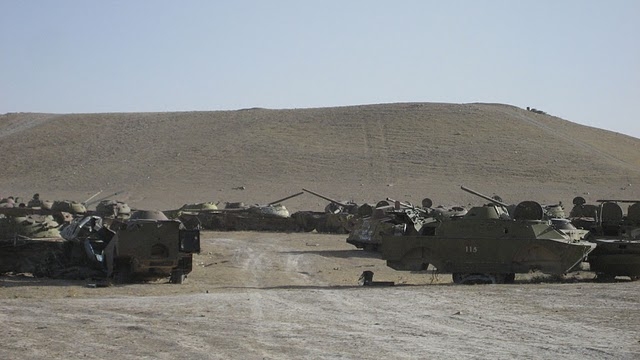
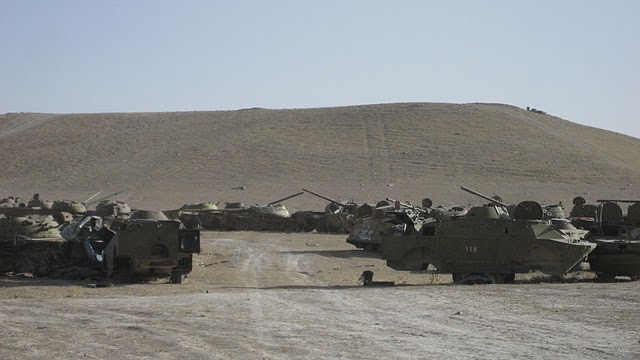
russian lost tanks

Across the former Soviet bloc, from the fields of Ukraine to the forests of East Germany and the vast emptiness of Siberia, massive “tank graveyards” appeared. Row upon endless row of T-64s, T-72s, and T-80s, parked in perfect formation and abandoned to the elements. These aren’t just a few forgotten vehicles. We’re talking about depots containing hundreds, sometimes *thousands*, of main battle tanks.

Why? The simple answer is money. It was cheaper to just walk away than to properly decommission or scrap such a gigantic arsenal. But the sight is profoundly unsettling. It’s a silent testament to the sheer scale of the Soviet war machine. A single one of these tanks was a city-leveling weapon. And here they sit, by the thousand, slowly being consumed by rust and weeds.

Urban explorers and photographers who have snuck into these sites describe an eerie silence, broken only by the wind whistling through open hatches. It feels like the aftermath of a war that never happened. A ghost army waiting for orders that will never come. But it also raises a darker thought: if this is what they were willing to just *leave behind*, what did they take the time to hide properly?

Plague Island: The Aral Sea’s Biological Nightmare

Of all the secret Soviet sites, perhaps none is more terrifying than Vozrozhdeniya Island. The name, ironically, means “Rebirth Island.” For decades, it was one of the planet’s most dangerous and secretive places—the main open-air testing ground for the Soviet Union’s massive biological weapons program.

Located in the middle of the vast Aral Sea, its isolation made it the perfect laboratory. From the 1950s onwards, scientists there worked with the deadliest pathogens known to man. They weaponized anthrax. They experimented with smallpox, plague, tularemia, and botulinum toxin. They exploded bombs filled with these agents over the island, testing their dispersal patterns on monkeys, sheep, and other animals.

It was a biological apocalypse in miniature. Then it got worse.

Starting in the 1960s, the rivers that fed the Aral Sea were diverted for Soviet irrigation projects. The sea began to shrink. Dramatically. Year by year, the water receded, and Rebirth Island grew larger. Then, in 2001, the inevitable happened. The southern edge of the island touched the mainland. The world’s deadliest laboratory was no longer an island. It was now connected to the continent.

Panic set in. What was buried on that island? In 1988, as the USSR was crumbling, the scientists dumped their remaining stocks of weaponized anthrax into pits and covered them with bleach. But did they get it all? Could the hardy anthrax spores survive? In 1971, a smallpox outbreak in a nearby city was traced back to the island, killing ten people. In 1988, 50,000 saiga antelope grazing nearby dropped dead. The cause was never officially confirmed, but the suspicion hangs heavy in the air.

An American-led team conducted a cleanup in the early 2000s, but many experts believe the threat is far from gone. The island is now a dusty, toxic wasteland littered with the ruins of laboratories and animal pens. Scrappers have since visited, looting the abandoned buildings for metal, potentially carrying away contaminated materials. The island is a ticking time bomb, a legacy of a secret program so reckless it poisoned the very land it occupied.

Russia’s Area 51? The Kapustin Yar Enigma

Every superpower needs a place to test its most advanced toys, and a place to hide its deepest secrets. For the United States, it’s Area 51 in the Nevada desert. For the Soviets, it was Kapustin Yar.

Founded in 1946, deep within southern Russia, Kapustin Yar was the USSR’s premier rocket development and testing site. This is where they tested captured German V-2 rockets after World War II. It’s where the Sputnik satellites and the first ICBMs were born. Its official history is impressive enough. But it’s the unofficial history that keeps conspiracy researchers up at night.

Whispers began almost immediately. Kapustin Yar, they said, was the Soviet “Roswell.”

According to persistent rumors and alleged KGB documents, a cylindrical, silver UFO was tracked on radar and then shot down by a MiG fighter near Kapustin Yar in 1948. Debris and alien bodies were supposedly recovered and taken to a secure underground facility beneath the base, known as Zhitkur. Sound familiar? The parallels to the Roswell story are uncanny, leading many to believe that both superpowers had their own “crash and retrieval” events that kickstarted a secret technological race.

Over the next few decades, the skies above Kapustin Yar were reportedly a hotbed of strange activity. Pilots reported bizarre lights, and personnel on the ground witnessed unexplained aerial phenomena. Was it just the constant testing of new, secret Soviet aircraft and missiles? Absolutely. But was it *only* that?

The “Soviet Roswell” theory claims that a massive effort to reverse-engineer alien technology took place at Kapustin Yar, fueling the incredible leaps in Soviet aerospace technology during the Cold War. It’s a wild claim with little hard proof. But given the documented level of paranoia and secrecy of the Soviet state, is it really so hard to believe that if they *did* find something, they would bury it under more layers of security and denial than any other secret they had?

The Dead Hand Is Still Twitching

Perhaps the most chilling legacy of the Cold War isn’t a place, but a system. A doomsday machine. It’s called “Perimeter,” but it’s better known by its terrifying nickname: the Dead Hand.

The theory was simple and horrifying. What happens if a surprise nuclear strike decapitates the Soviet leadership in Moscow? Who gives the order to retaliate? The Dead Hand was the answer. It was a semi-automated system designed to launch the entire Soviet nuclear arsenal if it detected a nuclear detonation on Soviet soil *and* communication with the high command was lost. A network of seismic, light, and radiation sensors would confirm the attack, and then a special command rocket would launch, flying across the country and broadcasting launch orders directly to the silos.

No human intervention required. An automated, vengeful ghost launching the apocalypse from beyond the grave.

Western intelligence confirmed the system’s existence after the Cold War ended. Russian officials have been cagey, sometimes admitting it existed, sometimes denying it. But the real question, the one that should send a shiver down your spine, is this: is it still active?

Many military analysts believe it is. Or that a modern, upgraded version of it is. In a world of hypersonic missiles and rapid-strike capabilities, the logic of an automated response system is, to a military planner, more compelling than ever. Somewhere, deep in a forgotten bunker, a machine might be waiting. Listening. For the signal to end the world.

This is the world modern internet sleuths are exploring. Using Google Earth and declassified satellite imagery, they hunt for clues. A strange new antenna array in the Urals. A freshly cleared road leading to a sealed-off mountain entrance. A heat signature where there should be none. They are piecing together the map of Russia’s ghost empire, and what they’re finding suggests that the past isn’t dead. It’s not even past. It’s just… waiting.

The Soviet Union may be gone, but its secrets, its weapons, and its ghosts are still out there. In forgotten cities, in poisoned labs, and in mountains hollowed out to survive the end of the world. And we’ve only just begun to find them.

Originally posted 2016-04-24 08:28:10. Republished by Blog Post Promoter