Thursday, May 14, 2026
HomeWeird WorldStrange StoriesRussian Ghostship Discovered

Russian Ghostship Discovered

The Soviet Ghost Ship That Vanished: The Terrifying Saga of the MV Lyubov Orlova

Out there. In the vast, churning, ink-black expanse of the North Atlantic, some things are better left lost. Some stories have no final chapter. They just stop. They fade into the fog and the salt spray, becoming whispers, legends, nightmares.

This is one of those stories.

It’s the story of a ship. A 4,000-ton steel ghost, once a proud vessel of the Soviet Union, that broke free from its chains and haunted the high seas. A ship with no captain, no crew, no lights. A dead ship, adrift in the world’s most dangerous waters, carrying a truly grotesque secret in its dark, groaning belly.

Its name was the MV Lyubov Orlova.

And for a terrifying few months, it was the most feared phantom on the planet. Then, it simply vanished. But not before one final, chilling sighting confirmed our worst fears.

A Cold War Relic’s Final, Fatal Voyage

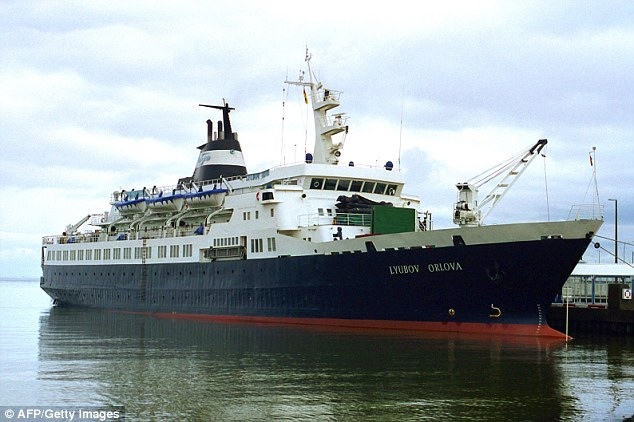
Every ghost has an origin story. A life before the haunting. The Orlova’s began not with a scream, but with the clatter and smoke of a Yugoslavian shipyard in 1976. Built for a Soviet-era shipping company, she was an ice-strengthened expedition vessel, designed to plow through the planet’s most hostile and frozen seas.

She was, in her prime, a thing of strange beauty. A vessel of contradictions.

20130222-235242.webp

Who Was the Real Lyubov Orlova?

They named her after a star. Lyubov Orlova was a celebrated actress of the Soviet screen, a cinematic icon said to be a favorite of Joseph Stalin himself. Her name evoked glamour, art, and the power of the Soviet state. The ship that bore her name was meant to project that same image to the world, carrying wealthy western tourists on arctic cruises one month, and stern-faced Soviet scientists on polar expeditions the next. Imagine the secrets whispered in its cabins, the deals made in its lounges, all while crushing through polar ice at the edge of the world.

For decades, she did her job. She sailed the poles, a floating piece of the Iron Curtain exploring the last great wildernesses. But empires fall. Times change. The Soviet Union crumbled, and the Orlova’s glory days faded with it.

From Arctic Explorer to Rusting Prison

The end began slowly, then all at once. By the 2000s, she was a relic, passed between different cruise companies, her finances becoming more and more tangled. The final straw came in 2010. She sailed into the harbor of St. John’s, Newfoundland, Canada, and never legally sailed out. A dispute over debts of a quarter-million dollars led to her seizure by Canadian authorities. The ship was impounded. The crew, abandoned by the owners, were stranded aboard for months, relying on local charity for food and supplies before finally being sent home.

For two years, the Lyubov Orlova sat and rusted in that Canadian harbor. A floating monument to a forgotten age. A giant piece of scrap metal nobody wanted. Finally, a buyer was found. The plan was simple: tow the derelict ship to a scrapyard in the Dominican Republic. It was a one-way trip to oblivion. A sad but necessary end.

The ocean, however, had other plans.

The Snap That Unleashed a Monster

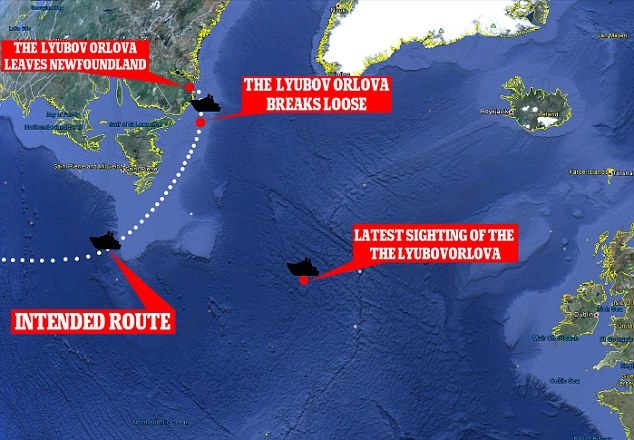
January 23, 2013. The North Atlantic in winter. Not a place for the faint of heart. The tugboat *Charlene Hunt* was straining against the dead weight of the Orlova, battling ferocious winds and waves the size of buildings. The journey was already a nightmare.

And then it happened.

With a sound like a gunshot, the tow line snapped. The connection was severed. In the heart of a raging storm, the 4,250-ton Lyubov Orlova was suddenly, terrifyingly free.

The Canadian authorities faced a choice. Risk the lives of sailors to recapture a worthless, empty hulk in impossible seas? Or let it go? They chose to let it go. Transport Canada stated it was no longer a threat to their waters and was drifting out into the vastness of the international Atlantic. It was, they figured, someone else’s problem now.

They had just created a ghost.

A massive, unlit, uncontrolled steel battering ram was now loose in one of the busiest shipping corridors on Earth. The hunt was on. But how do you track a phantom? The Orlova’s Automatic Identification System (AIS) was dead. It was a dark target, invisible to most modern tracking systems. For days, it was completely lost.

Then, a brief moment of hope. An offshore supply vessel, the *Atlantic Hawk*, managed to get a line on the Orlova, wrangling it under control. But the victory was short-lived. Due to jurisdictional squabbles and the sheer danger of the situation, they were ordered to release it. Again. They cut it loose in international waters, washing their hands of the problem once and for all.

The ghost was free again. This time, for good.

The Cannibal Rat-Infested Nightmare: A Theory Goes Viral

As the Orlova drifted into legend, a new and horrifying theory began to bubble up from the depths of the internet. It was a piece of speculation so gruesome, so visceral, that it captured the public imagination and turned the ship from a mere maritime hazard into a floating horror story.

The theory of the cannibal rats.

Think about it. A ship sits docked for two years. It’s a perfect breeding ground for vermin. Hundreds, maybe thousands of rats would have made the Orlova’s empty cabins and galleys their home. When the ship was set adrift, these rats were trapped. No food. No way off.

What happens to a large, contained population of rats when they begin to starve?

They turn on each other.

The story that spread like wildfire was that the Lyubov Orlova wasn’t empty at all. It was crewed by a legion of starving, disease-ridden, cannibalistic super-rats. The survivors of a grim war of attrition. Imagine it. The silent vessel, pitching and rolling in the endless waves, its dark corridors echoing with the skittering of its monstrous inhabitants. It was a vision straight out of a Stephen King novel.

20130222-235935.webp

Salvage hunters and maritime experts added fuel to the fire. One Belgian salvager, Pim de Rhoodes, went on record saying he was hunting for the ship, but warned that if he found it, boarding it would be incredibly dangerous. “It will be teeming with cannibal rats,” he warned the press. “You’d have to flood it with poison and wait for them all to die.”

Suddenly, the fear wasn’t just about a potential collision. The fear was about this plague ship, this floating biohazard, crashing ashore on the coasts of Ireland or the UK, unleashing its cargo of death and disease.

The Final Sighting and The Great Silence

For weeks, there was nothing. Just silence. The Orlova had been swallowed by the Atlantic. Had it already sunk? Was it halfway to Europe? No one knew. Maritime agencies posted warnings, satellites scanned the waves, but the ocean is incomprehensibly vast.

Then, a breakthrough. A document from the US National Geospatial-Intelligence Agency, dated February 22, 2013, was leaked. It contained a satellite hit. The Lyubov Orlova had been spotted. It was about 1,300 nautical miles from the Irish coast, still stubbornly afloat, still drifting eastward.

The ghost was real. And it was getting closer.

A new wave of panic and morbid fascination swept through Europe. Coast guards were on high alert. Newspapers ran frantic headlines. The rat-infested ghost ship was coming. Except, it never arrived.

That sighting was the last time anyone ever laid eyes on the Lyubov Orlova.

Shortly after, something else happened. Two Emergency Position-Indicating Radio Beacons (EPIRBs) from the Orlova began to ping. These devices are designed to activate automatically when they make contact with saltwater. They are the last cry of a dying ship. One beacon was traced to one of the ship’s lifeboats. The other, to the ship’s main body.

The signals were the final clues. After that… nothing. The pings stopped. The ship was gone. The great silence began.

Where Is the Lyubov Orlova Now?

The story doesn’t have an ending. It just has theories. It’s a mystery that will likely never be solved, leaving us with lingering questions that crawl under the skin.

Theory 1: A Watery Grave

This is the official, logical, and most likely explanation. The North Atlantic in winter is a ship-killer. Sometime in late February or early March of 2013, the Orlova, already in a state of severe disrepair, finally met a storm it couldn’t survive. The hull breached, the lifeboats were torn away by the waves (triggering the beacons), and the once-proud vessel plunged thousands of feet to the ocean floor. It now rests in eternal darkness, its secrets (and any potential rat skeletons) locked away forever. A silent tomb at the bottom of the world.

Theory 2: The Secret Salvage

This is where things get interesting. What if someone *did* find it? The ship was worth a fair bit in scrap metal, potentially over a million dollars. Could a private, clandestine salvage operation have located the ship after its last official sighting? They could have quietly towed it to a remote, unregulated scrapyard somewhere in the world, breaking it up for cash and avoiding all the legal red tape, environmental reports, and port fees. It’s a long shot, requiring immense luck and secrecy, but not impossible. In this scenario, the Orlova didn’t sink; it was dissected in secret.

Theory 3: The Ghost That Still Sails

This is the theory that keeps you up at night. The most terrifying. The most unbelievable. What if the EPIRB signals were a red herring, triggered by a lifeboat breaking off in a storm, but the main ship survived? Ocean currents are a strange and powerful thing. Some have speculated the Orlova could have been caught in the North Atlantic gyre, a massive rotating current system. Could it still be out there? A true ghost ship, trapped in an endless loop, its hull caked with a decade of marine growth, its cannibal rat population now a multi-generational society knowing nothing but their rusting, floating world.

It’s an insane thought. And yet…

The ocean is the last great frontier on our own planet. We know more about the surface of the moon than we do about the deep sea. The story of the Lyubov Orlova is a stark reminder of that fact. It’s a tale of how quickly our modern, tracked, and charted world can be humbled by the raw power of nature. A 300-foot-long, 4,000-ton ship can, even in the 21st century, simply be erased.

The ocean keeps its secrets. And the MV Lyubov Orlova is one of its darkest.

Amit Ghosh
Amit Ghoshhttps://coolinterestingnews.com
Aloha, I'm Amit Ghosh, a web entrepreneur and avid blogger. Bitten by entrepreneurial bug, I got kicked out from college and ended up being millionaire and running a digital media company named Aeron7 headquartered at Lithuania.
RELATED ARTICLES

1 COMMENT

- Advertisment -

Most Popular

Recent Comments

Warren Pan Abbott on The legend of the Devil Monkey !
chris davies on The McPherson Tape Mystery
Reed Reedly on ET has Internet!
Bea Houseoffashion on Proof Of Time Travellers – Gallery
Marcus2012 on ET has Internet!
Reed Reedly on ET has Internet!
LaughsAtConspiracyNuts on The 9/11 Conspiracy – Myths and Facts
Alex Sliverman on Did the ancients fly?
Doctor Wholigan on Time Traveler in 1938 film
chris davies on The McPherson Tape Mystery
Archie1954 on 10 secret UFO hideouts
chris davies on Ghosts of flight 401
Marcus2012 on ET has Internet!
jason Macdonald on Proof of Time Travel? – China
chris davies on Long-Lost Pyramids Found?
Reed Reedly on ET has Internet!
Milkman on Connected Universe
Tenmiles on Baigong Pipes Mystery
Simon Foster on Sirius – The Documentary
From the 1st April on 2013 – Alien Contact date ?
SkyWatcher on Is ET ignoring us?
I Come From The Future on Obama to make UFO Alien disclouser soon ?
ÛñK?øWn on 2013 – Alien Contact date ?
Just another person on 2013 – Alien Contact date ?
Malcolm Windowcleaner on The strange case of Rudolph Fentz
Mason Servio on Strange Things on Mars
Marke Wisdom Seeker on What will we find as arctic melts?
Andrea A Elisabeth Levyne on Aliens Captured in Varginha, Brazil
Mitch Grouyeki on Amazing Space Shuttle pictures