It was the most scrutinized six seconds in American history. Yet, amidst the chaos, the blood, and the screaming sirens, one figure stood perfectly still.
November 22, 1963. Dallas, Texas. The air was electric. Then, it shattered.
Snap. Crackle. Pop.
Gunfire echoed through Dealey Plaza. The world changed forever in a heartbeat. You know the story. You’ve seen the grainy footage a thousand times. President John F. Kennedy slumped forward. Jackie Kennedy scrambling onto the trunk of the limousine. Secret Service agent Clint Hill jumping to protect them. The panic was absolute. People hit the dirt. Parents threw their bodies over their children. Grown men ran for their lives.
But there is a ghost in the machine.
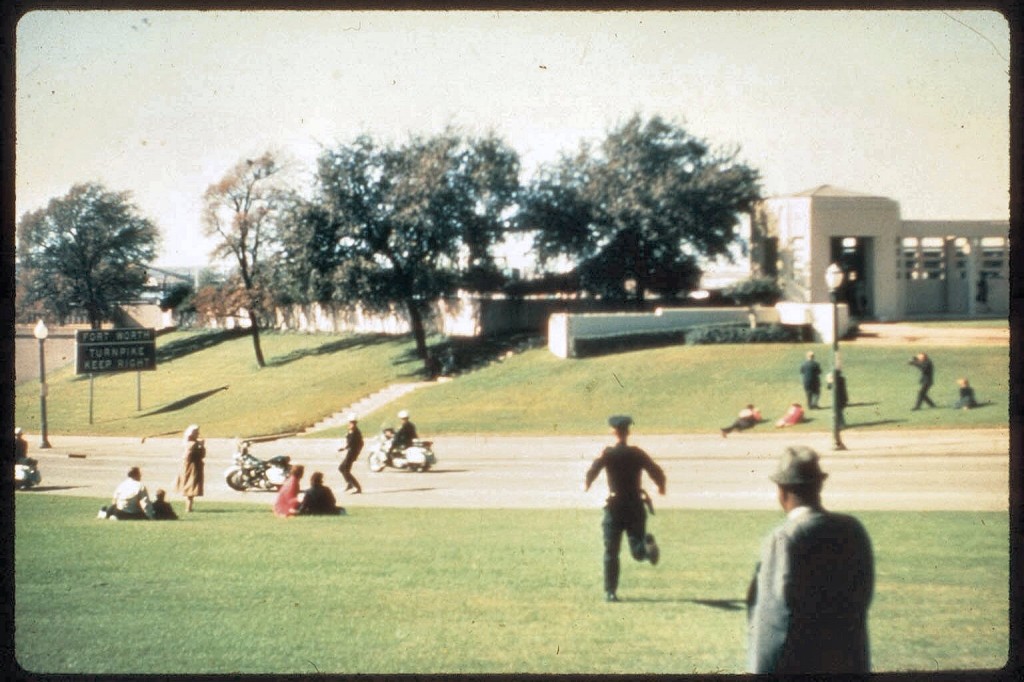
If you look closely at the edges of the famous films—the Zapruder film, the Marie Muchmore film, the Orville Nix film—you see something that doesn’t belong. You see a woman. She isn’t running. She isn’t screaming. She isn’t ducking for cover.
She is standing like a statue in the middle of a war zone. And she is holding a camera.
Who was she? What did she film? And why, for over sixty years, has she seemingly vanished off the face of the earth? Welcome to the rabbit hole of the “Babushka Lady,” the most mysterious witness to the crime of the century.
The Chaos of Dealey Plaza
To understand why this woman matters, you have to understand the madness of that afternoon. When the shots rang out, nobody knew where they were coming from. The echo in the plaza was deceptive. Was it the Texas School Book Depository? Was it the Grassy Knoll? Was it the overpass?
Law enforcement was flying blind. In the hours and days following the assassination, the FBI and Secret Service were desperate. They didn’t just need witnesses; they needed eyes. They needed evidence. They knew that in a crowd that size, people were taking photos. Home movie cameras were the iPhones of the 1960s. If you were at a parade, you were filming.
Investigators cast a wide net. They relied heavily on statements from spectators. But human memory is garbage. It changes. It warps under stress. One witness says the shots came from behind; another swears they came from the front. What the feds really wanted was hard proof. Celluloid. Film.
Once the movies and films were developed, law enforcement used the images to try to piece together the trajectory of the bullets. They needed to triangulate the sniper’s nest.
But there was a problem.
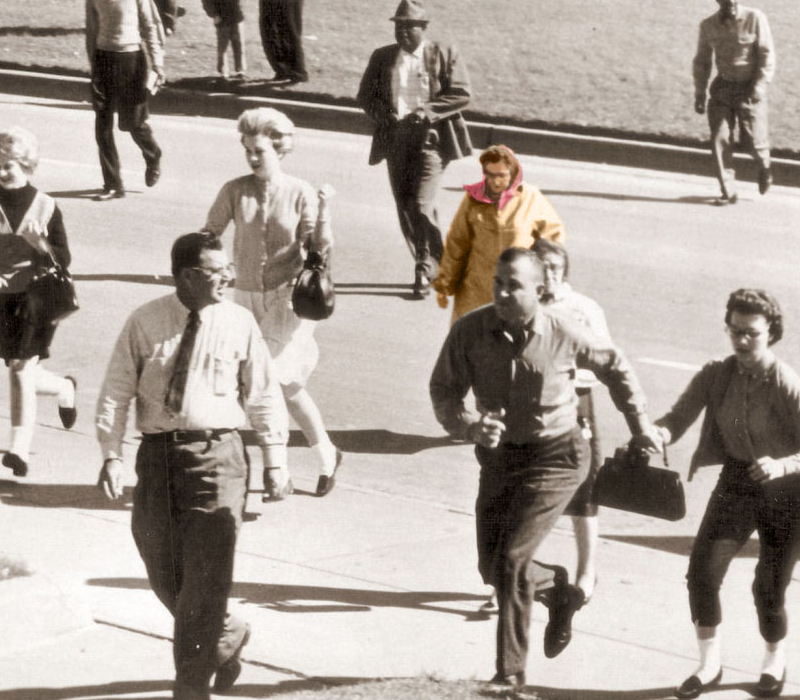
The photos and films they gathered were not exactly high definition. This was 1963. Images were grainy. Focus was soft. And the cameramen? They were terrified. In the excitement following the shooting, bystanders fled for cover and confusion reigned. As it was not immediately clear which direction the shots came from, people ran in every direction, colliding with each other, fleeing towards whatever “safe” places they could find.
Most of the footage from that day is shaky. It blurs wildly as the person filming flinches at the sound of the gunshots. Abraham Zapruder, who took the most famous home movie of the event, was standing on a concrete pedestal. You can see his camera shake as the fatal shot hits. He was in shock.
Everyone reacted. Everyone except one person.
The Woman in the Scarf
The days following the assassination were a whirlwind for investigators. It was a pressure cooker. The public was outraged. They demanded answers yesterday. The shooting of the main suspect, Lee Harvey Oswald, on live television by Jack Ruby just threw gasoline on the fire. It felt like the whole world was unraveling.
Agents were drowning in conflicting reports. But as they combed through the developed photographs and slow-motion film reels, a pattern emerged. A figure kept appearing. An anomaly.
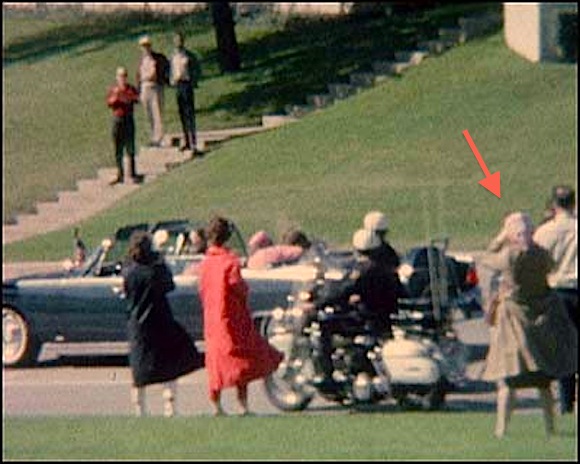
Clearly shown in several photographs is a woman with what appears to be a camera of some kind held up to her face. She is pointing it directly at the president’s motorcade at the exact moment the shots were fired. This wasn’t just a casual snapshot. Based on her posture, she was tracking the limousine.
Let’s talk about her position. It was perfect.
She is standing on the south side of Elm Street. The grass is green around her. She is relatively close to the street—much closer than Zapruder. She had a front-row seat to the kill zone. While Zapruder was filming from the right side of the President, this mystery woman was on the left. She would have had a clear, unobstructed view of the grassy knoll in the background of her shot.
If there was a second gunman? Her camera saw him.
She is wearing a heavy coat, which some found odd for a bright Texas day, though it was a bit brisk. But it was her headwear that gave her the name. Over her hair, she is wearing a scarf of a tan or light brown color tied under her chin. It resembled the headscarves worn by elderly Russian grandmothers. The press and the agents dubbed her the “Babushka Lady.”

While she appears in several photos, probably the best and closest image of the woman is from a movie taken by Marie Muchmore, another spectator. Unfortunately, the mystery woman has her back to Muchmore. We see the coat. We see the scarf. We see the posture. But we never see her face.
She appears in the Zapruder film too, just for a few frames. But again, she is obscured by the grass and the angle. We can’t see her eyes. We can’t identify her features. She is a blank slate.
The Impossible Calm
The investigating officials were intrigued, but soon they became obsessed. If the Babushka Lady had been so close and had taken photos or movies, the law was eager to see them. Her footage could answer the biggest question of all: Was Lee Harvey Oswald acting alone?
But there was something else. Something unsettling.
Also intriguing is the fact that photographic evidence shows that instead of running away after the shots were fired, as many people did, the Babushka Lady continued filming the procession.
Look at the timeline. The first shot hits. People turn their heads. The second shot hits. The President clutches his throat. The third shot—the fatal head wound—explodes. Panic ensues. Motorcycle cops rev their engines. Clint Hill jumps on the car. The limo speeds off.
And through all of this, the Babushka Lady is still standing there. Solid. Unmoving. Following the car with her lens.
After the limo disappears under the triple underpass, she doesn’t collapse. She doesn’t scream. She simply lowers her camera, pauses for a moment, and then calmly walks away. She crosses Elm Street toward the grassy knoll area and vanishes into the crowd.
Why didn’t she react? Was she in shock? Or did she know what was about to happen?
The Search That Found Nothing
A call went out from the FBI. They wanted everyone. If you had a camera near Dealey Plaza, Uncle Sam wanted to talk to you. They put out pleas in the newspapers. They asked Kodak processing labs to watch for specific types of footage.
Dozens of people came forward. Zapruder sold his film to Life Magazine. Orville Nix gave his film to the FBI. But the one film that might have shown the other side of the street? The film that might have caught the “Badge Man” on the grassy knoll or the smoke from a second rifle?
Silence.
The Babushka Lady never came forward. She ignored the pleas. She ignored the news. Despite evidence showing that she was capturing the tragedy in some way from a relatively good position, she chose to remain a ghost. Why?
Fear is a powerful motivator. In the days after JFK died, witnesses were terrified. Many people believed a hit squad was loose in Dallas. If you had footage of the shooters, maybe you were next on the list. Maybe she was an illegal immigrant. Maybe she was having an affair and didn’t want to be seen. Or maybe, just maybe, she was part of it.
The Kodachrome Clue
Just when the trail seemed cold, a weird little story popped up. It’s one of those details that keeps researchers awake at night.
Interestingly, a Dallas film developer later told FBI agents a strange tale. He claimed that shortly after the assassination, a woman came into his shop. She brought in a single color slide to be developed. This wasn’t a movie reel, but a slide.
The developer noted the image was somewhat blurry—out of focus, perhaps taken in haste. But from the developer’s description, the perspective matched up perfectly. It looked like it was taken from the exact spot the Babushka Lady was standing. He described seeing the motorcade from a low angle on the south side of Elm Street.
The woman collected the slide and left. She gave no name. The developer didn’t think much of it until later, when the FBI started asking questions. By then, she was gone. Was this our mystery woman? If so, why did she only have one slide? Was she taking still photos, not a movie? Or did she have a movie developed somewhere else?
The Beverly Oliver Confession: Truth or Hoax?
The trail of the mystery woman seemed to come to a dead end until 1970. Seven years of silence. Then, out of the blue, a woman named Beverly Oliver stepped into the spotlight.
Oliver was a singer and dancer at the Colony Club, a burlesque venue in Dallas that competed with Jack Ruby’s Carousel Club. She claimed she was the Babushka Lady. She told a harrowing story. She said she was 17 years old at the time and had gone to the plaza to film the President.
Her story got dark, fast. Oliver claimed that days after the shooting, two men in suits—presumably FBI or Secret Service—found her at work. She said they confiscated her camera and the film, promising to return it. They never did.
At first, this seemed to be the solution to the mystery. It fit the narrative of a government cover-up. The “Men in Black” taking the evidence? It’s classic conspiracy lore. Oliver even appeared in Oliver Stone’s movie JFK (as a character based on herself), cementing her story in pop culture.
But then, the researchers started digging. And the holes in her story were big enough to drive a motorcade through.
First, there was the camera. Oliver identified the camera she had used as a Yashica Super 8. It was a specific, high-quality camera. The problem? That model of camera—and the Super 8 film format itself—was not in production in 1963. It wasn’t invented until years later, around 1965 or 1969 depending on the specific model. It is physically impossible for her to have used that camera to film JFK.
When confronted with this, she claimed she had a “prototype” or an “experimental” model. That’s a convenient excuse, but highly unlikely for a 17-year-old dancer in Dallas to possess pre-market Japanese technology.
Then there is the physical evidence. Look at the photos again. Analysis of the photos that included the Babushka Lady seems to indicate a woman much older and heavier than Beverly Oliver. In 1963, Oliver was a slim, tall 17-year-old girl. The Babushka Lady appears to be a stout, middle-aged woman with a very different body shape. Her calves are thick; her stance is heavy. It just doesn’t match.
Similarly, witnesses who had been standing near the Babushka Lady were interviewed. They didn’t recall a teenager. They recalled an older woman. Some even said she seemed to be alone, while Oliver claimed she was with friends.
So, if Beverly Oliver isn’t the Babushka Lady, who is she? Most historians now file her under “publicity seeker.” But her story muddied the waters for decades, distracting from the real search.
Modern Theories: Spies, Time Travelers, and Binoculars
If it wasn’t Beverly, then we are back to square one. Why hasn’t this enigmatic woman come forward? What does she have to hide? The internet, of course, has ideas. Let’s look at the modern theories.
Theory 1: The Russian Spy
It’s in the name. “Babushka.” In the height of the Cold War, the fear of Soviet involvement was sky-high. Some theorists suggest she wasn’t just a lady with a scarf; she was a field asset. The fact that she stood so still, calmly filming a death, suggests training. Was she documenting the success of an operation? It sounds wild, but in the spy games of the 60s, anything was possible.
Theory 2: The Camera Was a Gun
Some fringe researchers have analyzed the blurry shape in her hands. They argue it doesn’t look like a standard 8mm camera. Could it have been a weapon disguised as a camera? The “Umbrella Man” (another mysterious figure that day) is often accused of signaling the shooters. Was the Babushka Lady part of a triangulation team? It’s unlikely, given she was surrounded by witnesses, but in the realm of JFK conspiracies, you can’t rule it out.
Theory 3: Just Binoculars
Could it be, as one simpler theory suggests, that the object she was holding was not a camera but a set of binoculars? If she was just holding binoculars to her eyes to get a better look, she wouldn’t have any film to turn in. She wouldn’t realize the authorities were looking for her specifically as a “photographer.” She might have just been an embarrassed lady who didn’t want to get involved in a police investigation. But look at the way she holds it. Her elbows are tucked. She pans with the car. It mimics the motion of filming perfectly.
Theory 4: The Time Traveler
We have to mention it. On forums like Reddit and 4chan, people love to suggest she looks “out of place.” Her clothes, while fitting the era, look slightly off to some modern eyes. Her digital camera-like stance. It’s nonsense, but it speaks to how eerie her presence is. She looks like an observer from another dimension.

The Final Verdict
It is most likely too late for the Babushka Lady to step forward, even if she is still alive. If she was in her 40s or 50s in 1963, she has long since passed away. She took her secrets to the grave.
But what about the film? That is the tantalizing part. Film doesn’t rot if it’s stored right. Somewhere in a dusty attic in Dallas, or a basement in the Midwest, there might be a small cardboard box. Inside might be a reel of 8mm Kodachrome film labeled “Dallas Trip 1963.”
The grandchildren of the Babushka Lady might throw it out during a spring cleaning, never knowing what it is. Or, maybe one day, someone will thread it into a projector, turn on the lamp, and see the motorcade from the other side of the street. They might see the grassy knoll clearly. They might see the flash of a muzzle. They might solve the crime.
Over the subsequent years, countless theories and “facts” about the events connected to the assassination have surfaced. We have digitized the audio, enhanced the Zapruder film to 4K, and run computer simulations of the bullet trajectories. Yet, we are still missing pieces of the puzzle.
Grainy images of the Babushka Lady on film are just another puzzle in a very mysterious Dallas afternoon. She stands there, frozen in time, the woman who saw everything and said nothing.
Read: The JFK Mysteries
Sources:
“Babushka Lady”, Wikipedia

Assassination Records Review Board Files
Originally posted 2016-04-08 16:28:04. Republished by Blog Post Promoter