Sunday, May 10, 2026
HomeWeird WorldTime TravelProof of Time Travel? - China

Proof of Time Travel? – China

The Swiss Watch in the Sealed Tomb: Did a Time Traveler Visit Ming Dynasty China?

Some discoveries don’t just rewrite history books. They shred them. They force us to look at the neat, tidy timeline of human progress and ask a terrifying question: what if it’s all wrong?

This isn’t a story about a pot shard or a fragment of bone. This is a story about a ghost. A ghost from a future that hadn’t been born yet, leaving a calling card in the most impossible of places.

The place? A 400-year-old sealed tomb in Shangsi County, China. The time? December, 2008. The team? A group of Chinese archaeologists, accompanied by journalists, ready to document the careful opening of a sarcophagus untouched since the Ming Dynasty.

They expected to find silk, jade, the preserved remains of a long-dead aristocrat. The air was thick with the dust of centuries. The silence was sacred. They were the first human beings to see this place since the final stone was set four centuries ago.

Or so they thought.

A Discovery That Shattered Reality

Imagine the scene. The team is carefully brushing away the last layers of compacted soil from around the giant outer coffin. This is the delicate part, the moment of truth. They are filming a documentary, every move recorded for posterity. Suddenly, a sound. A sharp, metallic *clink*. It’s a noise that doesn’t belong. Not here. Not in the dirt and decay of ancient history.

Jiang Yanyu, the former curator of the Guangxi Museum, was there. He later described the moment that sent a shockwave through the archaeological community. ‘When we tried to remove the soil wrapped around the coffin, suddenly a piece of rock dropped off and hit the ground with metallic sound.’

A rock? No. Not a rock.

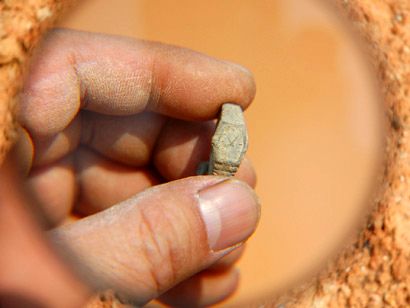
‘We picked up the object,’ Jiang continued, ‘and found it was a ring.’ But as they wiped away the centuries of grime, a dawning, chilling realization set in. ‘After removing the covering soil and examining it further, we were shocked to see it was a watch.’

A watch. A tiny, intricate, metal ring-watch. It was caked in the same mud and rock that had entombed the coffin, suggesting it had been there for a very, very long time. The hands were frozen, fixed for eternity at a specific moment: 10:06. And on the back, etched into the metal, was a single, impossible word.

Swiss.

The silence in the tomb was broken. In that moment, 400 years of history collided with a future that shouldn’t exist. The implications were staggering. When officials from the Chinese historical department were pressed by reporters, their alleged response sent the story into overdrive across the globe: “Time Travel! – no comment.”

Analyzing the Anomaly: A Watch Out of Time

So, what are we really looking at here? Let’s break down just how impossible this object is. This isn’t just slightly out of place. This is like finding a smartphone in the stomach of a Tyrannosaurus Rex. The very existence of this watch in this tomb defies everything we know.

The “Swiss” Conundrum

The word “Swiss” is the nail in the coffin of conventional explanation. The Ming Dynasty, the ruling power in China when this tomb was sealed, lasted from 1368 to 1644. During this period, the nation of Switzerland as we know it today simply did not exist. It was a loose confederation of cantons, not a unified state recognized as a global center for watchmaking. The concept of “Swiss Made” as a mark of quality and origin is a product of the late 19th century, created to combat foreign knock-offs.

There were no Swiss watches in the 1600s. Period. End of story. And yet, here one was, apparently buried alongside a Ming Dynasty noble.

What is a Ring Watch, Anyway?

This wasn’t a pocket watch or a wristwatch. It was a *ring watch*. A curious and rather niche piece of jewelry. While some rudimentary clockwork rings existed in Europe in the 18th century, they were rare, bulky novelties for the ultra-rich. The sleek, miniature design of the artifact found in China is unmistakably modern, likely a product of the 20th century. It’s the kind of thing you might find in a vintage store or a forgotten corner of your grandmother’s jewelry box.

It’s not an imperial treasure. It’s not a lost piece of ancient technology. It looks, for all the world, like a piece of modern, mass-produced bling.

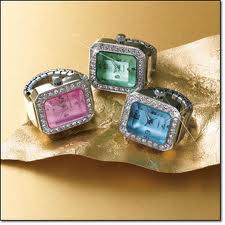
Looking at a modern version of the ring-watch, you have to wonder. What kind of time traveler would wear something like this? It’s hardly standard-issue temporal agent gear.

Frozen at 10:06

Why 10:06? Is it significant? Internet forums have exploded with theories. Was this the precise moment the time traveler’s device malfunctioned, stranding them in the past? Was it the time of their death? Or perhaps it was the moment they jumped back to their own time, the watch losing its power source and freezing instantly. Some have even suggested it’s a code, a breadcrumb left for future researchers to follow. Or maybe, just maybe, it’s the random moment a tiny battery finally gave up the ghost, its small life expiring centuries before its owner was even born.

Deep Dive: The Sanctity of a Ming Dynasty Tomb

To truly grasp the magnitude of this find, you have to understand what it means for a tomb to be “sealed.” The Ming emperors and their courts held deeply spiritual beliefs about the afterlife. A tomb was not just a burial place; it was a palace for the soul, a gateway to eternity. These were sacred spaces, designed to be protected from the outside world forever.

They were often massive, complex structures built deep underground, with heavy stone doors, intricate traps, and layers of earth packed on top. The goal was to make them impenetrable, to protect the occupant and their worldly treasures from grave robbers and the ravages of time. The idea that someone could just wander in, drop a watch, and leave without a trace is, to put it mildly, extremely unlikely.

Finding a modern artifact inside what was believed to be a perfectly preserved, undisturbed 400-year-old burial chamber isn’t just an oddity. It’s a violation of history itself. It suggests that the sacred seal was broken by someone who wasn’t from that time at all.

china time travel

The Theories: Unraveling the Threads of Paradox

When faced with the impossible, the human mind scrambles for an explanation. The Swiss watch of Shangsi County has generated a firestorm of speculation, ranging from the mundane to the truly mind-blowing. Let’s peel back the layers.

Theory 1: The Accidental Time Traveler

This is the theory that sets the imagination on fire. A traveler, from our future, journeys back to Ming Dynasty China. Why? Perhaps they are a historian, an anthropologist, a tourist on the most extreme vacation ever conceived. Something goes wrong. Maybe their temporal device fails, or they are caught in a collapse while observing the tomb’s construction. In a moment of panic, or perhaps upon their death, the tiny ring-watch falls from their finger, only to be mixed in with the soil and sealed away with the coffin.

It’s a romantic, tragic, and terrifying thought. A person, stranded centuries from home, their only legacy a small, broken piece of jewelry. It opens a Pandora’s box of questions: Are there others? Do they observe us now? Is history a playground for people who haven’t been born yet?

Theory 2: The Elaborate Hoax

Skeptics, of course, have a much simpler explanation: the entire story is a fabrication. Remember, there were journalists on site filming a documentary. What better way to generate viral buzz than to “discover” an object so unbelievable it defies explanation? It’s a story perfectly crafted for the internet age. It’s simple, visual, and has a killer headline.

Could one of the team members have planted the watch? Did they create the story after the fact, using a blurry photo to sell a tall tale? It’s a cynical view, but in a world of deepfakes and viral marketing, it’s a possibility that cannot be ignored.

Theory 3: The Forgotten Tomb Robber

This is perhaps the most plausible “rational” explanation. The tomb wasn’t as sealed as the 2008 team believed. At some point in the last 100 years—a time when ring-watches existed and tomb raiding was rampant—a thief managed to break in. During their illicit expedition, they lost their watch. Perhaps they were disturbed and fled in a hurry, or a tunnel collapse re-sealed the tomb, trapping the evidence inside.

Centuries of rain and shifting earth could easily make a previously disturbed tomb look pristine to modern archaeologists. This theory explains the modern object in the ancient place without resorting to paradoxes. It’s clean, simple, and entirely possible. But is it the truth?

Theory 4: An Out-of-Place-Artifact (OOPArt)

The Swiss watch doesn’t exist in a vacuum. It belongs to a strange and wonderful category of objects known as OOPArts—Out-of-Place-Artifacts. These are objects found in archaeological contexts where they just don’t belong. Think of the Antikythera mechanism, an astonishingly complex astronomical computer found in a Roman-era shipwreck, containing technology that supposedly wasn’t invented for another thousand years. Or the “Baghdad Battery,” a clay pot with an iron rod and copper cylinder that looks suspiciously like a primitive galvanic cell, dated to 2,000 years ago.

Are these all just misinterpretations? Or are they pieces of a much larger puzzle? Perhaps the Swiss watch is another clue, suggesting our timeline of technological development is fundamentally flawed, or that we’ve had visitors for a very, very long time.

Cracks in the Story: Where the Narrative Falls Apart

For all the breathless headlines and wild speculation, digging deeper into the case of the time-traveling watch reveals some troubling inconsistencies. The story, as tantalizing as it is, might be built on a foundation of sand.

Where is the Documentary?

The initial reports all stated that the discovery was made while filming a documentary. This is a crucial piece of the story, as it implies the entire event was caught on video. So, where is it? Years have passed since 2008, and this world-changing footage has never surfaced. No documentary about the dig has ever been released. This is, to put it lightly, a massive red flag. If you captured proof of a historical anomaly that could change human understanding, wouldn’t you shout it from the rooftops?

The Silence of the Lambs

Beyond the initial flurry of quotes attributed to Jiang Yanyu, the archaeologists and journalists involved have been bizarrely silent. There have been no follow-up interviews, no academic papers published, no museum exhibits featuring the incredible find. The story simply appeared, went viral, and then faded away, with the principal figures never substantiating it further. This silence is deafening, and it fuels the hoax theory more than anything else.

The Problem with the “Evidence”

All we have are a few grainy, low-resolution photos. In an age where even the mobile phones of 2008 had decent cameras, the lack of clear, detailed, high-quality images of the artifact is deeply suspicious. There are no photos of the watch “in situ” (in the place it was found), no video of its discovery, no close-ups of the “Swiss” engraving. The photographic evidence is, frankly, pathetic for a find of this supposed magnitude.

The Final Question: What Do You Believe?

So we are left at a crossroads, staring at an impossible object. A tiny watch that tells a story bigger than time itself.

Is it tangible proof that the barriers of time have been broken? A tiny, tragic memento of a traveler lost in the past? Is it a key that fits a lock we don’t even know exists yet, connecting to a history of forgotten technologies and secret visitors?

Or is it something far more mundane? A clever hoax that played the world for fools? A simple case of a lost item from a 20th-century grave robber, its story twisted and amplified into a modern legend?

The truth remains buried, perhaps deeper than any Ming Dynasty tomb. The watch exists only in a few blurry photos and the echo of a story that shook the internet. It’s a mystery without a solution, a puzzle with half the pieces missing. And maybe that’s the point.

It forces us to ask the question. It compels us to look at the world around us and wonder what other impossibilities might be hiding just beneath the surface, waiting for the right moment to go *clink* in the dark.

Amit Ghosh
Amit Ghoshhttps://coolinterestingnews.com
Aloha, I'm Amit Ghosh, a web entrepreneur and avid blogger. Bitten by entrepreneurial bug, I got kicked out from college and ended up being millionaire and running a digital media company named Aeron7 headquartered at Lithuania.
RELATED ARTICLES

18 COMMENTS

- Advertisment -

Most Popular

Recent Comments

Warren Pan Abbott on The legend of the Devil Monkey !
chris davies on The McPherson Tape Mystery
Reed Reedly on ET has Internet!
Bea Houseoffashion on Proof Of Time Travellers – Gallery
Marcus2012 on ET has Internet!
Reed Reedly on ET has Internet!
LaughsAtConspiracyNuts on The 9/11 Conspiracy – Myths and Facts
Alex Sliverman on Did the ancients fly?
Doctor Wholigan on Time Traveler in 1938 film
chris davies on The McPherson Tape Mystery
Archie1954 on 10 secret UFO hideouts
chris davies on Ghosts of flight 401
Marcus2012 on ET has Internet!
jason Macdonald on Proof of Time Travel? – China
chris davies on Long-Lost Pyramids Found?
Reed Reedly on ET has Internet!
Milkman on Connected Universe
Tenmiles on Baigong Pipes Mystery
Simon Foster on Sirius – The Documentary
From the 1st April on 2013 – Alien Contact date ?
SkyWatcher on Is ET ignoring us?
I Come From The Future on Obama to make UFO Alien disclouser soon ?
ÛñK?øWn on 2013 – Alien Contact date ?
Just another person on 2013 – Alien Contact date ?
Malcolm Windowcleaner on The strange case of Rudolph Fentz
Mason Servio on Strange Things on Mars
Marke Wisdom Seeker on What will we find as arctic melts?
Andrea A Elisabeth Levyne on Aliens Captured in Varginha, Brazil
Mitch Grouyeki on Amazing Space Shuttle pictures