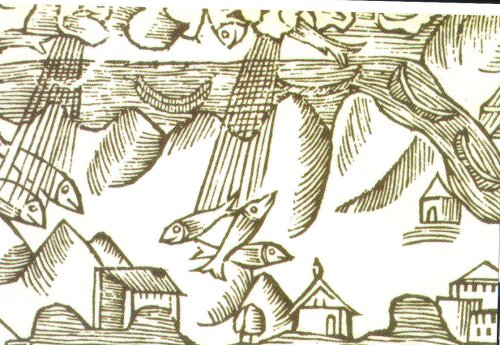
The Sky is Falling! No, Really. It’s Raining Fish.
Picture it. A quiet afternoon. The clouds gather, a familiar grey blanket rolling in. You hear the first patter of rain on the roof, a gentle rhythm. But then comes another sound. A wet, slapping sound. A thud. Another. You look outside, and the lawn isn’t just wet. It’s writhing.
It’s covered in fish.
Hundreds of them. Thousands. Silver scales flashing against the green grass, mouths gasping in a world they were never meant to see. This isn’t a scene from a bizarre movie. It’s not a dream. This is a documented, historical, and shockingly modern phenomenon known as the “rain of animals.” And it’s one of the most baffling and persistent mysteries on Earth.
Forget everything you think you know about weather. We’re about to go down a rabbit hole where the official explanations crumble under scrutiny, and the truth might be stranger than any of us can imagine.
The Modern Case Files: This Isn’t Ancient History
Think this is some dusty old legend from the Middle Ages? Think again. The sky is still, on occasion, dropping its living cargo all over the world.
Take the summer of 2000 in Ethiopia. It was a day like any other for the farmers in the rural countryside. Then the sky opened up. But it wasn’t just water. A local paper, struggling to make sense of the event, described a scene of pure chaos: “The unusual rain of fish, which dropped in millions from the air – some dead and others still struggling – created panic among the mostly religious farmers.”
Imagine the terror. The confusion. Is it a miracle? A curse? An omen? For those on the ground, scientific theories are a distant luxury. The reality is a terrifying, flapping, scaly carpet of life where it absolutely should not be.
And it keeps happening.
Fast forward to the final days of 2021. The residents of Texarkana, Texas, were dealing with a severe storm. Loud claps of thunder, flashes of lightning. And then, the thuds. People emerged from their homes to find small, palm-sized fish littering their yards, driveways, and even the parking lot of a local tire shop. It was real enough for the City of Texarkana to post about it on their official Facebook page, confirming the “animal rain” and immediately offering up the standard explanation.
The explanation we’re about to tear apart.
This isn’t just about fish. We have credible reports from all over. Frogs in Serbia. Spiders in Brazil, creating a horrifying “spider-web” effect in the sky. Worms in Louisiana. The list goes on and on, a catalogue of the impossible happening right in front of our eyes.
The “Official” Story: Celestial Vacuum Cleaners on a Fishing Trip?
Ask any meteorologist or mainstream scientist about this, and you’ll get a calm, rehearsed answer. It’s almost always blamed on one thing: waterspouts.
A waterspout is essentially a tornado that forms over water. You’ve seen the pictures. A twisting funnel of cloud and water, connecting the ocean or a large lake to the sky. The theory goes that these powerful vortexes act like giant vacuum cleaners.
Deep Dive: How a Waterspout (Supposedly) Does It
The mechanics sound plausible enough, at first. A column of rotating air, with incredibly high wind speeds, forms over a body of water. The intense low pressure at its core creates a powerful suction effect. It sucks up water, and along with it, anything unlucky enough to be swimming near the surface.
Fish. Frogs. Snails. Algae.
The whirlwind then carries this aquatic payload high into the atmosphere, sometimes for miles and miles, before its energy dissipates. As the vortex weakens, it can no longer hold its contents. And so, everything it vacuumed up comes tumbling back down to Earth, often far from the original source. Simple, right? A neat little box to pack the mystery in.
Too bad it’s full of holes.
Where The Official Story Springs a Leak
The waterspout theory is clean. It’s simple. It’s the kind of explanation that stops people from asking more questions. But the moment you start asking those questions, the entire explanation falls to pieces.
Problem #1: The Incredible Picky Eater
This is the big one. The absolute killer of the waterspout theory. In almost every single documented case, the rain consists of *only one type of animal*. Not just fish, but one specific *species* of fish. Or one particular kind of frog.
Think about that for a second. Have you ever seen a pond or a lake with only one species in it? No. A real body of water is a chaotic soup of life. There are different kinds of fish, frogs, newts, snails, water beetles, weeds, sticks, mud, sand, and probably a few rusty beer cans for good measure.
A tornado is a force of pure, indiscriminate violence. It is not a careful connoisseur, delicately plucking only the 3-inch silver herring from the water while leaving the catfish, the reeds, and the mud behind. If a waterspout sucked up a column of lake water, the resulting rain should be a disgusting, muddy, chaotic slurry of everything from that ecosystem. But it never is. We get a rain of perfectly clean, perfectly sorted perch. How?
Problem #2: Where’s the Water?
Another glaring issue. If a waterspout carried a massive school of fish for miles, it would have to carry an absolutely colossal amount of water along with them. We should be seeing a localized deluge, a flash flood accompanying the fishy downpour. But that’s not what witnesses report. They report the animals falling, sometimes with normal rain, sometimes from a clear blue sky with not a drop of extra water in sight. The creatures arrive, but their habitat doesn’t. Where did the lake go?
Problem #3: The Impossible Journey
Let’s assume a tornado *could* be so selective. The journey itself is a death sentence. These creatures would be violently sucked thousands of feet into the air, into the upper atmosphere where temperatures plummet well below freezing. They would be subjected to insane pressure changes and tumbling chaos. Yet, in many cases, witnesses report the animals are alive, even vigorous, upon landing. How could a delicate frog survive being flash-frozen and then dropped from a mile high? In other cases, they are frozen solid, which makes sense for the altitude, but that only deepens the mystery of the cases where they are perfectly fine.
Enter Charles Fort: The Grandfather of High Strangeness
Long before the internet, before X-Files, there was Charles Fort. In the early 20th century, this American writer and researcher became obsessed with events that conventional science swept under the rug. He spent his life in libraries, poring over scientific journals, newspapers, and magazines, collecting accounts of the inexplicable.
He was the original chronicler of the weird. Rains of fish, falls of frogs, mysterious explosions, unidentified aerial phenomena—he collected them all in his 1919 masterpiece, “The Book of the Damned.” Damned, he said, because they were facts and events that had been damned and excluded by the scientific establishment because they didn’t fit the neat, orderly narrative.
Fort was the first to catalogue these animal rains in a systematic way, pulling together dozens of historical accounts:
- A shower of small, yellow toads in Kirkcudbrightshire, Scotland, in 1894.
- A rain of periwinkles that covered the ground in Worcester, England, in 1881.
- A downpour of thousands of tiny fish over Singapore in 1861.
He was the one who first pointed out the absurdity of the waterspout theory. He mocked the selective nature of these “tornadic fishermen.” His work was so influential that today, these bizarre, unexplainable events are known as “Fortean phenomena.” He didn’t have the answers, but he was brave enough to say that the official stories were a joke.
If Not Tornadoes, Then What? The Theories Get Wild
Once you discard the flimsy waterspout explanation, you are left in a vast, open territory of speculation. The door is open to ideas that are far more mind-bending.
Theory 1: The “Upper Ocean” Hypothesis
What if the sky isn’t empty? Charles Fort himself toyed with the idea of a “Super-Sargasso Sea”—a vast, unseen ocean in the upper atmosphere, teeming with its own strange life. Could it be that these creatures aren’t from our lakes and rivers at all? What if they live up there, in some kind of atmospheric ocean we lack the tools to perceive? And what if, occasionally, disturbances in this upper realm cause its inhabitants to “fall” into our lower world? It sounds like science fiction, but is it any more ridiculous than a tornado that only eats one kind of frog?
Theory 2: Portal Malfunctions
Let’s go deeper. Modern physics theorizes about wormholes, extra dimensions, and the multiverse. What if our reality isn’t as stable as we think? Could these animal rains be the result of a brief, accidental tear in the fabric of spacetime? A momentary vortex opening up between our world and another place—or another dimension entirely? Perhaps on the other side, there’s a world where fish-filled oceans are in the sky, and we’re just getting the occasional, terrifying spillage. A cosmic plumbing leak. The ultimate “glitch in the Matrix.”
Theory 3: An Unknown Biological Function
This one is a little more grounded, but still deeply strange. Could this be part of a biological process we simply don’t understand? Perhaps certain species have evolved a bizarre, high-risk method of mass migration or spawning that involves getting lofted into the jet stream. Maybe their eggs are microscopic, get carried into the clouds, hatch, and grow into tiny froglets or fish before falling in the rain. It’s a long shot, but nature is filled with survival strategies that are far stranger than we can imagine.
The Honduras Miracle: Where The Impossible is an Annual Event
Nowhere is this phenomenon more profound, more predictable, and more mysterious than in the small city of Yoro, Honduras. Here, it doesn’t just happen once. It happens every single year.
It’s called the “Lluvia de Peces,” or the “Rain of Fish.”
Sometime between May and June, after a massive thunderstorm, the streets of Yoro are found covered in thousands of live, edible fish. It has happened for as long as anyone can remember—for well over a century. It’s so reliable that the locals see it as a miracle. Legend says a Spanish Catholic missionary, Father José Manuel de Jesús Subirana, visited the impoverished region in the 1860s and prayed for a miracle to feed the people. The Lluvia de Peces began shortly after and has continued ever since.
Scientists have, of course, tried to debunk this “miracle.” A team from National Geographic in the 1970s investigated and determined the fish were not a known local species, and were, in fact, completely blind, suggesting they lived not in lakes, but in underground rivers. The prevailing “skeptical” theory is that the heavy seasonal rains flood these subterranean caverns, forcing the fish up through sinkholes and onto the streets.
But that explanation has problems, too. Why does it only happen in this one small region? Why are they found on the streets after the storm, and not seen being washed up during it? The locals are adamant: the fish fall from the sky. They don’t wash up from the ground.
The annual Lluvia de Peces stands as a defiant, recurring monument to the unknown. A yearly appointment with the impossible.
So where does that leave us? We have a phenomenon with thousands of witnesses, spanning centuries and continents. We have an official explanation that is, frankly, laughable when you look at the details. And we have a set of alternative theories that range from the biological to the extra-dimensional.
The simple truth is, we don’t know. Science, for all its power, has a blind spot for things that refuse to fit. The rain of animals is one of those things. It’s a cosmic prank, a puzzle box dropped from the heavens.
So the next time you see a dark cloud on the horizon, don’t just reach for an umbrella. Look closer. Listen harder. You never know what might be about to fall out of it.
The world is stranger than they tell you.