India’s 10 Most Unbelievable Mysteries: The Truth Is Stranger Than You Think
Forget what you learned in history class. Peel back the curtain of the everyday world, and you’ll find something else waiting. Something older. Weirder. A world of whispers, ancient curses, and phenomena that defy every law of science we hold dear. India, a land of ancient wisdom and sprawling history, is ground zero for some of the planet’s most baffling enigmas. This isn’t just a list of spooky places. This is a dossier of the unexplained. A deep dive into the stories that scientists dismiss, governments ignore, and locals speak of only in hushed tones.
Are you ready to question everything? Good. Let’s begin.
Kuldhara’s Curse: The Town That Vanished in a Single Night
Imagine a thriving, bustling town. Over 1,500 people. Generations of families. Homes, temples, a community built over centuries. Now imagine it empty. Silent. Gone. Not over years, but in a single, terrifying night.
This isn’t fiction. This is the story of Kuldhara.

Deep Dive: The Minister’s Lust and the Brahmins’ Fury
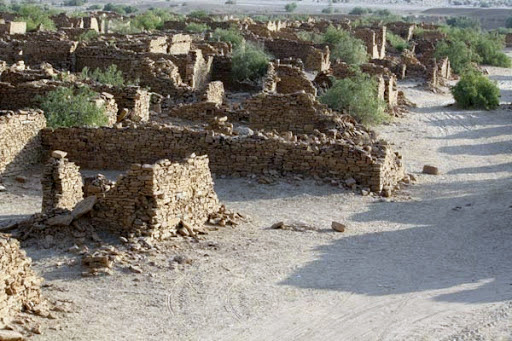
Established way back in the 13th century by the Paliwal Brahmins—a community known for their intelligence and prosperity—Kuldhara was a jewel in the desert near Jaisalmer. They were masters of agriculture in an unforgiving land. Their secret? They knew how to find water where no one else could. For over 500 years, they flourished.
Then came Salim Singh. The Diwan, or chief minister, of Jaisalmer. A man whose cruelty was as legendary as his greed. The story goes that Salim Singh set his predatory eyes on the beautiful daughter of Kuldhara’s village chief. He demanded her hand in marriage, threatening to impose crushing taxes on the entire community if they refused.
He gave them an ultimatum. An impossible choice. Surrender the girl or face ruin. The Paliwal Brahmins, a proud and honorable people, were not about to sacrifice one of their own to a tyrant. The chieftains of all 84 surrounding Brahmin villages met in secret. They made a pact. They would not bow. They would not break. They would leave.
And so, under the cover of a moonless night in the early 1800s, all 84 villages vanished. Thousands of people packed what they could carry and melted into the darkness, leaving behind their homes, their land, their history. But they didn’t leave quietly. Before they disappeared forever, they laid a curse upon Kuldhara. A curse of absolute desolation. No one, they vowed, would ever be able to settle on this land again. Anyone who tried would meet a grim fate.
The Lingering Ghosts of Kuldhara
Today, Kuldhara is an archaeological site. A ghost town. The stone houses still stand, eerily preserved by the dry desert air, but the silence is deafening. Tourists walk the empty streets during the day, but no one dares to stay after sunset. The curse holds. Locals swear the place is haunted by the spirits of the Paliwals.
Paranormal investigators who have visited the site with modern equipment report inexplicable phenomena. Sudden drops in temperature. Disembodied voices captured on audio recorders. Shadows flitting through doorways. Some have even reported being touched by unseen hands or seeing the faint handprints of children on dusty walls. The government tried to turn it into a tourist hub, but even the guards they hire refuse to work the night shift. They say the town is still alive after dark. And it does not welcome visitors.
Himalayan Enigmas: Yetis, Immortals, and Red Snow
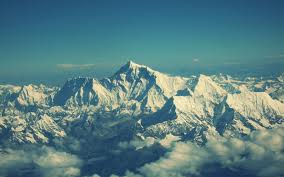
The Himalayas. The roof of the world. A place of staggering beauty and brutal, unforgiving nature. But these mountains hold more than just snow and rock. They are a hotbed of high-altitude mysteries that have puzzled explorers and mystics for centuries.

Deep Dive: The Abominable Snowman
Let’s start with the big one. The Yeti. Westerners call it the “Abominable Snowman,” a mistranslation of a local term. For the Sherpa people, the Yeti is a very real creature of the high snows, a powerful, ape-like beast to be feared and respected. For decades, stories have trickled down from the peaks. Sightings of a hulking, hairy biped. Strange, high-pitched whistles echoing through the valleys. And, most famously, the footprints.
In 1951, British explorer Eric Shipton was trekking near Mount Everest when he photographed a series of massive, human-like footprints in the snow. The image became iconic, a piece of irrefutable proof for believers. For skeptics? A bear track distorted by melting snow.
But the stories persist. Even Sir Edmund Hillary, the first man to conquer Everest, reported seeing strange tracks on his expeditions. Recent DNA analysis of supposed Yeti hair and bone samples has often concluded they belong to an ancient species of polar bear or the Himalayan brown bear. But here’s the question they never answer: could a simple bear inspire such a powerful, enduring legend across multiple cultures? Or is the scientific explanation just an easy way to dismiss something we can’t comprehend?
The Hidden City of the Immortals
The mystery of the mountains goes beyond cryptids. There are ancient tales of Gyanganj, which translates to “the land of the wise.” It’s said to be a hidden city-state, a secret kingdom of immortal yogis and enlightened beings, perfectly concealed within the remote valleys. This isn’t a physical place you can find on a map. The legends say it exists on a different vibrational plane, accessible only to those who are spiritually worthy. These beings are said to watch over humanity, subtly guiding our destiny from their mountain sanctuary. Is it just a myth? Or is there a hidden society of masters who have achieved what modern science deems impossible?
The Aleya Ghost Lights: Souls of the Swamps
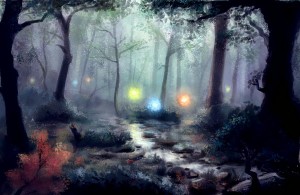
Travel east to the murky, mangrove-choked marshlands of West Bengal. Here, in the dead of night, local fishermen witness a terrifying and beautiful phenomenon: the Aleya, or “ghost lights.”

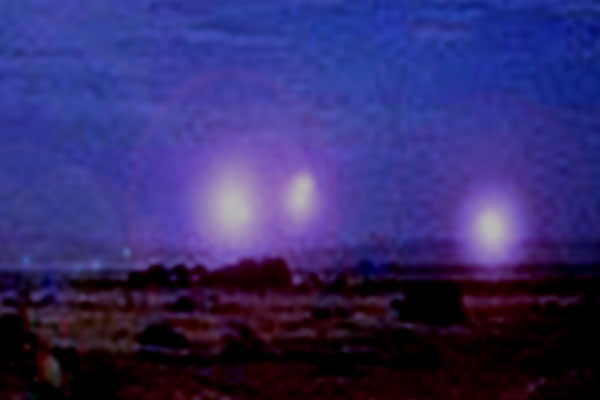
These are flickering, bobbing orbs of light that hover just above the water’s surface. They glow in eerie colors—red, green, blue—and seem to move with a strange intelligence. The folklore is chilling. The lights are believed to be the tormented souls of fishermen who drowned in the swamps. They are tricksters, luring living fishermen off the safe paths and deeper into the maze-like wetlands. Follow the lights, the stories warn, and you will lose your way, become hopelessly lost, and ultimately drown, your own soul joining the spectral dance.
The Skeptic’s Corner: Swamp Gas or Something More?
Scientists have a neat explanation, of course. They call it “will-o’-the-wisp.” The theory is that decomposing organic matter in the marshes releases gases like methane and phosphine, which can spontaneously ignite when they come into contact with the air, creating a brief, flickering flame. Case closed, right?
Not so fast. The fishermen who see these lights every night disagree. They say the lights are not random. They seem to follow boats. They appear to react to human presence. Sometimes, multiple lights will converge and move together in formation. Can simple swamp gas account for this seemingly intelligent behavior? And what about the numerous bodies of missing people found in the swamps, far from any known waterways? The locals know the truth. The lights are a lure. A deadly, supernatural trap.
The Crimson Rain of Kerala: A Message from the Stars?
In July 2001, the skies over Kerala opened up and it rained blood. Not literally, but the rain that fell was a startling, vibrant red. It stained clothes, buildings, and the ground itself a rusty, crimson color. The phenomenon continued sporadically for two months.

Deep Dive: Algae Spores or Alien Cells?
The official explanation settled on airborne spores from a local species of green microalgae, *Trentepohlia annulata*, which has a strong orange-red pigment. A massive “bloom” of these spores was supposedly sucked into the rain clouds, coloring the precipitation. It’s a plausible theory. But it doesn’t explain everything. Many witnesses reported hearing a massive sonic boom just before the first red downpour, suggesting a meteor airburst. Could an exploding meteor have seeded the clouds with something else?
This is where it gets really strange. Physicist Godfrey Louis, then at Mahatma Gandhi University, collected samples of the red rain. Under the microscope, he found something incredible. The red particles looked like biological cells. But they had no DNA. Let me repeat that. They were biological cells with no genetic material—something unknown to science on Earth. Louis proposed a radical theory: panspermia. He argued that the cells were extraterrestrial in origin, carried to Earth on a comet or meteor that exploded over Kerala. The red rain, he claimed, was evidence of life from space. His research was controversial, and largely dismissed by the mainstream. But the question remains: what really fell from the sky over Kerala?
Chir Batti: The Ghost Lights of the Great Salt Desert
In the vast, desolate expanse of the Banni grasslands and the Rann of Kutch, a massive seasonal salt marsh in Gujarat, another mysterious light phenomenon has been witnessed for centuries. The locals call it Chir Batti, which means “ghost light.”

These lights are described as intensely bright, pear-shaped orbs, about the size of a football. They change color from blue to red to yellow and move with astonishing speed. Sometimes they hover in one place; other times they dart across the flats. Border security forces and countless locals have reported the lights seeming to follow them, keeping pace with their vehicles before suddenly shooting off into the night. What are they? The scientific explanation is, once again, the oxidation of methane rising from the marshlands. But can that explain lights that appear to be under intelligent control? The folklore offers a different answer. They are spirits. Ghosts of the desert, forever wandering the salt flats.
The Barisal Guns: Cannons of the Gods?
Imagine hearing the thunderous boom of a cannon offshore. You look out to the water, but see nothing. No ships. No smoke. Just an empty horizon. For centuries, people living along the Ganges and Brahmaputra river delta have been hearing these “mistpouffers” or “Barisal Guns.”

These are unexplained sonic booms that have been reported long before the invention of jets or cannons. They sound like a single, massive explosion or a volley of artillery fire. Scientists have theories, of course. Distant thunder from a storm over the horizon. Methane gas erupting from the riverbed. Small earthquakes. But none of these theories fully fit the descriptions, which often mention the sounds occurring on clear, calm days. This phenomenon isn’t unique to India; similar sounds are heard all over the world. Is it the sound of the Earth’s tectonic plates groaning? Or is it something else, a sound from a source we have yet to identify?
Roopkund: The Glacial Lake of Skeletons
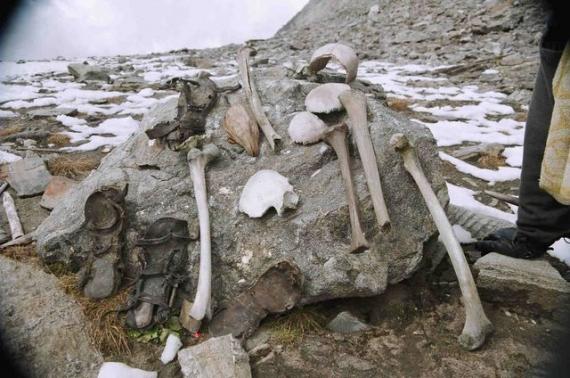
High in the Himalayas, at a breathtaking altitude of 16,500 feet, lies a small, frozen lake. It’s called Roopkund. For most of the year, it’s a tranquil, unremarkable body of ice. But when the snow melts for a short period each summer, it reveals a horrifying secret. The lake is full of bones.

Deep Dive: A Centuries-Spanning Death Puzzle
Discovered by a forest ranger in 1942, the shallow lake and its shores are littered with the skeletal remains of hundreds of people. Who were they? How did they all die here, in this impossibly remote location? For decades, the leading theory was that they were a king and his royal entourage, on a pilgrimage, caught in a sudden, freakish hailstorm around the 9th century. Forensic analysis supported this, showing that the victims all died from blows to the head, consistent with being struck by large, cricket-ball-sized hailstones from directly above.
But a groundbreaking 2019 DNA study blew that theory out of the water. The new evidence revealed something far stranger. The skeletons didn’t belong to one group, or even one time period. The analysis identified at least three distinct genetic groups who died there at different times. One group of South Asian ancestry did indeed die around 800 AD. But another group, with genetic ties to the eastern Mediterranean—people from Greece or Crete—died at the lake around 1800 AD! A full 1,000 years later. A third individual was of Southeast Asian ancestry.
This transforms the mystery. It’s no longer about a single catastrophe. It’s a puzzle. What is it about this one, tiny lake that drew people from different corners of the world, across a thousand years, to die in the exact same spot? The mystery of Skeleton Lake has only gotten deeper.
Kongka La Pass: A Joint India-China UFO Base?
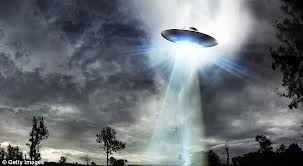
The Kongka La Pass is one of the most remote and inaccessible places on Earth. Located in the Himalayas, it sits on the disputed border between India and China in Ladakh. It’s a military no-man’s-land. And according to local residents on both sides of the border, it’s also home to a massive, underground UFO base.

The story goes that both the Indian and Chinese governments know about the base and have a tacit agreement not to patrol the area too heavily. Why? Because what’s there is beyond their control. For years, pilgrims and locals have reported seeing strange triangular craft and glowing discs silently emerging from the ground, hovering for a moment, and then shooting into the sky at impossible speeds. In 2012, the Indian Army and Indo-Tibetan Border Police reportedly observed a “luminous, unidentified object” over the region for several months. They tried to track it, but it was too fast and moved in ways no known aircraft could.
Is this just a rumor born from a tense, secretive military zone? Or have two of the world’s most powerful nations silently agreed to leave a small patch of the Himalayas alone because they know we are not the only intelligence operating on this planet?
Jatinga’s Bird Suicide Phenomenon
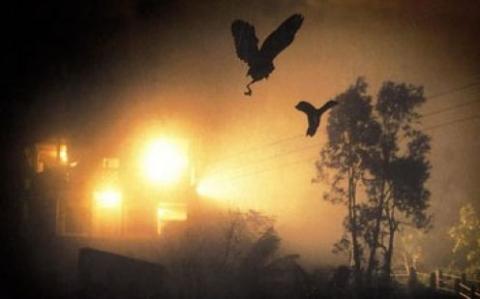
Every year, in the small village of Jatinga in Assam, something tragic and bizarre happens. Between September and November, on dark, foggy, moonless nights, hundreds of birds descend from the sky and drop dead.

It’s not technically a “suicide.” The birds, mostly migratory species, become disoriented and dazed. They fly towards the village lights and then crash into trees, buildings, and the ground. The phenomenon happens only along a very specific 1.5-kilometer strip of land, and only between 7 PM and 10 PM. Ornithologists believe the combination of high altitude, dense fog, and strong winds disorients the birds, and they are attracted to the village lights as a source of stability.
But that doesn’t feel like the whole story. Why does this happen so predictably, in this one specific location, year after year? Locals used to believe that evil spirits in the sky were responsible. While science has provided a partial explanation, the Jatinga bird phenomenon remains a deeply unsettling natural mystery. Is there a magnetic anomaly in the area? Some atmospheric condition we don’t understand? The birds of Jatinga keep their secrets.
Kodinhi: The Unexplained Village of Twins
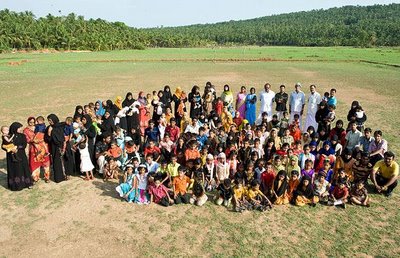
In the Malappuram district of Kerala lies a small, ordinary-looking village called Kodinhi. But there is nothing ordinary about it. This village has one of the highest rates of twin births in the entire world.

In a village of roughly 2,000 families, there are over 400 pairs of twins. That’s a rate nearly six times the global average. You can’t walk down a street in Kodinhi without seeing identical faces. It’s a town of doubles. The phenomenon started about three generations ago and has been accelerating ever since.
Doctors and scientists are stumped. They have studied the genetics of the villagers. They have tested the water, the air, and the soil. They have analyzed local diets. But they have found no clear reason for the twinning explosion. What’s even stranger is that women from Kodinhi who marry men from other villages and move far away also have a statistically high rate of twin births. It seems to be something in their genes, but what triggered it remains a complete mystery.
The world is filled with things we can’t explain. These places in India are not just points on a map; they are tears in the fabric of our reality, reminders that for all our science and all our technology, we are still just scratching the surface of the great, weird, and wonderful unknown.
Originally posted 2014-05-12 09:05:48. Republished by Blog Post Promoter