The Norwich Ghost Photo: Has This Image Captured Proof of the Afterlife?
Some pictures are worth a thousand words. Others are worth a million sleepless nights.
They say a camera can capture a soul. But what if it can capture a soul that’s already gone? What if a simple click, a flash of light in a dark room, could rip a hole in the veil between our world and the next? We’re not talking about blurry shapes or weird orbs of dust. We’re talking about something far more chilling. Something with a form. A presence. A figure sitting in an empty chair, staring out from the abyss of a photograph taken in the dead of night.
This is the story of one such photograph. An image so stark, so unsettling, that it has been whispered about in paranormal circles for years. It comes from a forgotten, unnamed building in the ancient city of Norwich, England. A place of deep history and, some say, even deeper sorrows.
Forget everything you think you know about ghost pictures. Prepare to look into the darkness. And ask yourself one question: What is looking back?
A Night of Fear in an Ancient City
The night was cold. The kind of damp, bone-chilling cold that seeps through stone and settles deep in your marrow. Inside a nondescript community hall in Norwich, the air was thick with anticipation and something else. Something heavy. Veteran paranormal investigators Jodie Carman and Chris Hunter were leading a small group, their faces illuminated by the faint green glow of night-vision cameras.
This wasn’t their first rodeo. They’d spent countless nights in England’s most haunted locations, chasing whispers in derelict asylums and shadows in crumbling castles. But this place… this place felt different.
It started subtly. A floorboard creaking upstairs when everyone was downstairs. A sharp, sudden rap on a distant wall. The kind of sounds you try to explain away. The building settling. The wind. A rat in the walls.
But then the activity escalated. Dramatically.
The Possession Incident
Sources from the investigation that night speak of a terrifying event that preceded the now-infamous photograph. One of the female guests on the tour suddenly became distressed. Her demeanor changed in a flick of a switch. One moment she was nervously sipping a flask of coffee; the next, her eyes glazed over. Witnesses claim she began speaking in a voice that was not her own—a harsh, guttural tone that echoed strangely in the cavernous hall.
She spoke of being cold. Of being lost. Of a fire.
The team, led by Hunter, tried to communicate, their own fear masked by a thin veneer of professionalism. The atmosphere became electric, charged with a terrifying energy. After a few tense minutes, the woman slumped forward, gasping, seemingly returning to her senses with no memory of the last few moments. She was shaken, pale, and utterly terrified.
The hall fell silent. The bumps and raps had stopped. But the feeling of being watched was now a hundred times stronger. The air was dead still. It was the calm before the storm. It was in this supercharged, unnerving silence that Jodie Carman raised her camera.
The Photograph That Defies Explanation
Jodie wasn’t aiming at anything in particular. She was just trying to document the room, capturing the rows of empty chairs in the oppressive darkness. She lifted her digital camera, framed the shot, and pressed the shutter.
Click. Flash.
The sudden burst of light momentarily blinded everyone. And in that split second, several people gasped. They saw it. A shape. A flicker of something in the seats a few rows ahead that vanished as their eyes adjusted back to the gloom.
“Did you see that?” someone whispered.
Chris immediately swung the beam of a powerful torch toward the chairs. Empty. Every single one. Just worn fabric and cold, empty air. There was nowhere to hide, no way anyone could have been sitting there and then disappeared in a second.
Jodie’s heart hammered against her ribs. She lowered the camera and looked at the small screen on the back. And then she froze.
“Oh my God,” she breathed. “Look.”
The team crowded around, their torch beams dancing nervously around the hall. On the camera’s display was the image of the empty chairs. Except they weren’t all empty.

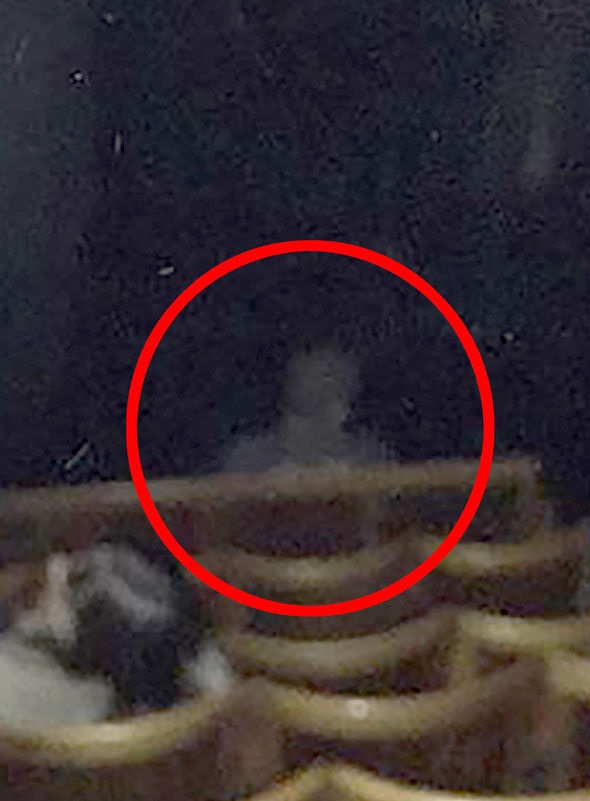
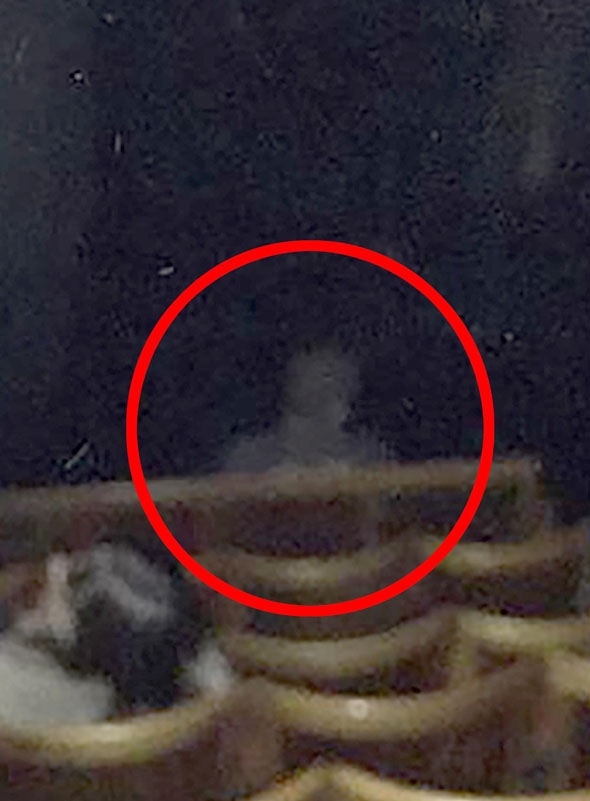
There, sitting upright in a chair a few rows down, was a figure. A spectral form. It wasn’t a smudge or a trick of the light. It was the unmistakable shape of a person’s head and shoulders, translucent and glowing with an eerie internal light against the deep shadows of the hall. It was solid enough to have a clear outline, yet you could see the chair right through it.
“We knew there was something there with us that night, we could hear it moving around the hall around us,” Jodie later recounted. “But this photo definitely proves it. There is no way that you can deny it as the shape is very clear.”
The initial shock gave way to a stunned amazement. This was it. The kind of evidence investigators spend a lifetime searching for, often in vain. “When everyone saw it they were at first stunned into silence,” Carman said. “Everyone had seen me take the picture and knew there was no one in front of me.”
A Closer Look at the Anomaly
Skeptics are always quick to jump on photos like this. It’s pareidolia, they say—the human brain’s tendency to see patterns, like faces, in random arrangements. It’s a reflection. A lens flare. A clever fake.
But let’s look closer. Let’s zoom in.

When magnified, the figure doesn’t dissolve into a random collection of pixels or a convenient light reflection. The shape holds. You can clearly make out the curve of a shoulder, the side of a head, and what appears to be a high collar or a hood. It’s not a wisp of smoke or a random flash. It has structure. It has form. It is *occupying* a space.
Jodie Carman stands by the photo’s authenticity. “There are lots of pictures that appear of ghosts, many of debatable quality but I think a photo like this is exceptionally rare,” she insisted. “To get a clear shot, with nobody near it, completely untampered with. It’s quite incredible and I’ve never seen anything like this before.”
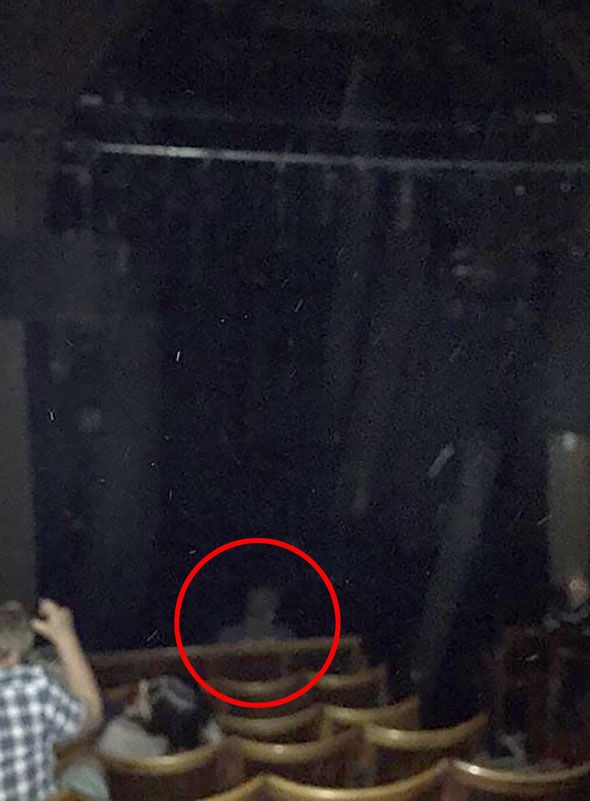
They checked for reflective surfaces. There were none. They tried to recreate the shot. They failed. The team was adamant: no one else was in the building. The doors were locked. This entity had appeared from nowhere, and vanished just as quickly.
Deep Dive: The Haunted History of Norwich
Why Norwich? Why this particular, unnamed hall? To understand the ghost, you have to understand the ground it walks on. The investigators have kept the exact location a secret to protect it, but Norwich itself is a city saturated with history and death.
Founded by the Anglo-Saxons, Norwich has seen it all. Viking raids. Norman conquest. It was once the second-largest city in England, a bustling hub of trade. But with great history comes great tragedy.
- The Plague Pits: Norwich was ravaged by the Black Death multiple times. In 1349, the plague wiped out nearly half its population. Mass graves, or plague pits, were dug all over the city. Could ancient bones lie beneath the foundations of this community hall?
- Kett’s Rebellion: In 1549, a massive peasant revolt led by Robert Kett ended in a brutal siege and the execution of thousands. The city ran with blood. The ghosts of this conflict are said to still linger in the shadow of Norwich Castle.
- The Workhouses: The Victorian era brought grim workhouses to the city, places of immense suffering, poverty, and despair. Families were torn apart, and people died in misery. Many old community buildings were once such institutions.
Could the figure in the chair be a lost soul from one of these dark chapters? A plague victim, forever searching for their family? The spirit of a tormented inmate from a long-demolished workhouse? The possession incident, where the woman spoke of being cold and of a fire, could be a clue—a residual memory from a spirit who met a tragic end.
The Internet’s Verdict: Digital Ghosts or Digital Fakes?
When the Norwich ghost photo first hit the web, it exploded. Paranormal forums and social media groups lit up with debate. Digital sleuths downloaded the image, picking it apart pixel by pixel. The theories were wild and varied.
Some cried fake immediately. “It’s a simple Photoshop job,” one commenter on a forum claimed. “Someone has taken a low-opacity image of a person and layered it over the chair.” Yet, no one has ever been able to produce definitive proof of tampering. The image metadata reportedly showed it came straight from the camera, unaltered.
Others proposed more grounded explanations. Could it be a long-exposure shot where someone sat down and then got up quickly, creating a “ghost” effect? The investigators deny this, stating it was a standard flash photograph, a split-second event.
Then came the more out-there theories. Some have suggested the figure bears a resemblance to a medieval monk or cleric, pointing to the “high collar” as evidence of a habit. Norwich was a major religious center with dozens of churches and priories. Could this be a spiritual guardian, disturbed by the investigation?
Perhaps the most fascinating theory is that it isn’t a ghost at all, but a “place memory”—a psychic impression left on the environment, replayed like a snippet of old film under the right conditions. The high energy of the “possession” event might have been the trigger that caused this spectral recording to play back, just for a moment, long enough for a camera to capture it.
What If It’s Real?
Let’s stop. Let’s push all the skepticism aside for a moment. Let’s entertain the most terrifying, most profound possibility: that the photo is 100% real. What does that mean?
It means that death is not the end. It means that an echo of consciousness, a fragment of a person, can persist long after the body has turned to dust. It means they are here, among us, sitting in our empty chairs, walking through our empty halls, silent and unseen.
Are they lost? Are they confused? Or are they watching?
The figure in the Norwich photograph isn’t a monster. It isn’t threatening. It’s just… there. Sitting quietly in the dark. A silent spectator from another world. And that, somehow, is more frightening than any Hollywood horror movie. It suggests a reality far stranger than we can imagine, a world teeming with invisible souls, going about their unseen business right next to us.
The photo doesn’t provide answers. It only creates bigger, more disturbing questions. Who was this person? What binds them to that hall in Norwich? And how many more are out there, waiting for the split-second of a camera flash to reveal their presence to a world that has forgotten them?
Look at the picture one more time. Look into the empty spaces. The dark corners. The vacant chairs. You never know who might be sitting there.