The REAL Bermuda Triangle is in Space, and It’s Zapping Our Satellites
You’ve heard the stories. The whispers. The legends of the Bermuda Triangle, that strange patch of ocean where ships and planes vanish without a trace. A place where compasses spin wildly and reality itself seems to bend. It’s a fantastic mystery, the kind that keeps you up at night.
But what if I told you the real Bermuda Triangle isn’t in the Atlantic Ocean?
What if it’s hundreds of miles above our heads? An invisible, swirling vortex of energy that our most advanced technology flies through every single day. A region of space where satellites suddenly shut down. Where multi-million-dollar telescopes go blind. Where hardened military and civilian computers inexplicably crash, their circuits fried by a force we are only just beginning to comprehend.
This isn’t science fiction. This isn’t a conspiracy theory from a grainy internet forum. This is real. Scientists are calling it a “Bermuda Triangle in space,” and the culprit is a one-two punch from our own sun and a bizarre quirk in Earth’s own planetary wiring.
Forget phantom islands and sea monsters. The truth is far stranger, and its effects are already being felt.
A Cosmic Hurricane Raging Through Our Solar System
To understand this celestial mystery, you first have to understand the monster at the center of our solar system. The Sun. It’s not just a friendly ball of light in the sky. It’s a churning, violent nuclear furnace, and it’s constantly throwing things at us.
I’m talking about the solar wind.
It’s not wind in the way you think of it. You can’t feel it on your face. You can’t hear it howl. It’s a completely invisible, unending storm of charged particles—mostly protons and electrons—blasted from the sun’s super-hot outer atmosphere, the corona. This isn’t a gentle breeze. This is a cosmic hurricane, a relentless river of plasma screaming through the solar system at speeds that are difficult to even imagine. We’re talking up to 2 million miles per hour.
Faster than a speeding bullet? That’s not even a fair comparison. It’s so fast it would get from the Earth to the Moon in a little over an hour.

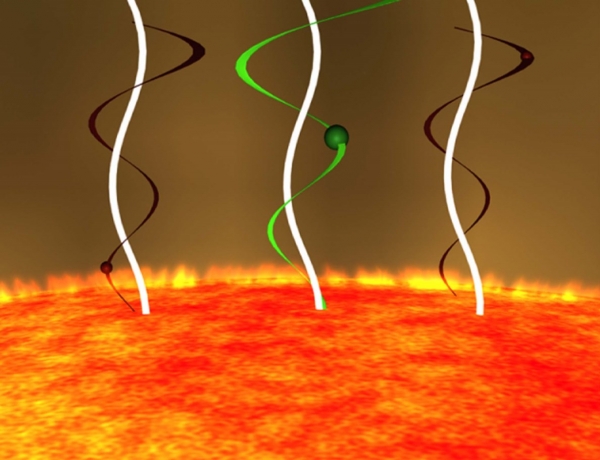
This NASA illustration gives you a small idea of what’s happening. Think of the Sun’s magnetic field lines (the white lines in the image) as giant, vibrating strings. These vibrations give the solar wind particles a massive push, like an ocean wave launching a surfer forward. It’s a constant, violent push that never, ever stops. Every planet, every asteroid, every satellite is being sandblasted by this invisible storm, 24/7.
The Ghost in the Machine: Discovering the Solar Wind
For most of history, we had no idea this was even happening. The space between the planets was supposed to be a perfect, empty vacuum. But strange things kept happening. Comet tails, for instance. Why did they always point away from the Sun, even when the comet was moving away from it? It was as if some invisible force was constantly blowing them outward.
The idea of a “solar wind” was first formally proposed in the 1950s by a brilliant astrophysicist named Eugene Parker. At the time, his theory was so radical, so outside the box, that two separate scientific journals rejected his paper. They thought he was nuts. But Parker was right. In 1962, NASA’s Mariner 2 probe, on its way to Venus, flew right through this “wind” and measured it directly. The ghost was real. And it was everywhere.
Earth’s Secret Electric River
So, we have this 2-million-mile-per-hour hurricane of particles constantly slamming into our planet. Why aren’t we all fried? The answer is our planet’s secret weapon: the magnetosphere.
You can think of it as an invisible force field, a giant magnetic bubble generated by the churning molten iron core of our planet. It’s our cosmic umbrella. For the most part, this magnetic shield does a brilliant job of deflecting the solar wind, forcing the deadly particles to flow around our planet like water around a boulder in a stream. It’s the reason life on Earth exists. Without it, the solar wind would have stripped away our atmosphere billions of years ago, leaving us a barren rock like Mars.
But our shield isn’t perfect. It has quirks. Weak spots. And one of the weirdest and most significant is a phenomenon known as the Equatorial Electrojet.
Sounds like something out of a comic book, doesn’t it? It might as well be. The Equatorial Electrojet is a narrow, intense ribbon of electrical current that flows like a super-highway for charged particles, high up in our ionosphere. It zips eastward, about 60 miles above the ground, directly over the planet’s magnetic equator. It’s a river of electricity in the sky, a natural feature of our planet’s wiring that we’re only now realizing has some very dangerous side effects.
When Worlds Collide: The Shockwave and the Storm
So, here are the two players in our cosmic drama. The relentless solar wind and Earth’s quirky electric river in the sky. Most of the time, our magnetic umbrella handles the wind just fine. But the sun is a fickle beast. It doesn’t just blow a steady wind; it also has violent outbursts. Solar flares. Coronal Mass Ejections. These events send out massive, concentrated shockwaves of energy and particles—gusts in the cosmic hurricane.
When one of these shockwaves hits Earth’s magnetic field, things get interesting. As space physicist Brett Carter from RMIT University so perfectly put it, Earth’s magnetic field acts like an umbrella, and when the “wind changes the umbrella also flops around.”
At the poles, this “flopping” creates the beautiful auroras, the Northern and Southern Lights. That’s the solar wind energy being funneled down and exciting gas particles in the atmosphere. Beautiful, but also a sign of a massive energy transfer. A geomagnetic storm.
But something new and far more localized has been discovered. Something that happens at the equator. When a solar wind shockwave hits Earth just right, it doesn’t just rattle the whole shield. It can strike the Equatorial Electrojet and do something terrifying.
It supercharges it.
Suddenly, that peaceful river of electricity becomes a raging torrent. This sudden, violent amplification creates an intense, localized magnetic storm, right over the equator. And this is the birth of the Space Bermuda Triangle. It’s a temporary, but violent, zone of pure electronic chaos.
Why Your GPS Might Suddenly Go Haywire
Imagine you’re a satellite. You’re orbiting the Earth at thousands of miles per hour, doing your job—relaying GPS signals, snapping weather photos, handling financial transactions. Then, without warning, you fly through one of these supercharged equatorial zones.
The intense magnetic field can induce powerful electrical currents in your delicate circuitry. Your onboard computer might suddenly reboot. Or worse, short-circuit and crash completely. Your sensors might go haywire, feeding junk data back to Earth. Navigation systems could fail. In this region, for a few minutes or even hours, the normal rules of physics seem to break down for our technology.
Satellites go quiet. Telescopes can’t get a clear picture. Communications drop. It’s a ghost in the machine, a temporary dead zone for our high-tech world, all because of an invisible storm we never even knew was happening.
The Disturbing Evidence Hiding in Plain Sight
How do we know this is real? Researchers didn’t just dream this up. Carter and his team embarked on a massive data-crunching mission. They painstakingly analyzed 14 years of ionospheric data from monitoring stations all around the globe. They were looking for patterns, for correlations between events in deep space and strange happenings in our upper atmosphere.
And they found it. A chilling connection.
They discovered that the Equatorial Electrojet had this terrifying tendency to act up, to become violently amplified, whenever it was struck by one of these interplanetary shockwaves. The real shocker wasn’t that this happened, but *how easily* it happened. Even small shockwaves, ripples in the solar wind that were too weak to trigger the big, famous geomagnetic storms at the poles, were more than capable of creating these intense magnetic maelstroms at the equator.
This means these events are happening far more frequently than anyone ever thought. We’ve been so focused on the spectacular light show at the poles that we missed the invisible storm brewing right over the heads of billions of people.
Not Just a Space Problem: The Threat on the Ground
Okay, so a few satellites get zapped. Why should you, down on Earth, care? Because this “space weather” doesn’t stay in space.
A powerful, fluctuating magnetic field in the sky can do something called induction. It can create very real, and very dangerous, electrical currents in long conductors on the ground. Things like power lines. And oil and gas pipelines.
They’re called Geomagnetically Induced Currents (GICs), and they are the stuff of nightmares for electrical engineers. These rogue currents can flow into our electrical grids, overloading transformers and causing them to overheat, melt down, or even explode. This isn’t a theoretical threat. It has happened before.
In March 1989, a massive solar storm slammed into Earth, triggering a geomagnetic storm that was felt across the globe. In Quebec, Canada, the GICs surged into the power grid. In less than 90 seconds, the entire province was plunged into a blackout that lasted for 12 hours, affecting six million people.
Now, take that scenario and move it to the equator. According to the new findings, these equatorial storms might rev up a lot more often than the big ones at the poles. The more frequent magnetic storms from the supercharged electrojet could be quietly causing serious problems for the critical infrastructure in places like South America, Africa, southern India, and Southeast Asia.
Could a Solar Storm Blackout a Billion People?
Think about the consequences. Unexplained pipeline corrosion that was blamed on poor maintenance. Strange power surges in electrical grids that were written off as equipment failure. Could they have been caused by these invisible equatorial storms? The researchers believe it’s not only possible, but likely.
These are not doomsday-style events that will end the world. But the idea that our technology, both in space and on the ground, can be so profoundly affected by a phenomenon so far away is a chilling wakeup call. What happens when a rapidly developing nation, increasingly reliant on a stable power grid and satellite communication, gets hit? The potential for disruption is immense.
The Unanswered Questions and Whispers Online
Like any good mystery, this discovery opens up more questions than it answers. It forces us to look back at past events with a new, unsettling perspective.
How many “unexplained” satellite failures over the last 50 years were actually victims of this Space Bermuda Triangle? How many times have we blamed human error or faulty engineering when the real culprit was a gust of solar wind hitting our planet just wrong?
Online forums and alternative history channels are already buzzing with the implications. Some have asked if past, mysterious power outages in equatorial regions, long before we had the tools to monitor such things, were linked to this. Events that history has forgotten, written off as local failures, could they have been the footprint of a cosmic storm?
And, as always, the deeper questions emerge. If this is a natural phenomenon, can it be predicted? Our space weather forecasting is still in its infancy. We can see a big storm leaving the sun, but predicting its precise impact on a specific region of Earth’s atmosphere is incredibly difficult. Are our modern satellites and power grids being built to withstand these newly understood equatorial threats?
The truth is, we live under an electric sky, one far more volatile and interconnected with our daily lives than we ever dared to imagine. The Sun is not a passive observer. It is an active and powerful engine, and its ghostly wind can reach out across 93 million miles of empty space and flip a switch on our planet. The mystery of the “Bermuda Triangle in space” isn’t solved. It’s just beginning.