Home Weird World Photo Galleries Nuclear Explosion – Amazing Pictures

Nuclear Explosion – Amazing Pictures

0
56

The Day the Sky Caught Fire: Why We Can’t Look Away

Boom. Silence. Then the roar of a thousand thunders.

Nuclear explosions are the ultimate nightmare fuel. They are the endgame. The final curtain. Yet, there is something hypnotically beautiful about them, isn’t there? It’s a guilty fascination. We stare at these images of absolute destruction the same way we stare at a cobra hooding up to strike. It’s terrible. It’s deadly. But you cannot take your eyes off it.

For decades, the governments of the world—specifically the US and the Soviet Union—locked this footage away. They buried it in lead-lined vaults. They stamped it TOP SECRET. Why? Because the raw power captured on these film reels was too much for the public psyche to handle. They didn’t just film explosions; they filmed the death of the old world.

But now, thanks to declassified archives and the relentless digging of internet archivists, we have the tapes. And let me tell you, the history books left out the weirdest parts.

We are going to take a hard look at the “Mushroom Cloud” phenomenon. We aren’t just looking at pictures. We are tearing apart the physics, the conspiracy theories, and the absolute insanity of the men who stood behind the cameras, watching the apocalypse unfold through a glass lens.

The Physics of Hell: Why Does It Look Like That?

Ever wonder why it’s always a mushroom? Why not a sphere? Why not a jagged bolt of lightning?

It’s not an artistic choice. It’s basic fluid dynamics acting on a god-like scale. When that bomb detonates, you are looking at a fireball that is hotter than the center of the sun. Literally. For a fraction of a second, we create a star on Earth.

That heat is desperate to move. It creates a vacuum. A low-density bubble of superheated plasma that shoots upward instantly. As it rises, it drags the cooler, denser air from below right up the middle. It’s a chimney effect from hell.

This creates the “stem” of the mushroom. The cap? That’s the fireball hitting the upper atmosphere, cooling down, and flattening out as it hits the tropopause. It hits a ceiling in the sky and spreads out. The result is that iconic, terrifying fungal shape.

The “Rope Trick” Anomaly

Look closely at some of the high-speed footage from the 1950s. You see these strange, vertical spikes poking out of the bottom of the fireball. They look like legs. Or ropes.

For years, conspiracy theorists went wild. Was the bomb leaking? Was it aliens? Was it a glitch in the simulation?

The truth is even weirder. It’s the “Rope Trick” effect. Those bombs were often suspended on steel towers or held in place by massive guide wires. The radiation from the blast is so intense, and travels so much faster than the shockwave, that it vaporizes the steel cables instantly. The cables turn to gas before the fireball even touches them. Those “spikes” are the ghosts of the tower, glowing in their death throes.

The Secret Movie Studio: Lookout Mountain

Here is where things get shady. You’d think these tests were filmed by military scientists, right? Lab coats and clipboards?

Wrong. They were filmed by Hollywood.

Enter the Lookout Mountain Laboratory. Nestled in the Hollywood Hills, this was a top-secret movie studio running from 1947 to 1969. It had sound stages, editing bays, and animation departments. Their only client? The United States Air Force and the Atomic Energy Commission.

They recruited the best cinematographers in the business. These guys were used to lighting movie stars. Now, they were lighting the end of the world. They developed special cameras protected by lead and steel bunkers. They invented lenses that could zoom in on a fireball from miles away without melting.

Why go to all this trouble? Why make it look “cinematic”?

Propaganda.

The government needed to sell the bomb. They needed to show the Soviets they had the bigger stick, but they also needed to show the American tax-payer that the money was worth it. They turned science into a blockbuster movie. Every mushroom cloud you see in history books was framed, composed, and edited for maximum psychological impact.

Operation Crossroads: The Water Monsters

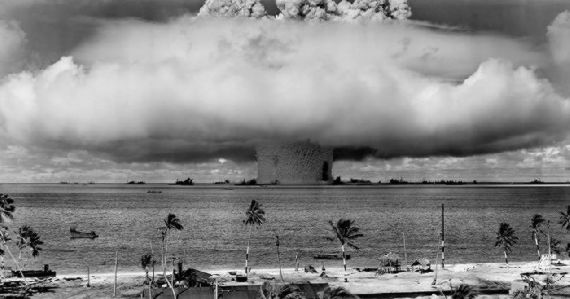
Let’s shift gears to 1946. Bikini Atoll. Operation Crossroads.

This wasn’t a desert test. This was a water test. They wanted to see if a nuke could sink a navy fleet. So, they dragged a bunch of captured German and Japanese battleships—and some old American ones—out to the middle of the lagoon and dropped the sun on them.

The “Baker” shot is perhaps the most famous photo in history. But look closer. That’s not smoke. That is water.

The explosion lifted two million tons of water into the air. That column you see? It’s hollow. The walls of that water column are 300 feet thick. And right there, on the side of the column, you can see a black smudge. A vertical shadow.

That smudge is the USS Arkansas. A 27,000-ton battleship.

The blast lifted a battleship vertically into the air like a toy in a bathtub. The ship was crushed, pulverized, and erased before the water even crashed back down. This creates the “base surge”—a rolling wall of radioactive mist that engulfed the nearby observation ships.

This was the moment the military realized: “Oops. We can’t clean this up.” The radiation didn’t go away. The ships that survived the blast were so radioactive they had to be sunk later because you couldn’t stand on the deck for five minutes without your hair falling out.

The “Atomic Soldiers” Conspiracy

It gets darker.

While the cameras were rolling, capturing the majesty of the cloud, there were human beings in the trenches. Thousands of them.

These were the “Atomic Soldiers.” Young men, mostly in their early 20s, drafted or enlisted, who were ordered to march toward the mushroom cloud. The official story? They were training for nuclear warfare. They needed to see how troops would react psychologically to a blast.

The unofficial theory? They were lab rats.

Many of these soldiers reported seeing the bones in their hands. When the flash hit, it was so bright—an X-ray pulse of unimaginable power—that for a split second, they could see through their own flesh. They covered their eyes with their hands, and they saw their own skeletons.

Then came the heat. Then the wind. Then the dust.

For decades, the government denied that these men were harmed. “The dosage was low,” they said. “It was safe,” they claimed. But the cancer rates among these veterans tell a different story. They were witnesses to the forbidden fire, and they paid for it with their lives.

Castle Bravo: When the Math Failed

If you think the scientists always knew what they were doing, let me introduce you to Castle Bravo.

1954. The US is testing a new design. A dry fuel hydrogen bomb. They crunched the numbers. They expected a yield of about 6 megatons. Massive, sure. But manageable.

They pushed the button.

The explosion wasn’t 6 megatons. It was 15 megatons.

It was 1,000 times more powerful than the Hiroshima bomb. The scientists in the concrete bunker nearly died. The ground shook so hard the lights went out. The fireball just kept growing. It expanded miles into the sky in seconds. It was a monster that broke its cage.

Here is the tragedy. Because the blast was triple the size expected, the wind maps were useless. Radioactive ash—what looks like white snow but burns like acid—began to fall on inhabited islands. It fell on the Lucky Dragon 5, a Japanese fishing boat that was supposedly in the “safe zone.”

The fishermen didn’t know what it was. They brushed the “snow” off their decks with their bare hands. By the time they got back to port, their skin was turning black. It sparked an international incident and gave birth to the movie Godzilla. That monster wasn’t just a fantasy; it was a metaphor for Castle Bravo.

High Altitude Madness: Nuke the Rainbow

We didn’t just blow up the ground. We blew up space.

Enter Starfish Prime in 1962. The question was simple: What happens if we detonate a nuke 250 miles above the Earth? You know, just to see what happens.

The result was an artificial aurora borealis. The sky over the Pacific Ocean turned blood red, then violent purple, then green. It was beautiful. It looked like a rift in spacetime had opened up.

But the EMP (Electromagnetic Pulse) was stronger than anyone predicted. It knocked out streetlights in Hawaii, 900 miles away. It fried satellites in orbit. It created a radiation belt around the Earth that lingered for years.

There are theories—deep rabbit holes—that suggest this actually weakened the magnetosphere. Did we permanently scar the shield that protects us from the sun? Some climatologists look at the weather data from the mid-60s and point to some very strange anomalies.

The Double Flash Mystery

Here is a detail for the true detectives out there. A nuclear explosion has a “fingerprint.” It’s called the Double Flash.

If you watch a regular bomb, it goes boom and fades. A nuke is different. It flashes incredibly bright, then dims for a split second, then gets bright again. Why?

The first flash is the shockwave moving so fast it creates a superheated shell of air that blocks the light from the inside. The air becomes opaque. It’s a light-blocking shield made of heat. Then, as the shockwave expands and cools, the air becomes transparent again, and the fireball inside becomes visible. Flash. Dim. Flash.

This is how satellites detect secret nuclear tests. You can hide the seismic rumble, but you can’t hide the double flash. It’s the signature of the atom splitting.

The Lost Footage & The Mandela Effect

There are rumors of footage that has never been released. Footage that shows things physics books can’t explain.

Some archivists claim there are reels from the Soviet Tsar Bomba test—the largest explosion in human history—that show atmospheric ignition. Rumors of localized weather distortions that lasted for weeks. Strange lights in the sky *before* the detonation.

Is it possible that ripping apart the building blocks of reality does more than just make a big boom? Are we weakening the fabric of our dimension?

Look at the footage again. Watch the clouds. Watch the shockwaves. It doesn’t look like fire. It looks like a living thing. A growing, breathing entity that consumes everything it touches.

The Silence of the Aftermath

What’s left after the mushroom fades?

Glass. Trinitite. The desert sand melts into green glass. It’s beautiful, smooth, and radioactive. It’s a reminder that we have the power to turn the world into a glazed marble.

These photos are not just history. They are a warning. We built these things. We tested them over 2,000 times. We poisoned our own air, our own water, and our own soldiers, all in the name of security.

The next time you look at that mushroom shape, don’t just see a weapon. See the hubris of man. See the moment we took the fire of the gods and realized it was too hot to hold.

The archives are open. The footage is out there. Go watch it. But be warned: once you see the raw power of the atom, the world looks a lot more fragile.

What do you think?

Are these just explosions, or is there something more sinister hiding in the frames of these old films? Did the “Atomic Soldiers” see something they weren’t supposed to? Drop a comment below. The truth is usually stranger than the official report.

Originally posted 2016-04-09 04:27:56. Republished by Blog Post Promoter