Tuesday, May 5, 2026
HomeWeird WorldScienceNewton's 'Philosopher's Stone' recipe found

Newton’s ‘Philosopher’s Stone’ recipe found

Stop everything. Forget what you learned in high school physics. Wipe the slate clean.

We are taught that Sir Isaac Newton was the father of reason. The man who sat under an apple tree, got bonked on the head, and suddenly figured out gravity. The rational genius who brought order to a chaotic universe with clean, mathematical laws. But that is a curated lie. It is a sanitized version of history designed to make you feel safe.

The truth? The truth is much stranger. And a lot darker.

Newton wasn’t just the first scientist of the Age of Reason. He was the last sorcerer. He was a man obsessed with the occult, biblical prophecy, and the bending of reality itself. And for centuries, the scientific establishment tried to hide this side of him. They buried it.

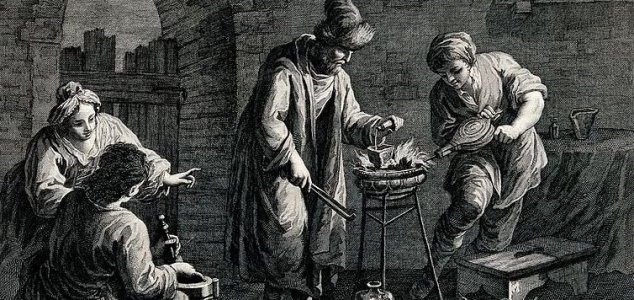
Vintage Alchemy Illustration

The Secret Manuscript Resurfaces

For hundreds of years, the world looked away. But the cracks in the official story are getting too big to ignore. A 17th-century alchemy manuscript, handwritten by Isaac Newton himself, has surfaced. It wasn’t in a museum. It wasn’t in a university library. It was found buried in a private collection, hidden away from prying eyes for decades.

This isn’t just a grocery list. This is a smoking gun.

The manuscript details a recipe. A specific, step-by-step guide to creating “philosophic mercury.” If you don’t know what that is, buckle up. In the shadowy world of alchemy, philosophic mercury wasn’t just a chemical. It was the primary ingredient—the “key”—needed to create the Philosopher’s Stone.

Yes. That Philosopher’s Stone. The legendary substance believed to grant immortality and turn base metals like lead into pure gold.

The manuscript recently went under the hammer at Bonhams in Pasadena. It didn’t just sell; it caused a frenzy. The Chemical Heritage Foundation (CHF) in Philadelphia snapped it up, finally bringing these forbidden notes out of the dark and into the public eye. But why now? And why was Newton, the man who gave us calculus, trying to cook up a magical potion to cheat death?

The “Last Magician”

To understand this, you have to understand the era. The 1600s were a wild time. Science and magic weren’t enemies yet. They were roommates. In fact, they were often the same thing.

Newton wrote over 10 million words in his lifetime. Here is the kicker: only a fraction of those words were about math or physics. The vast majority? Theology. Prophecy. And alchemy.

When the famous economist John Maynard Keynes bought a trunk of Newton’s private papers at an auction in 1936, he was shocked by what he found. He expected to see the calculations for the motion of planets. Instead, he found the ramblings of a mystic. Keynes famously said, “Newton was not the first of the age of reason. He was the last of the magicians.”

This newly discovered manuscript proves Keynes was right.

Newton didn’t see the universe as a mechanical clock. He saw it as a riddle left by God. He believed that the ancients possessed a secret wisdom that had been lost—a prisca sapientia. He thought that if he could decode the mythology of the Greeks and the Egyptians, he could find the recipe for the ultimate power over matter.

The Forbidden Recipe: Philosophic Mercury

So, what exactly is in this manuscript? It’s a copy of a text by George Starkey, an American alchemist who wrote under the pseudonym Eirenaeus Philalethes (“A Peaceful Lover of Truth”).

Starkey is a fascinating character all on his own. He was an American colonist, living in the wilds of New England, who eventually moved to London in 1650. He was possibly America’s first world-renowned scientist. Newton didn’t just read Starkey; he revered him. He copied Starkey’s notes word-for-word, trying to crack the code.

The recipe focuses on “philosophic mercury.” Normal mercury (quicksilver) is a liquid metal. But alchemists believed that if you could strip mercury of its impurities—if you could “kill” the metal and resurrect it—it would become a universal solvent. This solvent could then dissolve gold, not to destroy it, but to help it grow. They believed gold was alive. They thought it grew inside the earth like a plant. Philosophic mercury was the fertilizer.

“This manuscript links Newton’s alchemical practice to the American figure George Starkey,” said rare book curator James Voelkel. “He’s probably America’s first renowned, published scientist.”

Think about the implications. Newton was spending his nights hunched over a furnace, inhaling toxic fumes, trying to create a substance that would break the laws of physics as we know them. While the rest of London was sleeping, the smartest man on Earth was trying to hack reality.

Gold, Greed, and the Royal Mint

Here is where it gets suspicious. Why was all of this kept so quiet? Why did Newton burn so many of his papers before he died?

Consider his day job. Later in life, Isaac Newton became the Warden of the Royal Mint. He was the man in charge of England’s money. He was responsible for catching counterfeiters (and he did, sending many to the gallows). Now, imagine if the man in charge of the currency discovered a way to manufacture infinite gold in his basement.

The economy would collapse. The British Empire would fall. Money would become worthless overnight.

Did Newton find something? Did he get close? Some theorists suggest that his “nervous breakdown” in 1693 wasn’t just stress. It was mercury poisoning. Or maybe, just maybe, it was the psychological weight of knowing something he shouldn’t.

Alchemists used code names for ingredients. The “Green Lion.” The “Red King.” The “Doves of Diana.” This wasn’t just to be poetic. It was encryption. They were hiding their findings from the unworthy. Newton was a master of secrets. If he had cracked the code for the Philosopher’s Stone, he would have taken it to his grave.

The Quest for Immortality

The Philosopher’s Stone wasn’t just about getting rich. That’s the small-brain take. The true goal was spiritual and physical perfection.

The Stone was also known as the Elixir of Life. It was believed to cure all diseases, reverse aging, and grant eternal life. For a man like Newton, who was terrified of his own mortality and obsessed with his legacy, this was the ultimate prize.

At the time, alchemists believed that it was possible to break down metals into their constituent parts and transmute them into more valuable ones such as gold and silver. But it went deeper. It was about purifying the soul. You couldn’t make the Stone if you weren’t pure of heart. It was a chemical reaction that required prayer.

The manuscript found at Bonhams shows Newton correcting Starkey’s text. He is editing the recipe. He is interacting with it. He isn’t just a passive reader; he is an active participant in the Great Work.

A Dangerous Obsession

Alchemy was dangerous. Not just because of the explosions (though there were plenty of those). It was heresy. The Church didn’t look kindly on people trying to play God. If you were caught brewing strange potions and talking about “red dragons,” you could end up in a very bad situation.

Newton had to be careful. He kept his alchemy separate from his public face. To the world, he was the rigid mathematician. In private, he was a wizard. He analyzed the Bible to find the date of the Apocalypse (he predicted the world wouldn’t end before 2060, by the way). He tried to reconstruct the floor plan of Solomon’s Temple, believing it held the geometry of the universe.

This newly found document is a piece of that puzzle. It reminds us that the line between “science” and “magic” is a modern invention. For Newton, it was all one search for the truth.

Why This Matters Today

You might be asking, “Who cares? It’s just old, bad chemistry.”

Don’t be so sure. Newton’s alchemy wasn’t a waste of time. His work with alloys and metals likely informed his work on optics and the mirrors for his telescopes. His obsession with forces acting at a distance (like gravity) may have come from his alchemical belief in invisible, magical forces connecting all matter.

Without his “magical” thinking, we might not have the laws of gravity. The apple didn’t fall because of math. It fell because Newton was looking for the invisible hand of God.

Newton’s notes, which sold at auction to the Chemical Heritage Foundation (CHF) in Philadelphia, are now set to be published online to make them available for further study and analysis. This is huge. For the first time, internet sleuths, chemists, and historians can comb through these recipes together.

The Modern “Alchemy”

Today, we actually can turn lead into gold. We do it in particle accelerators. It costs billions of dollars and you only get a few atoms, but the principle is sound. Newton wasn’t wrong; he was just a few hundred years too early.

But the spiritual side? The quest for immortality? Look at Silicon Valley today. Billionaires are pouring money into “bio-hacking” and life extension technology. They are injecting young blood, freezing their bodies, and trying to upload their brains to the cloud. It’s the same old song.

They are the new alchemists. And just like Newton, they are looking for the Elixir of Life.

The Mystery Remains

What else is out there? Newton wrote thousands of pages that have never been fully analyzed. Some were lost. Some were burned. Some are sitting in dusty attics, waiting for an auctioneer to find them.

This manuscript is a window into the mind of a genius who walked the line between madness and brilliance. It forces us to ask: What did he really know? Did he find the answers he was looking for?

Maybe the Philosopher’s Stone wasn’t a rock. Maybe it was the knowledge itself. And maybe, just maybe, Newton found it.

So the next time you see a picture of Isaac Newton, don’t just see the scientist. See the alchemist. See the man who spent his life trying to turn the grey, heavy lead of this world into the shining gold of the divine. He was chasing a ghost. But in that chase, he built the modern world.

The manuscript is safe now in Philadelphia. But the questions? The questions are still burning.

Arindam Mukherjee
Arindam Mukherjee
Arindam loves aliens, mysteries and pursing his interest in the area of hacking as a technical writer at 'Planet wank'. You can catch him at his social profiles anytime.
RELATED ARTICLES
- Advertisment -

Most Popular

Recent Comments

Warren Pan Abbott on The legend of the Devil Monkey !
chris davies on The McPherson Tape Mystery
Reed Reedly on ET has Internet!
Bea Houseoffashion on Proof Of Time Travellers – Gallery
Marcus2012 on ET has Internet!
Reed Reedly on ET has Internet!
LaughsAtConspiracyNuts on The 9/11 Conspiracy – Myths and Facts
Alex Sliverman on Did the ancients fly?
Doctor Wholigan on Time Traveler in 1938 film
chris davies on The McPherson Tape Mystery
Archie1954 on 10 secret UFO hideouts
chris davies on Ghosts of flight 401
Marcus2012 on ET has Internet!
jason Macdonald on Proof of Time Travel? – China
chris davies on Long-Lost Pyramids Found?
Reed Reedly on ET has Internet!
Milkman on Connected Universe
Tenmiles on Baigong Pipes Mystery
Simon Foster on Sirius – The Documentary
From the 1st April on 2013 – Alien Contact date ?
SkyWatcher on Is ET ignoring us?
I Come From The Future on Obama to make UFO Alien disclouser soon ?
ÛñK?øWn on 2013 – Alien Contact date ?
Just another person on 2013 – Alien Contact date ?
Malcolm Windowcleaner on The strange case of Rudolph Fentz
Mason Servio on Strange Things on Mars
Marke Wisdom Seeker on What will we find as arctic melts?
Andrea A Elisabeth Levyne on Aliens Captured in Varginha, Brazil
Mitch Grouyeki on Amazing Space Shuttle pictures