The Pluto Mission Was a Lie: What NASA’s New Horizons Probe is REALLY Hunting in the Deep Dark
Everybody remembers 2015. The world watched, breathless, as a machine the size of a grand piano screamed past Pluto after a nine-year journey across the solar system. We saw the pictures. The stunning, high-resolution shots of a frozen world with a giant heart etched on its surface. It was a triumph. A textbook case of exploration.
And that’s the story they want you to remember.
But the Pluto flyby wasn’t the end of the mission. It was the beginning. It was a gravity-assist maneuver. A cosmic slingshot. It was a course correction for the *real* target, a destination so remote, so strange, and so deep in the black that almost no one had ever heard of it. NASA’s New Horizons probe didn’t stop at Pluto. It punched the gas and aimed for the darkness.
Why? What’s really out there in the cold, silent graveyard of our solar system? The official answer is science. The real answer… well, the real answer is far more complicated. And a whole lot stranger.
The Kuiper Belt: The Solar System’s Forbidden Zone
Forget the neat, orderly maps of the solar system they showed you in school. The eight planets circling the sun like perfect little marbles. That’s a lie. A comfortable, tidy lie.
Beyond the orbit of Neptune, everything breaks down. Out there lies a realm of chaos. A colossal donut of ice, rock, and primordial debris left over from the dawn of creation, 4.6 billion years ago. This is the Kuiper Belt.
Think of it as our solar system’s attic. A dark, dusty, and freezing cold place filled with the stuff that never quite made it. Objects that never formed into planets. Ancient relics floating in a silent, cosmic sea. There are millions of them. Maybe billions. Most are small. Some are the size of moons. And they are all time capsules, perfectly preserved in the deep freeze of space, holding the original chemical recipe of our cosmic neighborhood.
This is where New Horizons was sent. Not just to visit one object. But to become the first human emissary to this forbidden zone.

This wasn’t an afterthought. It was always part of the plan. The probe was built with extra fuel. It was designed to last for decades out in the harshest environment imaginable. It was never just about Pluto.
The Target: A Ghost in the Dark
So, where do you go in a field of a billion objects? You don’t pick one at random. You just don’t.
Years before New Horizons even reached Pluto, astronomers were frantically scanning a tiny patch of sky with the Hubble Space Telescope. They were hunting. Searching for something specific. Something small, faint, and on the perfect trajectory for the probe to intercept after its Pluto flyby. It was a cosmic needle in a haystack spanning billions of miles.
And they found it.
A tiny pinprick of light designated 2014 MU69. A speck. Barely 30 kilometers across and more than a billion miles past Pluto. This was it. The chosen one. Out of all the cosmic debris, this was the rock they were going to spend a hundred million dollars to visit.
Makes you wonder, doesn’t it?
Deep Dive: The Impossible Search
Let’s be clear about how insane this search was. They were looking for an object darker than charcoal, smaller than a city, from over 4 billion miles away. The Hubble, as powerful as it is, was pushed to its absolute limits. The first few searches found nothing. Zero. It was only after NASA approved a high-risk, dedicated search that they finally got a hit.
Think about the resources poured into finding this one specific object. Was it just because it was conveniently located? Or was there something about 2014 MU69 that flagged it as special? Something in its light signature, its orbit, its… something. Something they weren’t telling us. The official story is that it was simply the most fuel-efficient target to reach. Convenient.
As the flyby approached, the object was given a nickname: Ultima Thule, a classical term for a place beyond the borders of the known world. How fitting. Later, it was given its official name, Arrokoth, a word for “sky” in the Powhatan/Algonquian language. A beautiful name for a mysterious object.
January 1, 2019: The Encounter
New Year’s Day, 2019. While the world was nursing hangovers, a small, lonely probe was performing the most distant planetary flyby in human history. It screamed past Arrokoth at 32,000 miles per hour, its cameras and sensors gobbling up every possible scrap of data in a frantic, automated sequence.
And then… silence.
Because of the immense distance, it takes a radio signal over six hours to travel from the probe back to Earth. For six hours, the mission controllers at Johns Hopkins University could do nothing but wait. Stare at screens. Drink coffee. And hope. Hope that their calculations were perfect. Hope that the probe hadn’t been vaporized by an unseen piece of debris. Hope that it had seen the ghost they sent it to chase.
Then, the signal came. A whisper across the void. “I’m okay.” Data began to trickle in. The first fuzzy images appeared. A blob. Then a slightly less-fuzzy blob. Then… something no one expected.
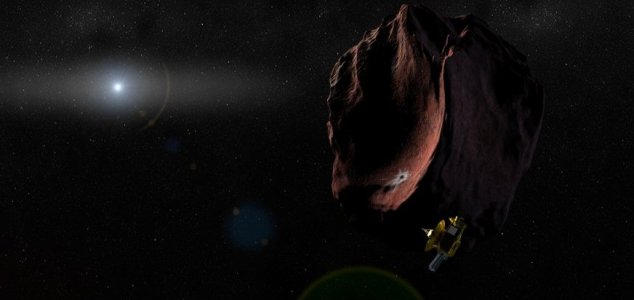
Arrokoth wasn’t a sphere. It wasn’t a potato-shaped asteroid. It was two objects. Two separate, reddish spheres, gently fused together at the “neck,” looking for all the world like a bizarre, lumpy snowman.
It was the first close-up look humanity has ever had of a Kuiper Belt Object. And it was weird.
What They Tell Us Arrokoth Is (And What It Might Really Be)
The official explanation from NASA is beautiful, in a sterile, scientific way. They call Arrokoth a “contact binary.” Two primordial objects, floating in the early solar nebula, that gently, slowly, bumped into each other and just… stuck. They didn’t smash. They kissed. And they’ve been floating together like that, almost completely undisturbed, for 4.5 billion years.
They say its strange, reddish color comes from organic molecules called tholins, created when simple compounds like methane are blasted by cosmic rays for eons. They point to the almost complete lack of impact craters as proof of its pristine, ancient nature. It’s a fossil from the birth of our solar system.
It’s a great story. But it leaves so many questions unanswered.
Theory 1: The Derelict Alien Machine
Let’s just say it. The shape is bizarre. It doesn’t look like a rock. It looks *constructed*. The two lobes, “Ultima” and “Thule,” are flattened like pancakes, not spherical. Why? Natural collisions don’t typically produce such a symmetrical, snowman-like object. Especially one with flattened sides.
And the lack of craters. The Kuiper Belt should be a shooting gallery. For billions of years, this thing should have been pelted by smaller rocks and ice. Yet it’s almost perfectly smooth. How is that possible? Is it made of something that self-heals? Or is its surface artificial, designed to withstand minor impacts?
What if New Horizons wasn’t sent to look at a rock? What if the faint signal Hubble picked up had a flicker of something… unnatural? A hint of technology? What if Arrokoth is a 4.5-billion-year-old alien probe, long dead, that was placed in the outer solar system to watch us? A silent sentinel. And NASA knew exactly what they were sending their probe to photograph.
Theory 2: The Marker for Planet X
For years, astronomers have been haunted by the strange, clustered orbits of objects in the extreme outer solar system. It’s as if they are all being herded by the gravity of something massive. Something we can’t see. A hidden giant. The hypothetical “Planet Nine,” or Planet X.
Now, look at the trajectory of New Horizons. It flew past Pluto. It flew past Arrokoth. It is continuing deeper into the Kuiper Belt. Is it just wandering? Or is it following a very specific path?
What if Arrokoth isn’t the destination, but a breadcrumb? A signpost? Perhaps its unusual orbit is influenced by Planet Nine, and by studying Arrokoth up close, NASA scientists can refine their models and pinpoint the location of the real prize. The New Horizons mission, then, is a secret reconnaissance flight for the biggest discovery in modern astronomy. They’re not looking for a small rock; they’re hunting a hidden world in our own backyard.
Theory 3: The Seed of Life
Remember those reddish tholins? NASA admits they are complex organic molecules. The very building blocks of life. For decades, the theory of “panspermia” has suggested that life didn’t start on Earth, but was delivered here by comets and asteroids.
Arrokoth is essentially a comet that never got close to the sun. It’s a pure, un-melted sample of the stuff that built everything. What if it’s more than just “organic molecules”? What if these objects are literal seeds, carrying frozen, dormant microbial life? And the flyby was an attempt to analyze one of these seeds up close, without the “contamination” of entering Earth’s atmosphere.
Could the real purpose of the New Horizons mission be to find the origin of life itself, frozen and waiting in the dark? It would be the most profound discovery in human history. It would also be a discovery so disruptive that they could never, ever announce it to the public directly. They would leak it out, slowly, in scientific papers filled with jargon about “complex organic compounds.”
The Mission Isn’t Over. It’s Just Gone Dark.
Here’s the kicker. New Horizons is still flying. It’s still healthy. It still has fuel. The original post from 2015 was right—scientists estimated it could keep going into the 2030s. It is now more than 5.6 billion miles from Earth, and moving away at almost 30,000 miles per hour.
NASA is actively searching for a third target. A third rendezvous deep in the Kuiper Belt.
Once again, they are using telescopes to scan the darkness ahead of the probe. Once again, they are looking for a very specific, hard-to-find object. What are the criteria this time? What secrets did they learn from Arrokoth that are now guiding their new search? The data from the Arrokoth flyby took a full 20 months to be completely downloaded. Are we sure we’ve seen all of it? Or were the most interesting readings classified the moment they arrived?
The story of New Horizons isn’t over. It has entered a new phase, one of deeper mystery. It is a lonely emissary in a part of our solar system we know virtually nothing about. It saw the heart of a fallen world. It photographed a strange snowman billions of miles from home. What will it see next?
The official mission is science. But out there in the cold and the quiet, where the sun is just another bright star, anything is possible. We didn’t just send a machine to take pictures. We sent a scout into the unknown. And we are still waiting to hear what monsters—or miracles—it finds in the dark.