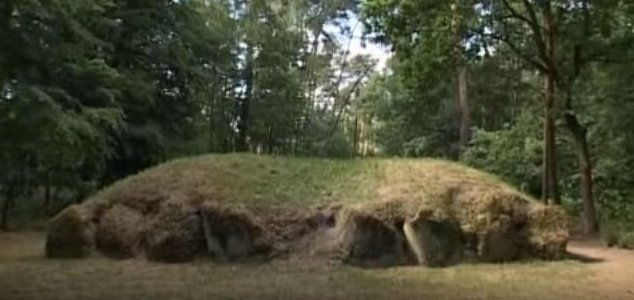
Poland’s Forgotten Pyramids: The 5,500-Year-Old Secret That Rewrites History
Forget what you think you know about the ancient world. Forget the sun-scorched sands of Giza. Forget the tales of pharaohs and their sky-piercing tombs. Because deep in the quiet, misty forests of Poland, a secret has been sleeping for millennia. A secret older than the pyramids. A secret that shatters our timeline of human civilization.
They are calling them the Polish Pyramids.
And they force us to ask a terrifyingly simple question: who were the master builders who came *before* the Egyptians?
The Discovery That Left Scientists Speechless
It didn’t happen with a shovel and a brush. Not at first. This wasn’t some lucky treasure hunter stumbling upon a lost relic. No. This revelation came from the sky. Researchers from the University of Szczecin were using a technology that sounds like something out of a sci-fi movie: airborne laser scanning. LIDAR.
Think of it as a high-tech x-ray for the Earth itself. A plane flies over the dense, ancient forests, firing millions of laser pulses toward the ground. These pulses slice through the thick canopy of leaves, past the branches, beyond the undergrowth, and map the hidden contours of the land beneath. They create a perfect 3D model of the ground, stripping away the forest to reveal a landscape untouched by modern eyes for centuries.
And what they found near the village of Dolic was staggering.
There, hidden in plain sight, were the unmistakable shapes of massive, man-made structures. Not one. Not two. But dozens.
Agnieszka Matuszewska, one of the researchers on the project, could barely contain her team’s excitement. “The area near Dolic is undoubtedly the most interesting, we have selected at least a dozen potential megalithic tombs,” she reported. But as the data poured in, the number just kept growing. “In the course of verification in the field we have clearly confirmed the presence of 18 Kujawy type megalithic tombs, a much higher number than previously known from the literature.”

Eighteen. An entire necropolis of giants, hidden beneath the trees.

These weren’t just mounds of dirt. They were tombs. Megalithic tombs. Engineered structures built from enormous stones, some weighing several tons, arranged in a precise and deliberate pattern. A graveyard for kings. And carbon dating puts them somewhere around 5,500 years old.
Let that sink in.
Five. Thousand. Five. Hundred. Years.
That’s a full 1,000 years before the first stones were stacked at Stonehenge. It’s nearly a millennium before the famous Great Pyramid of Giza was even a blueprint in a pharaoh’s mind. While the people of the Nile valley were still living in simple mud-brick villages, a mysterious culture in the heart of Europe was already engaged in colossal architectural projects.
Everything we’ve been taught about the dawn of civilization is centered on Mesopotamia and Egypt. The Fertile Crescent. But this discovery screams that another advanced society, a powerful and organized people, was thriving in the cold forests of the north.
Deep Dive: What Are These “Kujawy Type” Tombs?
So what do these structures actually look like? The term “pyramid” might conjure images of the Egyptian giants, but these are something different. Something uniquely European. Archaeologists call them “Kujawy type” long barrows, named after the Kujawy region of Poland where they were first identified.
Imagine a massive, elongated triangle, sometimes stretching longer than a football field. The base can be up to 15 meters wide, tapering to a point. The entire structure is outlined with enormous boulders, creating a stone skeleton. This stone frame was then packed with earth and smaller rocks, creating a monumental mound. The widest part, the “front” of the tomb, often featured a grand entrance made of even larger stones, leading to a small inner chamber.
This was the final resting place. The tomb proper.
Inside these chambers, archaeologists have found the remains of individuals, believed to be tribal chieftains, powerful priests, or revered elders. They weren’t just buried; they were interred with ceremony. Grave goods, though sparse, hint at a belief in an afterlife. Pottery. Flint tools. The essentials for a journey into the next world.
But the sheer scale is what’s mind-boggling. How did a supposedly primitive people, without the wheel, without metal tools, quarry and transport these multi-ton stones? How did they organize the labor force to build structures on this scale? This wasn’t the work of a small tribe. This was a massive, coordinated societal effort. It speaks of a culture with a strong social hierarchy, advanced planning capabilities, and a deep, driving spiritual conviction.
The Funnel Beakers: Europe’s Lost Super-Culture
So who were they? Who were these master builders of the north?
The history books call them the Funnel Beaker Culture. A rather dull name for such a remarkable people. The name comes from their most common artifact: a distinctive style of pottery with a flared, funnel-like neck. It’s the archaeological equivalent of their calling card, found at sites stretching from the Netherlands to Ukraine, from southern Sweden all the way to the feet of the Alps.
They were not a single kingdom or empire. They were a vast cultural network. A web of interconnected tribes who shared technology, beliefs, and, most importantly, a revolutionary new way of life. They were Europe’s first widespread farming society. They cleared the primeval forests, planted the first crops of wheat and barley, and herded the first domesticated cattle.
They fundamentally changed the continent. They were the pioneers.
But they were also obsessed with their dead. Or perhaps, more accurately, with honoring their ancestors. All across the lands they inhabited, they built these incredible megalithic tombs. The Polish Pyramids are not an isolated phenomenon; they are the grandest examples of a tradition that spanned a continent. They represent the peak of Funnel Beaker engineering and spiritual expression.
Then, around 2800 BC, they just… fade away. Their distinctive pottery disappears from the archaeological record. Their tomb-building ceases. They are replaced by new cultures, new peoples with new technologies, like the Corded Ware culture. It wasn’t a sudden collapse, but a gradual vanishing act. They built monuments to last an eternity, and then they themselves disappeared into the mists of prehistory.
The Timeline That Breaks Mainstream History
Let’s put this into a brutal, simple perspective. Let’s line up the dates and see how radical this Polish discovery really is.
- ~3500 BC: The Funnel Beaker people in Poland begin constructing their massive megalithic tombs, the “Polish Pyramids.”
- ~3100 BC: The first dynasty of pharaohs rises in Egypt, uniting the Upper and Lower Kingdoms.
- ~2670 BC: The architect Imhotep designs the Step Pyramid of Djoser, Egypt’s very first pyramid. It is a masterpiece, but it is almost 1,000 years *after* the Polish tombs were being built.
- ~2580 BC: Construction begins on the Great Pyramid of Giza, the wonder of the ancient world.
The evidence is undeniable. The timeline doesn’t lie. A sophisticated European culture was building monumental stone architecture for their dead centuries before the Egyptians even conceived of the idea. This single fact should force a complete re-evaluation of early human civilization. It suggests that the leap into complex, large-scale construction wasn’t an isolated event in the Nile Delta but a widespread human impulse that ignited independently in the forests of Europe.
So why isn’t this front-page news? Why aren’t documentary crews flocking to Poland? Is it because it doesn’t fit the comfortable, established narrative? The one we’ve been fed for generations?
The Conspiracy Corner: What If They Were More Than Just Tombs?
This is where things get really interesting. Mainstream archaeology will tell you these are “just” tombs. Important, yes, but simply elaborate graves. But what if that’s only part of the story? What if that’s the safe, easy answer that ignores the truly profound questions these structures raise?
Once you start looking, the coincidences become too hard to ignore.
What If They Are Celestial Markers?
Look at their design. These long, triangular barrows are not randomly placed. Many seem to have specific orientations. Internet researchers and archaeo-astronomers have long theorized that megalithic sites are aligned with celestial events. The solstices. The equinoxes. The rising and setting of certain stars like Sirius or the Pleiades.
Could the Polish Pyramids be more than tombs? Could they be astronomical clocks? Calendars etched onto the landscape itself? The long, triangular shape acts like a giant pointer, an arrow aimed at a specific point on the horizon. Perhaps on the winter solstice, the sun would rise or set perfectly framed by the entrance stones. Perhaps they were used to predict seasons, to know when to plant and when to harvest. The tomb part might be secondary—a way to imbue the sacred scientific instrument with the spiritual power of the ancestors.
What If They Are Plugged into the Earth?
Another theory gaining traction in online forums connects these sites to a global grid. The concept of “ley lines”—supposed lines of invisible earth energy that crisscross the planet—has been around for decades. Proponents of this idea point out that an uncanny number of ancient, sacred sites seem to fall along these straight lines.
Could the Funnel Beaker people have been sensitive to this energy? Did they build their tombs on specific nodes or power spots to harness this energy for healing, for rituals, or to create a bridge between the world of the living and the world of the dead? When you map the Polish sites and connect them to other Funnel Beaker megaliths in Germany, Denmark, and Sweden, strange patterns begin to emerge. It paints a picture of a culture that understood the very planet they lived on in a way we have completely lost.
What If They Didn’t Build Them Alone?
This is the question the mainstream is most afraid of. How did they do it? The official explanation is “brute force and ingenuity.” Log rollers, ropes, ramps, and an endless supply of human labor. And maybe that’s true.
But what if it isn’t? What if they had access to a lost technology? Knowledge of acoustics and sonic frequencies that could levitate stone? Or what if the legends of giants that permeate ancient European folklore aren’t just stories? The sheer audacity of these constructions, undertaken by a Neolithic people, forces us to at least consider the possibility that something is missing from the picture. That a key piece of the puzzle of our own past has been deliberately left out of the box.
The Story Is Far From Over
The discovery in Dolic is not an ending. It is a beginning. The LIDAR technology has given us a new set of eyes, allowing us to peer into the past like never before. How many more of these structures lie sleeping under the forests of Europe, waiting to be found? Each new discovery is another nail in the coffin of the old, outdated model of history.
The work on the ground is slow and painstaking. Archaeologists are now carefully excavating these sites, hoping to find artifacts, human remains, and environmental clues that can tell us more about the Funnel Beaker people. DNA analysis of the bones could reveal who they were, where they came from, and what they looked like. Isotopic analysis could tell us what they ate and where they traveled.
We stand at the edge of a new frontier in our own history. The secrets are out there. Not in some faraway desert, but right in the heart of modern Europe. The Polish Pyramids are a silent, stone challenge to everything we thought we knew. They prove that our ancestors were more sophisticated, more capable, and far more mysterious than we ever gave them credit for.
The story is just getting started. And the biggest discoveries are yet to come.