Echoes in the Void: The Chilling Stories Behind the World’s Ghost Towns
Silence.
It’s the first thing that hits you. A profound, unnatural quiet where the roar of life once was. Imagine standing in the middle of a street, surrounded by apartment blocks, schools, and playgrounds, yet the only sound is the wind whistling through a broken window pane. The air is thick with questions. Who lived here? What were their dreams? And the biggest question of all… where did they all go?
Some places die slowly. The jobs dry up, the people drift away, and the town withers on the vine. But others die in an instant. A single, catastrophic event that rips the soul from a community, forcing everyone to flee with only the clothes on their backs. They become accidental time capsules, frozen moments of panic and departure. A child’s doll left on a porch swing. A newspaper from a day that started like any other, now yellowing on a kitchen table. These aren’t just empty buildings. They are monuments to lives interrupted. They are ghost towns.
What causes a city to be wiped off the map, not by bombs, but by circumstance? Sometimes it’s the poison you can’t see. Sometimes it’s a political machine chewing up and spitting out its own people. And sometimes? Sometimes, the stories get weird. They talk of curses, of bad luck so potent it makes the land itself hostile to human life.
Let’s peel back the curtain of dust and decay. Let’s walk these silent streets together and listen to the echoes of what happened here.
The Nuclear Ghost: Pripyat’s Sudden, Silent End
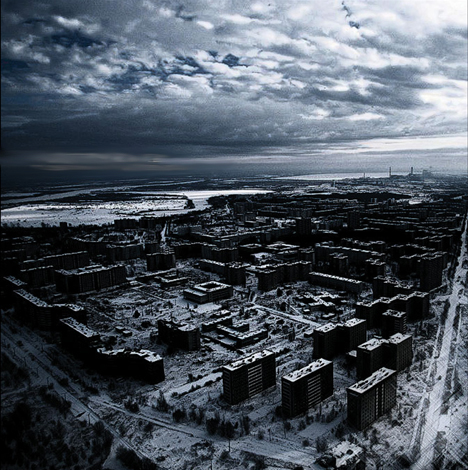
There is no place on Earth quite like Pripyat. Before April 26, 1986, it was a dream. A Soviet “atomograd,” or atomic city, built to house the workers of the nearby Chernobyl Nuclear Power Plant. It was young, modern, and brimming with optimism. With an average age of just 26, its 50,000 residents enjoyed amenities unheard of in other parts of the USSR: supermarkets, swimming pools, a cultural palace, and an amusement park set to open just days after the disaster.
It was a picture of the perfect socialist future.
Then, that future was annihilated in a flash of blue light.
In the early hours of the morning, a catastrophic power surge during a safety test at Reactor No. 4 caused an explosion that blew the 2,000-ton lid clean off. It spewed a plume of radioactive poison directly into the atmosphere—a fallout 400 times more potent than the bomb dropped on Hiroshima. Yet, in Pripyat, just a few kilometers away, the day began as normal. Children went to school. People went to work. They were completely unaware that they were breathing in particles of death.

The Three-Day Lie
It wasn’t until 36 hours later, after the wind had carried the radioactive cloud across Europe and alarms began blaring in Swedish power plants, that the Soviet government was forced to act. A fleet of over a thousand buses descended on Pripyat. The announcement came over the loudspeakers: a temporary evacuation. For their safety. They were told to pack only essential documents and a small amount of food. They were told it would only be for three days.
It was a lie.
They never returned. The city was abandoned in just over three hours. They left behind a world frozen at the exact moment of departure. Schoolbooks lie open on desks in a classroom, the lesson unfinished. In the iconic amusement park, the ferris wheel that never carried a single paying customer stands as a skeletal silhouette against the grey sky, a haunting symbol of a stolen future. Pripyat became the heart of the “Chernobyl Exclusion Zone,” a vast, contaminated territory where nature, in a strange and terrifying twist, has begun to reclaim what was lost. Wolves, bears, and wild horses now roam the empty streets, indifferent to the Geiger counters that still click frantically in the background.
The Arctic Anomaly: A Soviet Utopia Frozen in Time
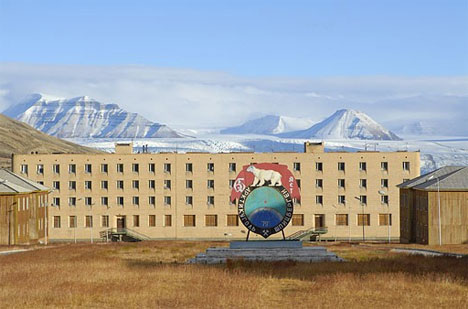
Deep inside the Arctic Circle, on the Norwegian archipelago of Svalbard, lies a place that shouldn’t exist. A perfect, preserved Soviet town, complete with a statue of Lenin staring out over the icy landscape. This is Pyramiden.
But wait. A Soviet town in Norway? How is that even possible?
The story begins with a strange international agreement called the Svalbard Treaty of 1920. It gave Norway sovereignty over the islands but allowed citizens of signatory countries—including the newly formed Soviet Union—to live and conduct business there. The Soviets, seeing a strategic and resource-rich foothold in the West, bought the coal-mining rights from Sweden in 1927 and established the town of Pyramiden, named for the pyramid-shaped mountain looming over it.
It was more than a mining town. It was a propaganda masterpiece.
The USSR poured money into Pyramiden to create an idealized communist community. For the 1,000-plus residents, it was an arctic paradise. They had the world’s northernmost swimming pool (heated, of course), the world’s northernmost grand piano, a state-of-the-art sports complex, and a cultural center with a theater and library. Families were prioritized, and life was good. It was a carefully constructed diorama designed to scream to the world: “See? The Soviet way is better!”

The Final Straw
The dream began to crumble with the fall of the Soviet Union in 1991. Subsidies from Moscow dried up, and operating a remote arctic mine was no longer economically viable. But the town clung to life. The real death blow came in 1996. A charter flight from Moscow, carrying miners and their families to Svalbard, crashed into a mountain on approach. All 141 people on board were killed. The tragedy devastated the small, tight-knit community of Pyramiden. It was a wound from which the town would never recover.
The decision came down from the state-run company, Arktikugol. The mine would close. The town would be abandoned.
The departure was swift and surreal. On March 31, 1998, the last ton of coal was extracted. Within months, everyone was gone. They left as if they were just popping out to the store. Film projectors in the theater still have reels in them. Athletic medals hang in display cases. In the school, children’s drawings are pinned to the walls. Because of the cold, dry arctic climate, decay has been held at bay. The buildings stand perfectly preserved, a ghost town so pristine it feels like the residents might return at any moment. But they won’t. Lenin still stands watch, the northernmost statue of him on Earth, presiding over a silent, frozen kingdom.
The UFO Ghost Town: Taiwan’s Cursed Pod City
Some places are abandoned for reasons you can measure, like radiation or economics. And then there’s San Zhi. A place abandoned because of whispers, nightmares, and a creeping dread that suggested the project was doomed from the very start. It was a place many believe was simply… cursed.
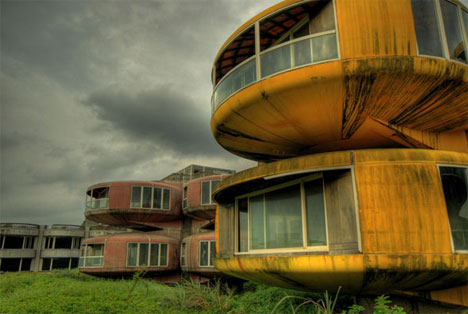
In the late 1970s, on the northern coast of Taiwan, a truly bizarre construction project began. It was to be the San Zhi Pod Resort, a futuristic luxury vacation spot aimed at wealthy locals and American military officers stationed in East Asia. The design was straight out of a sci-fi movie: clusters of colorful, flying saucer-shaped “Futuro houses” on stilts, offering stunning sea views. It was meant to be the future of leisure.
It became a legend of misfortune.
The full, official story is murky, clouded by decades of folklore and rumor. What we do know is that the project was plagued from day one. A series of strange and fatal accidents began to occur. Workers fell from scaffolds. Car accidents on the winding coastal road leading to the site became eerily frequent, with many involving project staff. The incidents grew so numerous and so bizarre that a dark cloud of superstition formed over the UFO-like pods.

A Recipe for a Haunting
Why? The local theories are the stuff of internet legend.
- The Dragon’s Curse: One popular story claims that the developers destroyed a ceremonial Chinese dragon statue at the resort’s entrance to widen the road. In feng shui, this is a catastrophic act of disrespect, inviting terrible luck and angering local spirits.
- The Unhallowed Ground: Another persistent rumor, repeated for years in online forums, is that the resort was built on top of a Dutch colonial-era burial ground. The restless spirits of the dead, their graves disturbed, were said to be lashing out at those who dared to build upon their final resting place.
- The Ghostly Traps: Some even whispered that the strange, unconventional architecture of the pod houses was disorienting to the spirits of the dead, trapping them inside and turning the entire resort into a haunted labyrinth.
Whether it was bad luck, bad karma, or just a series of tragic coincidences, the result was the same. The project ran out of money and investors pulled out. Construction halted. The San Zhi Pod Resort was left to rot, an unfinished dream decaying by the sea. For nearly 30 years, it stood as one of the world’s most famous and creepiest modern ruins, a magnet for urban explorers and ghost hunters. The fiberglass shells of the pods peeled and cracked, looking like the decaying husks of alien spacecraft. The site was finally, and completely, demolished between 2008 and 2010. Erased. As if someone wanted to make sure the curse, and the story, was buried for good.
Battleship Island: Japan’s Concrete Labyrinth of Lost Souls
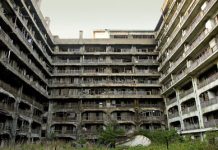
From a distance, it looks like a colossal, grey warship steaming through the East China Sea. Get closer, and you see it’s not a ship at all. It’s an island. An island made almost entirely of concrete. This is Hashima Island, better known by its nickname: Gunkanjima, or “Battleship Island.”
For almost a century, Gunkanjima was a hub of undersea coal mining, operated by the Mitsubishi Corporation. To house the thousands of workers and their families needed to extract coal from the dangerous pits deep beneath the ocean floor, an entire city was built on this tiny rock. Apartment blocks, a school, a hospital, shops, and a cinema were all crammed onto an island just 16 acres in size. At its peak in the 1950s, over 5,000 people lived here, making it the most densely populated place in the history of the planet. It was a concrete jungle in the truest sense, a vertical city connected by a maze of stairways and corridors, all protected from typhoons by a massive sea wall.
A Dark and Contested History
But this hive of industry had a dark underbelly. During World War II, as Japan’s able-bodied men were sent to fight, the empire relied on forced labor to keep its war machine running. Hundreds of Korean and Chinese civilians and prisoners of war were sent to Gunkanjima to toil in the mines under horrific conditions. They faced malnutrition, exhaustion, and brutal treatment in the hot, gas-filled tunnels. Many died. This history is a deep stain on the island, a source of ongoing political tension and a somber reminder that the island’s prosperity was built on immense suffering.
The end for Gunkanjima came as quickly as its rise. In the 1960s, petroleum began to replace coal as Japan’s primary energy source. Mines across the country started closing, and Gunkanjima’s was no exception. In January 1974, Mitsubishi officially announced the closure. The exodus was stunningly fast. Within three months, the most densely populated place on Earth was completely empty. Residents left with what they could carry, leaving televisions, furniture, and personal belongings behind in a mass departure. The island was sealed off, forbidden to all visitors.
For decades, Gunkanjima was left to the mercy of the typhoons. Today, it has partially reopened for tourism, and its crumbling, concrete silhouette has become world-famous, even serving as the inspiration for the villain’s lair in the James Bond film *Skyfall*. Yet, as you gaze upon the collapsed apartment walls and the silent, empty schoolrooms, you can’t help but feel the weight of its dual history—a story of incredible industrial ambition, and a story of heartbreaking human tragedy.
These places are more than just ruins. They are warnings. They are stories etched in concrete and rust, testaments to disaster, political whim, and the chilling power of belief. They remind us how fragile our own bustling cities are, how quickly the hum of daily life can be replaced by the whisper of the wind. What secrets are still waiting to be found in their silent streets? And what other towns, right now, are just one disaster, one decision, or one whispered curse away from joining them?
Originally posted 2016-04-18 20:27:55. Republished by Blog Post Promoter