Everything You Know About History Is Wrong: The Silicon Valley Time Travel Conspiracy
Open your eyes. Look around. Do you really trust the history books? They tell us a linear story. Cavemen, fire, wheel, industrial revolution, iPhone. A straight line. But what if that line is actually a circle? A loop? What if the technology we think is “cutting edge” today has actually been here before?
We are talking about Out-of-Place Artifacts (OOPArts). Glitches in the matrix.
We thought we had seen it all. We’ve analyzed the blurry photos of the 1928 Charlie Chaplin “cell phone” lady. We’ve scoured the internet for the “hipster time traveler” in that 1941 bridge opening photo. But those? Those are child’s play.
Because recently, we received evidence that doesn’t just whisper “time travel.” It screams it.

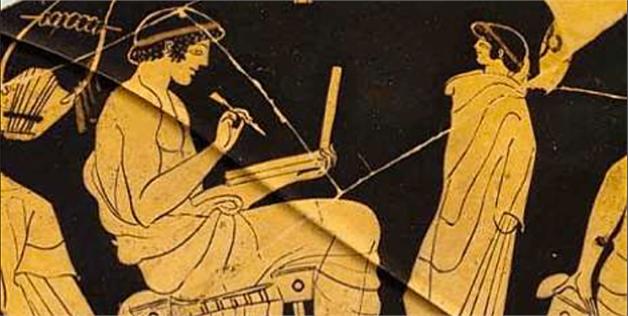
The Oracle’s “Gateway”: A Greek Laptop in 100 BC?
Stop scrolling. Look at that image again.
This isn’t a Photoshop job. This is a legitimate photograph of a grave stele (a funeral marker) from ancient Greece, dating back to around 100 BC. It’s currently sitting in the J. Paul Getty Museum in California. They call it the “Grave Naiskos of an Enthroned Woman with an Attendant.”
Mainstream archaeologists—the ones who want to keep you in the dark—will tell you it’s a jewelry box. Or a shallow chest. Or maybe a wax tablet.
A jewelry box? Seriously?
Look at the way the “attendant” is holding it. Look at the lid. It’s open at a 90-degree angle. Look at the woman’s eyes. She isn’t looking at a necklace. She is focused on a screen.
But here is the detail that sends shivers down the spine. Look at the side of the device. Do you see those two circular holes?
Those aren’t keyholes. Ancient jewelry boxes didn’t have side-mounted audio jacks or USB-C ports. Those are inputs.
The “Oracle” Connection
Let’s play devil’s advocate. Let’s get weird. The Greeks were obsessed with the Oracle of Delphi. A priestess who could communicate with the gods and see the future. She would inhale vapors and “see” things that hadn’t happened yet.
What if the Oracle wasn’t magic? What if she just had Wi-Fi?
Imagine you took a laptop back to 100 BC. You have the entire sum of human knowledge on your hard drive. Wikipedia. Maps. Medical data. To the locals, you are a god. You are Apollo. You predict eclipses because you have a calendar app. You cure plagues because you have a PDF on basic hygiene.
The artwork above reveals a terrifying truth. Ancient civilizations didn’t stumble upon math and philosophy by accident. They had help. They had laptops.
Aliens vs. Time Travelers: The Great Debate
So, we have a laptop in ancient Greece. How did it get there?
The internet is torn between two theories. Theory A: Extraterrestrials. Theory B: Humans from the future.
Let’s use some logic here. If aliens traveled lightyears across the galaxy to visit Earth, why would they bring a clunky, hinged laptop? That is human engineering. It has a hinge. It has a bezel. It looks like a Dell or an early MacBook.
Aliens? No way. As pointed out by the sharper minds in our office, visitors from outer space would be way past this tech. They’d be using neural links, holographic projections, or at the very least, ultra-thin tablets made of liquid glass.
This means the person in the sculpture isn’t an alien. It’s a time traveler.
And not just any time traveler. Based on the thickness of that device, they are likely visiting from the late 1990s or early 2000s. A traveler from 2025 would have a foldable phone. This is a bulky, durable machine. A workhorse.
But who? Who has the resources to build a machine, go back, and sit for a sculpture?

The Silicon Valley Anomaly
Fast forward to today. Or what we think is today.
If that’s not evidence enough, look at the picture above. This image was captured recently in the Bay Area. At first glance, it looks like a movie prop. But dig a little deeper.
This car is futuristic, but it lacks the branding of known concept cars. It’s sleek, silver, and looks aerodynamic enough to break the sound barrier. We checked the records. No major car maker—not Mercedes, not Tesla, not BMW—has come forward to claim this design. It’s a ghost car.
And the driver?
Witnesses say the man behind the wheel was a dead ringer for Mark Zuckerberg. Not “looked like him.” Was him.
The “Blue Line” Theory
Notice where it’s parked? Look at the ground. That isn’t a standard public parking spot. It’s parked in a bay with blue lines. In corporate Silicon Valley campuses, blue lines often denote “Executive” or “Special Project” parking.
It’s reserved for the top of the food chain. Reserved for Facebook (Meta) elite.
Think about it. Who has zillions of dollars? Who has access to the most advanced AI on the planet? Who seems strangely robotic in interviews, as if he is trying to remember how humans act in this specific time period?
Time travel research isn’t cheap. You can’t build a flux capacitor in your garage anymore. You need a server farm. You need quantum computing. You need the GDP of a small country.
What would you do if you cracked the code?
If you invented time travel, you wouldn’t just go back to kill Hitler. That’s too risky. Too many variables. You would preserve the timeline while ensuring your own dominance.
- Get Rich: Go back to 2004. Invent the biggest social network in history before anyone else can. Call it Facebook. Secure the funding.
- Get the Gear: Use that money to build the toys you saw in the future. Like the silver car above.
- Have Fun: Travel back to the Renaissance or Ancient Greece just to mess with people. Leave clues. Easter eggs for the observant.
It sounds crazy. Until you see the painting.

The 1544 Portrait: The Smoking Gun
This is where the skepticism usually dies.
This is a real picture. No AI generation. No deep fake. This is a painting by the German artist Georg Pencz. It was painted in 1544—nearly 500 years ago. It hangs in a museum.
Look at the face. The pale skin. The shape of the nose. The slightly detached, analytical stare. It is Mark Zuckerberg. It is undeniable.
But looking like someone is just a coincidence, right? Every face has a doppelganger eventually. That’s just genetics.
Wrong. Look closer.
Internet sleuths who have examined high-resolution scans of this painting claim something impossible. On the white label or cover of the book/ledger he is holding, there is faint lettering. It is claimed it has the letters FB.com inscribed on the top.
The Message in the Paint
Alas, most images available online are too compressed to verify this 100%. Skeptics say it’s just scribbles. But why would a 16th-century man be holding a book with that specific logo placement? Why does he look like the man who owns the URL today?
Is this Georg Pencz painting a portrait of a local merchant? Or did a stranger appear in town one day? A stranger with strange clothes and a lot of gold, who asked to be painted holding his “ledger”?
Perhaps Mark didn’t just invent Facebook in 2004. Perhaps he has been seeding the brand for centuries. A subliminal marketing campaign lasting 500 years.
The Grand Paradox
If Mark Zuckerberg is a time traveler, it explains everything.
It explains why he looked so uncomfortable drinking water in front of Congress (he’s used to future hydration tablets). It explains how Facebook crushed the competition so easily—he knew exactly what features would work because he had already seen the future of the internet.
He isn’t guessing. He’s remembering.
And the Greek laptop? Maybe that was an early prototype. Maybe he went back too far, ran out of battery, and had to leave it behind. The locals found it, thought it was a divine object, and carved it into a tombstone to honor the “Messenger from the Gods.”
We are living in a loop. The clues are in the museums. They are in the parking lots. They are staring at us from 1544.
The question isn’t “is time travel real?” The question is: What happens when they decide to rewrite the timeline again?
Keep your eyes open. Watch the background of old movies. Check the statues in your local park. The evidence is everywhere.
Originally posted 2016-04-22 16:29:54. Republished by Blog Post Promoter