Has an alien being been found on Mars?
Stop scrolling. Look closely. No, closer than that.
We are told that Mars is a dead world. A rusted, frozen graveyard where the only movement comes from dust devils and the mechanical wheels of our own rovers. They tell us it is desolate. Empty. Barren.
But what if they are wrong?
Or worse… what if they are lying?
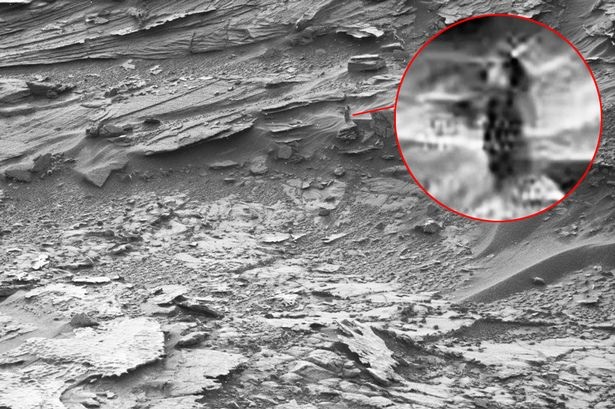
A mysterious ‘dark being’ has been spotted looking out into space from the surface of Mars, and the internet is absolutely losing its mind over it. This isn’t just a smudge on a lens. It isn’t a dead pixel. It’s a shadow that shouldn’t be there.
The eerie shape was taken by the NASA Curiosity Rover, the robot exploring a crater on the red planet. And what it found might just change history forever.
This is not the first strange and mysterious picture taken on Mars. But is it really an alien? Or is it a ghost of a civilization that died a billion years ago?
The Anomaly: Analyzing the “Dark Lady”
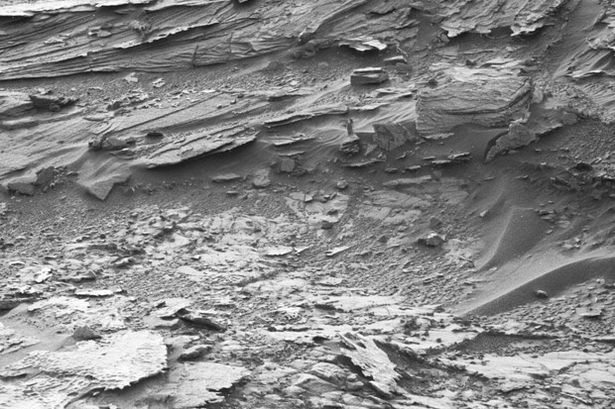
Let’s break this down. You see rocks. You see dirt. You see the endless, depressing horizon of the Gale Crater. And then, perched up high on a rocky ridge, there is something that defies the geology around it.
It stands upright.
Rocks don’t usually stand like that. Gravity on Mars is weaker than Earth’s, sure, but geology still follows rules. Layers of sediment lay flat. They crumble. They erode into mounds. They do not form perfect silhouettes of humanoid figures staring wistfully across the wasteland.
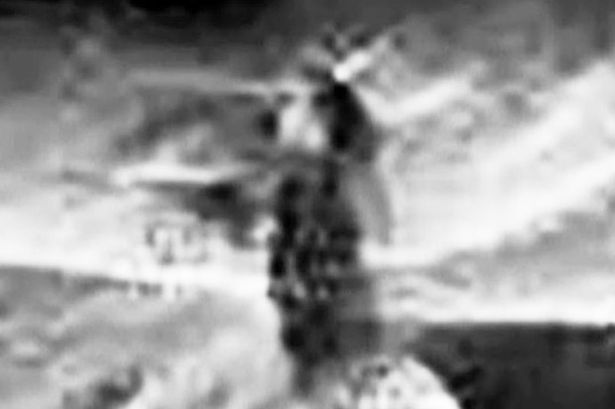
We also see two arms that are lighter in color and what looks like a head with long hair. Look at the shading. The “chest” area casts a shadow consistent with a draped garment. A cloak? A dress? Or perhaps a biological exoskeleton designed to shield a living creature from the harsh UV radiation of a planet with no ozone layer?
The figure appears to be watching. Waiting.
“Its hard to tell if this is a living being, or a statue of a being from long ago,” says one internet theorist who has spent hundreds of hours combing through raw NASA data. It’s a valid point. Mars is old. Incredibly old. If a civilization thrived there while Earth was still a molten ball of goo, their ruins would be unrecognizable dust by now. Unless…
Unless they built things to last.
“However, a statue that small would be eroded and destroyed easily, so it has a higher chance of being a living being,” the theory continues. Wind on Mars is brutal. Sandstorms can cover the entire planet for months. A tiny stone statue would have been sandblasted into oblivion millions of years ago. But a living thing? A living thing heals. A living thing moves. A living thing hides.
“Also it is facing the Mars rover…watching it from a distance.
The Scale Problem: Micro-Aliens?
Now, let’s talk about the size. This is where things get really weird.
“This being is about 8-10 cm tall.
That is tiny. We are talking about something the size of an action figure. Skeptics use this to dismiss the whole thing. “It’s just a rock,” they laugh. “Why would aliens be three inches tall?”
But think about it. Really think about it.
Mars has lower gravity. It has scarce resources. In evolutionary biology, we know about “insular dwarfism.” On islands on Earth, big animals shrink over time to survive on less food. Mammoths became tiny on Wrangel Island. Maybe, as Mars died, as the oceans dried up and the atmosphere vanished, the Martians didn’t leave.
Maybe they evolved. Maybe they shrank. Smaller bodies need less water. Less oxygen. Less food. A micro-civilization could survive in the cracks and caves of Mars for eons, unnoticed. Until we dropped a nuclear-powered tank into their backyard.
“This looks real.
It does. It looks unsettlingly real. The shadowing matches the surrounding rocks, meaning it was physically there when the photo was taken. It is not a Photoshop job. It is not a glitch. It is a physical object on the surface.
Pareidolia: The Convenient Excuse?
Whenever images like this surface, NASA scientists and debunkers scream one word: Pareidolia.
This is the psychological phenomenon where the human brain forces random patterns into recognizable shapes. It’s why you see a dragon in a cloud or Jesus on a piece of burnt toast. Our brains are hardwired to recognize faces. It’s a survival mechanism. If you see a tiger in the bushes, you run. If you’re wrong, you’re just embarrassed. If you don’t see the tiger and you’re wrong, you’re lunch.
So, is the “Dark Lady” just a trick of the mind? A shadow falling on a jagged rock at the perfect time of day?
Maybe. It’s possible.
But isn’t “pareidolia” the perfect shield? If you wanted to hide the biggest discovery in human history, wouldn’t you just tell everyone, “Oh, you’re just imagining it”? It shuts down the conversation. It makes you feel stupid for seeing what your eyes are clearly telling you is there.
For centuries people have speculated about the possibility of life on Mars due to the planet’s proximity and similarity to Earth. Although there has been much speculation, to date there has never been any proof of life existing on Mars. However, cumulative evidence is now building that Mars once was habitable – the question is: Was it?
We know now that Mars had oceans. We know it had rivers. We know it had a thick atmosphere. It was a twin to Earth. So why is it so crazy to think it had life? And if life started there, did it ever really end?
The Pattern of High Strangeness
This “Dark Lady” isn’t an isolated incident. If this were the only weird photo, we could write it off. But it’s not.
The ‘dark lady’ follows in quick succession after the ‘ awesome Martian space crab ‘ was spotted a few days ago.
Remember the crab? A terrifying, multi-legged anomaly tucked into a crevice, looking exactly like the facehugger from the movie Alien. And then there was the “Floating Spoon,” a rock formation so delicate and thin it hovered over the surface, casting a perfect shadow underneath. NASA said it was a “ventifact”—a rock shaped by wind. But to create a floating spoon shape by random wind erosion? The odds are astronomical.
And let’s not forget the “Mars Rat.” The “Pyramids.” The “Face on Mars” in the Cydonia region that sparked this whole obsession back in 1976.
There are too many anomalies.
Why Doesn’t NASA Turn Around?
This is the question that keeps conspiracy theorists awake at night. The Curiosity Rover is a mobile laboratory. It has lasers. It has drills. It has high-resolution zoom cameras.
If you are operating a rover on another planet, and you see something that looks even 1% like a statue, a bone, or a person… do you know what you do?
You hit the brakes. You turn the rover. You drive right up to it and you investigate.
NASA didn’t do that.
They kept driving. They ignored the Dark Lady. They ignored the Crab. They ignored the Spoon.
Why? There are only two options:
- Incompetence: They are so focused on drilling into boring grey rocks to find methane that they are missing the visual evidence right in front of them.
- Cover-up: They saw it. They analyzed it. And they decided the world isn’t ready to know.
If they acknowledged this figure, society would crumble. Religions would panic. History books would burn. The idea that we are unique, special, and alone in the universe would be shattered in a millisecond.
The “Watcher” Theory
Look at the pose again. The figure is looking at the rover.
The rover is loud. It’s a nuclear-powered machine crushing rocks and firing lasers. If you were a survivor on a dead planet, hiding in the shadows, wouldn’t you watch it? You wouldn’t approach it. It looks like a monster. You would stand on a ridge, safe in the distance, and observe.
“And it should concern every country in the world. There is life out there. ”
This quote sums up the fear and the excitement. If there is life on Mars, even if it is just a 10cm tall primitive humanoid, it means the universe is teeming with life. It means we are not the first. And we won’t be the last.
It also means that planets die. Mars was once like Earth. Now it is a hellscape. Is the “Dark Lady” a warning? Is she the last witness to a climate catastrophe that wiped out an entire world? Are we looking at our own future?
The Skeptic’s View (And Why It Might Fail)
To be fair, we have to look at the science. Digital compression is a real thing. These images are sent from millions of miles away. They are compressed into JPEGs. Pixels get blocky. Shadows get distorted. Sometimes, a rock is just a rock.
But the sheer geometry of this figure is hard to dismiss. The symmetry of the shoulders. The definition of the head. The distinct difference in albedo (reflectivity) between the “arms” and the “body.”
Nature creates chaos. Intelligence creates order. This shape has order.
Modern internet sleuths are doing the job that NASA refuses to do. They are downloading the gigapixel panoramas. They are adjusting the contrast. They are finding the things that slip through the cracks. And every day, the file of “unexplained Martian objects” gets thicker.
Conclusion: The Truth is in the Pixels
We may never know for sure what the Dark Lady of Mars is. NASA has moved on. Curiosity is miles away now, climbing Mount Sharp, leaving this mystery behind in the dust.
But the image remains.
It haunts us because it looks so familiar. It isn’t a tentacled blob. It isn’t a slime mold. It’s a person. A small, lonely person standing on a dead rock, watching a robot from Earth drive by.
If it’s a trick of light, it’s a cruel one. But if it’s real… then everything we think we know about our place in the cosmos is wrong.
Keep your eyes open. Question everything. And never stop looking at the shadows.