Space isn’t just empty. It’s watching. It’s waiting. And sometimes, it turns sideways to hide its true face.
When you look up at the night sky, you usually see the chaotic sprawl of spiral galaxies face-on. They look like spilled milk. Whirlpools of light. They show you everything—their arms, their clusters, their messy, violent nurseries of star birth. But not this one. This one is different. This one is keeping secrets.
Imagine a galactic empire so vast that it dwarfs our own Milky Way, yet it refuses to show us its face. Instead, it presents a razor-sharp edge. A line in the dark. A cosmic shiv made of billions of burning suns.
Meet NGC 4565. The Needle Galaxy.
The Cosmic Razor Blade
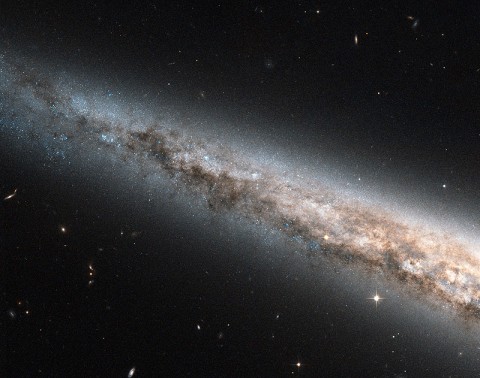
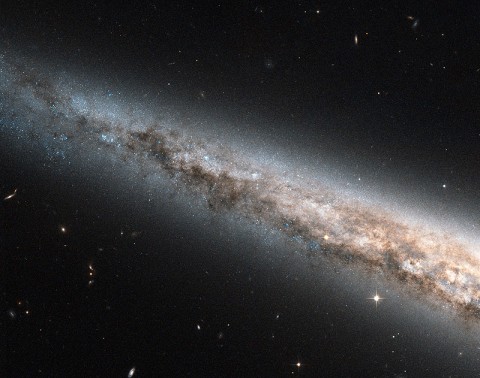
Look at that image. Seriously, stop scrolling for a second and look at it. That isn’t a smear on the lens. That is a city of stars containing more mass than you can possibly comprehend, turned completely on its side relative to Earth. The NASA/ESA Hubble Space Telescope snapped this shot, revealing an exquisitely detailed view of the disc.
It’s perfect. Almost too perfect.
Most galaxies are messy. They interact. They collide. They warp. But NGC 4565 cuts through the void of the Coma Berenices constellation like a laser beam. Astronomers call it an “edge-on” spiral galaxy. That’s the scientific term. But let’s call it what it really is: a barrier.
Because of this orientation, we are seeing right into its luminous disc, but we are blocked from seeing the center. We are staring at the galactic rim. It’s like trying to figure out what a pizza looks like by staring at the crust. Except the crust is made of dark matter, ancient dust, and the potential for millions of civilizations.
Why Is It Hiding?
NGC 4565 has been nicknamed the Needle Galaxy for obvious reasons. When viewed in full, it appears as a narrow sliver of light. But don’t let the skinny profile fool you. This thing is a monster. A true titan.
It sits about 40 million light-years away. In the grand scheme of the universe, that’s right next door. That’s a neighbor. But here is the kicker: NGC 4565 is a whopper. It is roughly a third larger than our own Milky Way. We are talking about a diameter of over 100,000 light-years. Maybe more. Some estimates suggest it stretches even further into the black.
If the Milky Way is a standard metropolis, the Needle Galaxy is the mega-city that eats other cities.
The Dark Rift Mystery
Zoom in on that image again. Do you see the dark line running right through the middle? That’s not empty space. That is the Great Rift of the Needle. It’s a thick, choking lane of interstellar dust and gas. It absorbs the light from the billions of stars behind it.
What is happening inside that dust lane?
In our own galaxy, dust lanes are where stars are born. They are the construction zones. But in NGC 4565, the dust is so thick, so perfectly defined, that it effectively splits the galaxy in two from our perspective. Mainstream science tells us this is just cold gas. Carbon. Silicates. The debris of dead stars.
But let’s play the “What If” game. What if you were a Type III civilization on the Kardashev scale? You can harness the energy of an entire galaxy. Where would you live? You wouldn’t live out on the exposed spiral arms where gamma-ray bursts and supernovae could wipe you out. You would dig in. You would hide in the buffer zone.
That dark lane could be protecting the inner sanctum of the galaxy from the harsh radiation of the intergalactic medium. It’s a shield. A blanket. And we can’t see through it.
The Mirror of the Milky Way
Studying galaxies like NGC 4565 helps astronomers learn more about our home. Why? Because we can’t take a selfie of the Milky Way. We are stuck inside it. Imagine trying to draw a map of your house while you are locked in the basement closet. That’s our situation.
We think the Milky Way looks a lot like NGC 4565. We suspect we are a barred spiral galaxy. We suspect we have a similar central bulge. By staring at the Needle, we are essentially looking in a mirror. But mirrors can be distorted.
The comparative study of this object is essential. It proves that galaxies can maintain a flat, disc-like structure over billions of years without bulging out into a sphere. It shows that rotational forces are keeping everything in check. It’s a masterclass in cosmic gravity.
The 40-Million-Year Lag
Here is a thought that will keep you awake at night. The light hitting the Hubble lens—the light that made the digital file for the image above—left NGC 4565 forty million years ago.
Let that sink in.
When those photons started their journey across the dark ocean of space, humans did not exist. There were no cave paintings. No stone tools. Earth was in the Eocene epoch. Early mammals were just starting to get a foothold. The ancestors of whales were walking on land. The Himalayas were just starting to rise.
We are looking at a ghost. We are seeing the Needle Galaxy as it was, not as it is. For all we know, it’s gone. Maybe it collided with another galaxy five million years ago. Maybe a supermassive black hole consumed the entire core. We wouldn’t know. We won’t know for another 40 million years.
The universe is a live feed with a terrible delay.
The Bulge: A Box of Secrets
Look at the center of the image. The galaxy bulges out. It glows brighter. This is the “galactic bulge.” In NGC 4565, the bulge isn’t a perfect sphere. It’s boxy. It looks a bit like a peanut.
For years, astronomers argued about this. Why the box shape? The leading theory now involves the dynamics of stellar bars. A “bar” of stars funnels gas into the center, fueling the star birth and the central black hole. Over eons, this bar buckles, thickening the center vertically.
It’s a sign of age. It’s a sign of maturity. This is an old galaxy. It has been spinning and eating and growing for a long time. The peanut shape suggests that the Milky Way likely has the exact same structure. We are living in a peanut, folks. A giant, spinning, radioactive peanut.
The Monster in the Middle
You can’t have a galaxy this big, this bright, and this organized without an anchor. Gravity needs a source. While the Hubble image shows the beautiful dust lanes, it cannot show you the monster lurking in the exact geometric center of that bulge.
A Supermassive Black Hole.
Every major galaxy has one. Ours is called Sagittarius A*. The one in NGC 4565? We don’t have a cute name for it yet, but we know it’s there. And given the size of the galaxy (remember, 33% bigger than us), the black hole in the middle is likely a behemoth.
It is feasting on that dust. It is stripping stars of their gas. It is the engine that drives the rotation. And it is hidden behind that wall of dust. We can only detect it by looking at how fast the stars near the center are whipping around. They are moving at impossible speeds. If the black hole wasn’t there holding them, they would fling off into the void.
The Invisible Halo
The image above was taken with Hubble’s Advanced Camera for Surveys (ACS). It has a field of view of roughly 3.4 by 3.4 arcminutes. That sounds small, but in astronomy terms, it’s a wide enough window to capture the glory of the disc.
But the visible light is just the tip of the iceberg. Literally.
If you could see in X-rays or radio waves, NGC 4565 would look like a giant sphere. It is surrounded by a massive “halo” of dark matter and hot gas. This halo is the scaffolding. The visible stars are just the Christmas lights strung up on the dark matter tree.
Modern theories suggest that this halo contains hundreds of “Globular Clusters”—balls of ancient stars that swarm around the galaxy like bees around a hive. Some of these clusters are as old as the universe itself. 12 or 13 billion years old. They are the survivors. The witnesses.
Are We Alone? The Fermi Paradox Connection
Let’s get speculative. I told you we’d go deep.
NGC 4565 has roughly 1 trillion stars. Let’s assume 10% are like our Sun. Let’s assume 1% of those have Earth-like planets. That is still millions of potential worlds. Millions.
And yet, silence.
When we point our radio telescopes at the Needle, we hear static. The hiss of cosmic background radiation. The scream of dying stars. But no talk radio. No distress beacons. No math.
Why?
Is the edge-on orientation blocking the signals? Radio waves can penetrate dust, so that shouldn’t be the issue. The scary answer is that civilizations don’t last. Or, they hide. If there is a predator in the cosmic forest, the smart prey stays quiet.
Maybe the Needle Galaxy is teeming with life, but they are all listening, afraid to transmit. They look at the Milky Way—at us—blasting our TV signals and radar into space, and they think, “Those idiots. They’re going to get themselves killed.”
The Technical Marvel of the Shot
We need to give credit to the hardware. The Advanced Camera for Surveys (ACS) on Hubble is a legend. It was installed in 2002 during Servicing Mission 3B. This camera changed everything. Before ACS, we had blurry blobs. After ACS, we had individual stars in distant galaxies.
To get this image, Hubble had to stare at the same spot in the sky for a long time. It had to lock onto guide stars and hold perfectly still while orbiting the Earth at 17,000 miles per hour. One wobble, and the image is ruined. One micrometeoroid impact, and it’s over.
The resulting data isn’t just a pretty picture. It’s a data set. Astronomers break this light down into spectra. They analyze the redshift to confirm the distance. They analyze the color to determine the age of the stars (blue for young/hot, red for old/cool).
In the image, notice the yellowish hue of the central bulge? That means old stars. Billions of years old. Now look at the edges of the disc. See the blue tints? That’s new growth. That’s where the galaxy is still building itself.
The “Great Galactic Wall” Theory
Internet theorists have had a field day with NGC 4565. Because it looks like a wall, some have speculated: What if it is a wall?
Not a brick wall, but a domain boundary. In some alternative cosmology models, the universe is cellular. Galaxies aren’t just random; they are the membranes between different pockets of spacetime. The edge-on appearance is just our perspective of the boundary.
It sounds crazy. It probably is. But when you look at how straight that line is, how sharp the cut is against the velvet black of space, you start to wonder. Nature rarely makes straight lines. Rivers meander. Trees twist. Coastlines are fractal.
But NGC 4565 is straight. Unnervingly straight.
Could the magnetic fields of the galaxy be so strong that they force matter into this tight plane? Yes, that’s the physics answer. But the visual impact remains unsettling. It looks artificial. It looks engineered.
The Future of the Needle
Nothing lasts forever. Not even giant galaxies.
NGC 4565 is traveling through the Coma I Group (a cluster of galaxies). It is interacting gravitationally with its neighbors. See the small, fuzzy patches nearby in wider shots? Those are satellite galaxies. Dwarf galaxies.
NGC 4565 is slowly eating them.
It pulls them in with its tidal forces. It rips them apart. It absorbs their stars and gas into its own disc. That’s how it got so big. It’s a cannibal. The beautiful, sleek shape we admire is built on the bones of lesser galaxies.
Eventually, it might collide with another large spiral. If that happens, the beautiful disc will be destroyed. The orderly rotation will turn into chaos. The stars will be flung out into random orbits. The two galaxies will merge to form a giant “Elliptical Galaxy”—a shapeless blob of old, red stars. The Needle will be broken.
But that won’t happen for billions of years.
Final Thoughts: The View From the Edge
So, why should you care about NGC 4565? Why does a smudge of light 40 million light-years away matter to your life?
Because it puts things in perspective. We get caught up in our daily grind. Traffic. Politics. The price of coffee. But just overhead, hidden by the blue sky of day or the light pollution of our cities, are monsters like this.
They are out there, spinning silently in the deep dark. They are vast beyond comprehension. They contain mysteries we will likely never solve. NGC 4565 is a reminder that we are small. We are microscopic. We are living on a dust mote, orbiting a spark, on the edge of a spiral much like the one we see in that picture.
Next time you feel like the world is closing in on you, pull up this image. Look at the Needle. Look at the dust lanes. And wonder: Is anyone sitting on a planet in that dark rift, looking back at us, seeing our galaxy as a thin line in their sky, wondering if they are alone?
The universe is a hall of mirrors. And we are just trying to find our reflection.