The Weather Plane That Never Was: Deconstructing the Lie Behind the U-2 Spy Crisis
It was a lie wrapped in a cover story, hidden inside a government press release. A matryoshka doll of deception. And at its heart was a single airplane, a ghost flying at the edge of space, that was never supposed to exist.
The date was May 1, 1960. May Day. A day of celebration in the Soviet Union. But high above the parades and pageantry in the city of Sverdlovsk, a different kind of drama was unfolding. A lone American pilot, Francis Gary Powers, was falling from the sky. His mission was secret. His plane was a phantom. And his capture was about to light a fuse that would blow up a superpower summit and plunge the world deeper into the icy paranoia of the Cold War.
When President Dwight D. Eisenhower heard the news, a cold dread must have set in. It wasn’t just about the pilot. It was about the wreckage. It was about the camera. It was about the mission that, officially, wasn’t happening. The world could not know. The American people could not know. A story was needed. A plausible, believable, bulletproof story.
Fast.
So, in the smoke-filled rooms of Washington D.C., a desperate plan was hatched. They would turn to the one agency that symbolized peaceful, scientific exploration. The one agency nobody would ever suspect of being a cog in the military-industrial machine. They turned to NASA.
Forged in Secret: The Birth of the Dragon Lady
To understand the lie, you first have to understand the machine. The U-2 wasn’t just any airplane. It was a miracle of engineering born from pure Cold War terror. In the mid-1950s, America was flying blind. The Soviet Union was a vast, impenetrable fortress, the “Iron Curtain” a very real barrier to intelligence. What was happening behind it? Were they building fleets of new bombers? Were their missile silos multiplying like a virus across the steppes?
Fear of a “bomber gap,” and later a “missile gap,” consumed the Pentagon. They needed eyes in the sky. Desperately.
Enter Clarence “Kelly” Johnson and his legendary Skunk Works, Lockheed’s black-ops design group. The request from the CIA was simple, yet utterly impossible: build a plane that can fly higher than any Soviet fighter could climb or any missile could reach. Fly so high that it was, for all intents and purposes, invisible.

The result was the U-2, nicknamed the “Dragon Lady.” It looked less like a spy plane and more like a bizarre, oversized glider. Its wingspan was enormous, a staggering 103 feet, dwarfing its slender 63-foot fuselage. It was built for one thing and one thing only: lift. Everything was sacrificed for altitude. It was stripped of armor, landing gear, and any creature comfort. The plane was so light and fragile that its wings had to be propped up by “pogos”—temporary supports that fell away on takeoff. Landing was a nightmare, a controlled stall that required a chase car to race behind the plane, talking the pilot down.
But it worked. The U-2 could soar above 70,000 feet, an altitude previously thought unattainable. From that incredible height, its state-of-the-art cameras, designed by the brilliant minds who would later create the Polaroid, could take pictures so sharp they could resolve individual railroad ties on the ground. It was the ultimate peeping tom.
The Pilot, The President, and the Point of No Return
Flying the Dragon Lady wasn’t a job for just any pilot. It was a grueling, dangerous affair. Pilots had to wear what were essentially early spacesuits and breathe pure oxygen for hours before a mission to purge nitrogen from their blood. The flight itself was a delicate balancing act. Up at 70,000 feet, the margin between the plane’s maximum speed and its stall speed was terrifyingly thin—sometimes less than 10 knots. This razor’s edge was known as the “coffin corner.” One mistake, and the fragile craft would rip itself apart or fall into an uncontrollable spin.
Francis Gary Powers was one of the few with the nerve and skill for the job. A former Air Force captain, he was recruited by the CIA for his cool head and steady hands. He was a civilian, a “contractor,” a legal distinction that would become a critical part of the coming cover-up.
President Eisenhower was always uneasy about the U-2 flights. He knew they were a profound violation of Soviet airspace. He knew they were an act of espionage that, if discovered, could be interpreted as an act of war. Every mission required his personal approval. And with a crucial Four Power peace summit in Paris just weeks away, the pressure was on. One more flight. They needed to know what was happening at the Tyuratam missile test range. One more roll of the dice.
On May 1, 1960, Powers climbed into the cockpit of his U-2 at a base in Peshawar, Pakistan. His mission, codenamed Operation GRAND SLAM, was one of the most ambitious yet: a massive, nine-hour, 3,788-mile flight clear across the heart of the Soviet Union, from south to north, landing in Bodø, Norway. He was a lone man, a silver needle piercing the heart of the bear. He had no idea he was flying directly into a trap.
May Day! May Day! The Shootdown Over Sverdlovsk
The official story is tidy. At 08:53 Moscow time, a Soviet SA-2 Guideline surface-to-air missile found its mark. A concussive blast near the tail of the U-2 sent it spiraling out of control. Powers, unable to activate the plane’s self-destruct mechanism, bailed out and parachuted into the hands of bewildered Soviet farmers.
But is that what really happened?
The story gets murky, fast. For years, rumors and alternative theories have swirled around the incident. Soviet Premier Nikita Khrushchev later boasted that a single rocket brought the plane down. But Soviet records, unsealed years later, tell a more chaotic story. In their frantic effort to down the intruder, the Soviet air defenses launched no fewer than *fourteen* SA-2 missiles. One of them even hit one of their own planes, a MiG-19 fighter scrambled to intercept the U-2, killing the pilot, Senior Lieutenant Sergei Safronov.
Was it even a missile? Powers himself always maintained he never saw a missile and only felt a dull “thump” before the plane went into a spin. Some analysts have suggested a “proximity kill,” where the missile exploded nearby, and the shockwave was enough to cripple the delicate U-2. Another, more dramatic theory, was put forward by a former Soviet pilot, Igor Mentyukov, who claimed in 2000 that his unarmed Su-9 aircraft, on a one-way suicide mission, intentionally rammed the U-2, causing it to lose control. He claimed he was ordered to silence, and Safronov’s death was used to cover his own heroic story.
What if the plane simply malfunctioned? A flameout in the single, temperamental engine at that altitude would have been catastrophic. A failure in the oxygen system could have incapacitated Powers. We may never know the exact sequence of events that sent the Dragon Lady falling from the heavens. But one thing was certain: America had a massive problem.
Deep Dive: The Anatomy of a Cover Story
Back in Washington, the clock was ticking. The first assumption was that the pilot was dead and the plane was vaporized. No pilot, no plane, no problem. Standard procedure was to wait a few days and then release a pre-packaged cover story. The plan was simple, and it hinged on NASA.
This wasn’t the first time. Since the U-2 program began in 1956, the National Advisory Committee for Aeronautics (NACA), NASA’s predecessor, had been its public face. Press releases described the U-2 as a high-altitude weather research plane, studying things like cosmic rays and the jet stream. It was a brilliant piece of misdirection.
The NASA Press Release: A Masterpiece of Misdirection
On Thursday, May 5, 1960, with Powers still officially “missing,” NASA released the lie to the world. It was a work of art, a carefully constructed narrative designed to quell suspicion and paint a picture of a routine scientific mission gone wrong.
The statement began: *“One of NASA’s U-2 Research Airplanes, in use since 1956 in a continuing program to study gust-meteorological conditions found at high altitude, has been missing since about 9 o’clock Sunday morning… when its pilot reported he was having oxygen difficulties over the Lake Van, Turkey area.”*
Every word was chosen with care. “NASA’s U-2,” not the CIA’s. A “continuing program” since 1956, establishing a history of peaceful research. The specific problem? “Oxygen difficulties,” a common and plausible emergency for a high-altitude flight. The location? Lake Van, Turkey—a location safely inside allied airspace, hundreds of miles from the Soviet border.
The release went on to flesh out the fictional flight plan. The takeoff from Incirlik Air Base, the route through Turkish airspace, the desperate last radio call. It was all a script. It stressed that the pilot was a civilian, an employee of Lockheed, with no military affiliation. This was crucial—it was meant to shield him from being treated as a spy or a prisoner of war.
It even detailed the instruments supposedly on board: equipment to measure air turbulence, cosmic rays, and water vapor. There was no mention of a 2,000-pound, high-resolution camera capable of reading a newspaper from 13 miles up.
Painting a Lie: The Edwards AFB Stunt
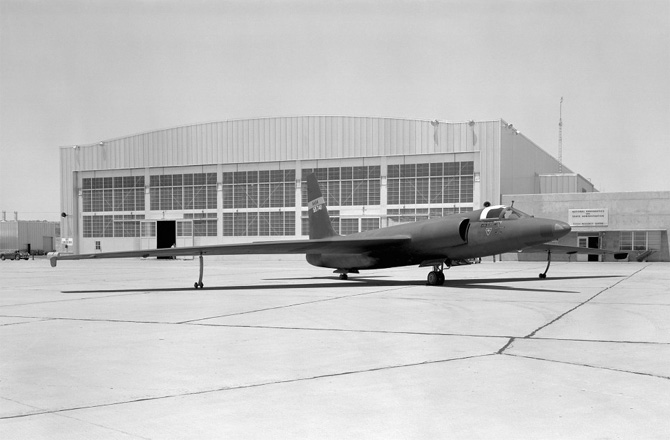
To sell the lie, they needed a visual. Words on a page weren’t enough. So, at NASA’s Flight Research Center at Edwards Air Force Base in California, a ground crew scrambled. They took a genuine U-2, hastily painted a fake NASA registration number on its tail, and slapped on a sunny yellow “NASA” stripe.
On May 6, this decoy Dragon Lady was rolled out in front of the press. Reporters snapped pictures of the “weather plane.” The prop was in place. The story was solid. The Eisenhower administration breathed a collective sigh of relief. They thought they had gotten away with it. They were wrong.
Khrushchev’s Trump Card: The Lie Collapses
Half a world away, in Moscow, Nikita Khrushchev was playing a game of high-stakes poker. He let the Americans build their house of cards. He let them issue their press releases and trot out their fake NASA plane. He waited. He knew something they didn’t.
He had the pilot. Alive.
And he had the wreckage. Not pulverized, but largely intact. Including the camera and its spool of damning film showing detailed images of Soviet military installations.
On May 7, in a dramatic speech to the Supreme Soviet, Khrushchev sprung his trap. He announced that an American “spy plane” had been shot down deep inside Soviet territory. He held up pictures of the wreckage. He revealed the espionage equipment. Then, for the grand finale, he revealed his trump card: “I must tell you a secret. When I was making my report, I deliberately did not say that the pilot was alive and well… and so are the remnants of the plane.”
The world gasped. The American cover story was instantly shredded. Eisenhower was caught in a bald-faced lie on the world stage. The embarrassment was total and absolute. The carefully crafted image of America as the honest broker, the peaceful explorer, was shattered.
The fallout was immediate. The much-anticipated Paris Summit, meant to ease Cold War tensions, collapsed before it even began. A furious Khrushchev demanded an apology from Eisenhower, who refused. The Soviet leader stormed out, and any hope for détente vanished. The lie about one “weather plane” had just made the world a much more dangerous place.
The Bridge of Spies: A Cold War Epilogue
For Gary Powers, the ordeal was just beginning. He was subjected to a televised show trial in Moscow, where he was convicted of espionage and sentenced to 10 years in a Soviet prison. He became a pawn in the great game between superpowers.
His freedom would eventually come, not through diplomacy, but through a clandestine trade worthy of a spy novel. On February 10, 1962, on the fog-shrouded Glienicke Bridge connecting East and West Berlin, Francis Gary Powers was exchanged for a high-level Soviet spy, KGB Colonel Vilyam Fisher, better known as Rudolf Abel. It was a scene that would be immortalized in history and film as the quintessential “spy swap.”
Powers returned home not to a hero’s welcome, but to suspicion. Some in the military and the public questioned why he hadn’t used the CIA-issued suicide pin (a needle filled with poison hidden inside a silver dollar) or why he hadn’t done more to destroy his aircraft. It took years for him to clear his name and for the full story of his ordeal to be understood.
The Ghost of the U-2: How One Lie Changed Espionage Forever
The U-2 incident was more than just a failed spy mission; it was a turning point. It proved that even flying at the edge of space was no longer safe from enemy defenses. The era of manned aerial reconnaissance over hostile territory was coming to a close.
The debacle accelerated a top-secret program that would change the world: spy satellites. The Corona program, which had been in development, was now given top priority. Just a few months after Powers was shot down, the first successful Corona satellite returned images from orbit, ushering in the age of space-based espionage. No pilots to get shot down. No risk of international incidents. Just a silent eye in the sky.
Yet, the ghost of the U-2 lingers. The story serves as a raw reminder of the lengths governments will go to in the name of national security, and how easily truth can become a casualty. It’s a story of incredible technology, human courage, and a monumental lie that backfired in the most spectacular way imaginable.
And it makes you wonder. The U-2 incident was exposed because the Soviets recovered the evidence. How many other “weather studies,” “oceanographic surveys,” or “atmospheric tests” over the decades were just cover for missions we will never know about? The lie of the NASA U-2 wasn’t the end of the story. It was just the beginning of the rulebook.
Originally posted 2013-04-12 21:02:06. Republished by Blog Post Promoter