Russia’s Stonehenge? Vottovaara, The Mountain of Impossible Stones and Whispering Spirits
Forget what you know about ancient mysteries. Forget perfectly carved pyramids and manicured stone circles basking in the English sun. We’re going somewhere else. Somewhere raw. Somewhere… broken.
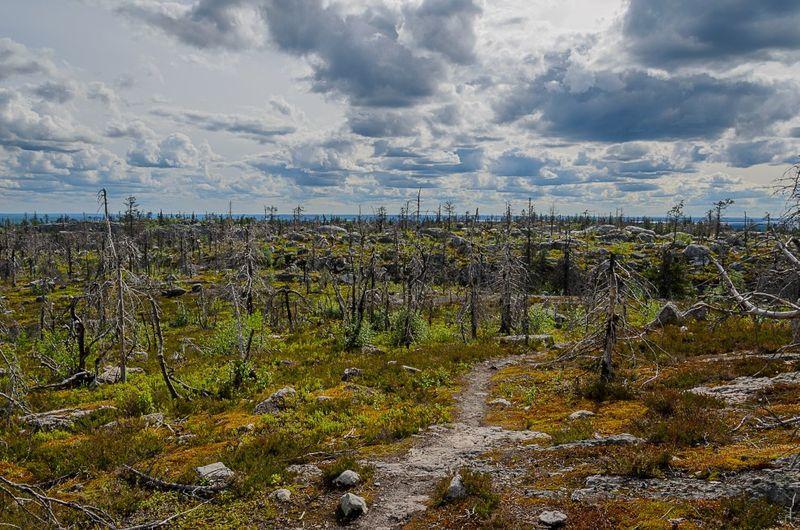
Deep in the untamed wilderness of Karelia, Russia, a place of sprawling forests and a million silent lakes, there is a wound on the face of the Earth. A place the locals call Vottovaara. Some call it “The Mountain of Death.” It’s a landscape of gnarled, skeletal trees and an oppressive silence that feels heavy, ancient. And it is littered with stones.
But these aren’t just any stones. These are nightmares in granite.
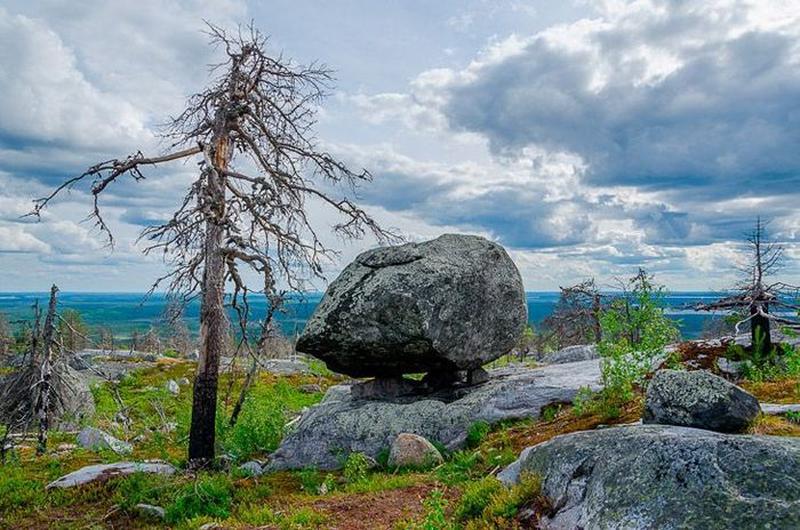
Massive boulders, some weighing many tons, are perched precariously on top of tiny pebbles, defying gravity and logic. Others are split with laser-like precision, as if a giant took a cosmic blade and cleaved them in two. There are stairways that climb into thin air and colossal slabs that form what looks like a sacrificial altar. The official story? Glaciers did it 10,000 years ago.
Right.
Welcome to Vottovaara, one of the most bizarre and unsettling places on the planet. A place where geology, ancient shamanism, and high-strangeness collide. A place that asks a terrifying question: what if nature didn’t do this at all?
The Seida: Nature’s Art or an Ancient Message?
The heart of the Vottovaara enigma lies with its thousands of strange stone formations. The indigenous Saami people, who have roamed these lands for millennia, have a name for them: Seida. A Seida isn’t just a rock. It’s a home. A vessel for a spirit. These were places of immense power, focal points where the physical world and the spirit world bled into one another.
The Saami would leave offerings. They would commune with the forces of nature that resided within these granite shells. That much, history agrees on. But looking at the stones themselves, you have to wonder if the Saami were just continuing a tradition that began long, long before them.
Deep Dive: The Official Glacial Theory
Let’s get the textbook explanation out of the way first. Geologists will tell you that Vottovaara is a classic example of a post-glacial landscape. Around 10,000 years ago, as the last Ice Age loosened its grip on the planet, massive sheets of ice, miles thick, began to retreat. This process was not gentle. It was a slow-motion cataclysm that tore the land apart.
As these glaciers moved, they plucked enormous boulders from the bedrock and carried them for miles. When the ice finally melted, it dropped these “glacial erratics” in strange and wonderful positions. The immense pressure and subsequent “frost-wedging” (water seeping into cracks, freezing, and expanding) could, theoretically, split massive boulders over thousands of years. This, they say, explains the clean cuts and odd placements.
It’s a neat story. It’s clean. It fits into our understanding of the world. And in many places, it’s probably true.
But not here. At Vottovaara, the official story starts to fall apart the longer you look.

The Evidence That Screams “Man-Made”
Look at the pictures. Really look. Does that look random to you?
The problems with the glacier theory are immediate and glaring.
- The “Stones on Legs”: The most famous formations are the massive, multi-ton boulders balanced delicately on a few smaller stones. Think about the sheer violence of a retreating glacier. It’s a grinding, crushing, chaotic force. The idea that it would gently place a ten-ton boulder on three perfectly positioned little support stones is, to put it mildly, a stretch. It’s like a tornado assembling a watch.
- The Impossible Cuts: Many of the boulders aren’t just cracked; they’re sliced. Some have perfectly flat surfaces and 90-degree angles. Frost-wedging creates irregular, jagged cracks following the natural fault lines in the rock. It doesn’t create geometry. What we see on Vottovaara looks less like frost and more like a saw. A very, very big saw.
- The “Stairway to Nowhere”: One of the most haunting features is a series of 13 carved steps ascending a cliff face that leads to… nothing. A sheer drop. Geologists have no good explanation for this. It serves no obvious purpose, yet the regularity of the steps suggests intentional design. Was it a ceremonial platform? An unfinished project? Or a pathway to something that is no longer there?
- The Pool and the Amphitheater: There’s a curious pool, a perfect rectangle carved from solid rock, which is almost always full of water, even in dry seasons. Nearby, the landscape seems to have been shaped into a crude amphitheater, a basin-like depression that focuses sound. Random glacial movement? Or a purpose-built complex for ritual and ceremony?
When you stack up the anomalies, the glacier theory starts to feel less like science and more like a convenient way to close an uncomfortable file. The evidence doesn’t whisper. It screams.
Gateway to a Darker World?
The strangeness of Vottovaara isn’t just geological. It’s atmospheric. It’s a place that gets under your skin. People who visit report wild swings of emotion. Artists and musicians claim it fills them with boundless inspiration, a raw creative energy. But just as many report a feeling of profound dread, of being watched, of an ancient and malevolent presence in the twisted woods.
They don’t call it the “Mountain of Death” for nothing. The trees are stunted and warped, growing in bizarre, unnatural angles, as if they’re trying to flee from something in the soil itself. There is very little wildlife. An eerie silence pervades the landscape, broken only by the wind whistling through the stone monoliths.
This has, unsurprisingly, given rise to some wild theories.
Theory 1: The Portal
Could Vottovaara be a weak spot between dimensions? A gateway to a parallel universe? It sounds like science fiction, but it’s a theory that many visitors and modern esoteric groups take seriously. They point to alleged magnetic anomalies and compasses that spin uselessly near certain Seida stones. There are countless reports of disembodied voices, strange lights in the sky, and an unnerving feeling of time distortion.
The UFO connection is strong here. For decades, locals and hikers have reported strange, silent crafts moving over the mountain, particularly at night. Are these visitors from other worlds, or are they slipping through from somewhere much, much closer?
The “Stairway to Nowhere” takes on a new, sinister meaning in this context. Perhaps it wasn’t a stairway to a physical place, but an energetic one. A platform for shamans to project their consciousness, or a literal launchpad to somewhere else entirely.

Theory 2: The Hyperborean Connection
What if the builders weren’t human? At least, not as we know them today.
Alternative history buffs often link Vottovaara to the legend of Hyperborea. Ancient Greek texts spoke of a mythical, god-like race that lived “beyond the North Wind.” A lost arctic civilization of immense wisdom and power. According to these legends, the Hyperboreans were masters of sound, vibration, and energy, capable of levitating and cutting stone with technology we can only dream of.
In this view, Vottovaara wasn’t a settlement. It was a machine. A power plant. A massive complex designed to harness the Earth’s natural energies. The precisely cut stones, the balanced boulders, the basin-like formations—were they all components? Resonators and capacitors in a vast, continent-spanning energy grid? Did the Saami people stumble upon the ruins of this incredible technology and, not understanding it, simply worship it as the home of powerful spirits?
It’s a fantastic idea, but it fits the visual evidence in a way the glacier theory simply can’t. It explains the precision, the scale, and the sheer weirdness of the place.
Theory 3: An Ancient Cult
Perhaps the truth is darker and more human. The mountain’s reputation as a place of sacrifice might be more than just a folk memory. Could Vottovaara have been the center of a powerful, pre-Saami death cult? A place where blood rituals were performed on a massive scale?
The stone altar. The amphitheater. The oppressive, negative energy so many people feel. It paints a grim picture. Perhaps the twisted trees and the silence of the animals are not natural, but a lasting scar on the landscape from ages of dark rituals. Maybe the “spirits” the Saami sensed were not benign nature elementals, but the tormented echoes of countless victims.
This theory would explain the mountain’s chilling nickname and the deep sense of unease it inspires. It suggests the stones were not just shaped, but consecrated with a dark and terrible purpose that still lingers today.
The Modern Mystery
For centuries, Vottovaara was a local secret, a place known only to the Saami and a few hardy hunters. That all changed in 1978, when a Russian adventurer named Sergey Simonyan stumbled upon the complex while exploring. The site’s subsequent publicity turned it into a magnet for the strange.
Today, it’s a pilgrimage site for Russian and Finnish neopagan groups who come to perform their own rituals, seeking a connection to the old ways. It’s a laboratory for paranormal investigators and dowsers, who arrive with ghost-hunting gear and energy-reading equipment. The internet has lit a fire under the mystery, with drone footage and high-resolution photos spreading across forums and social media, allowing millions to scrutinize the impossible stones from their keyboards.
Every new photo seems to reveal another anomaly. A strange symbol that looks almost carved. A rock formation that, from just the right satellite angle, appears to form a perfect circular outline. The mystery isn’t fading with time; it’s getting deeper.
What Are We Really Looking At?
So, what is Vottovaara mountain?
Is it just a pile of rocks, a fluke of geology that our pattern-seeking brains are desperate to imbue with meaning?
Is it a sacred temple, a precious remnant of the animistic beliefs of the ancient Saami people, a place where humans sought to connect with the soul of the world?
Or is it something else? A remnant of a lost, high-tech civilization? A malfunctioning portal to another dimension, bleeding dread into our world? The cursed altar of a forgotten death cult?
The stones stand silent, as they have for ten thousand years. Or maybe longer. They offer no easy answers. They just sit there, in the howling Karelian wind, balanced impossibly, cut cleanly, defying our simple explanations.
Perhaps the greatest mystery of Vottovaara is not what built it, but what it’s waiting for. The stones aren’t talking. Or maybe… they are, and we’ve simply forgotten how to listen.