Home Weird World Space NASA: Space Station ideas

NASA: Space Station ideas

0
61

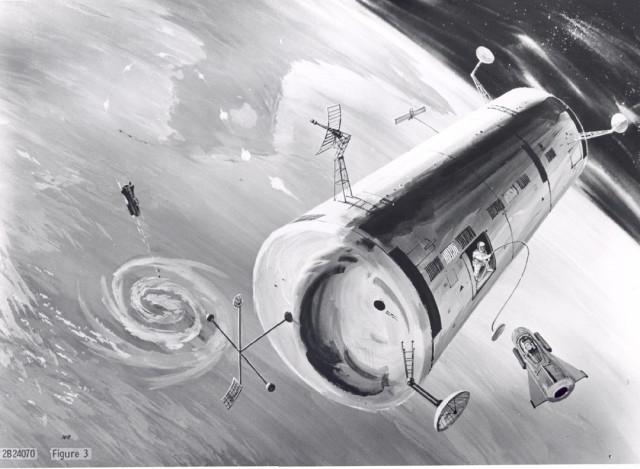
NASA space station - secretA 1960 concept image of the United States Air Force’s proposed Manned Orbiting Laboratory (MOL) that was intended to test the military usefulness of having humans in orbit.

The Ghost Station: Did the Military Secretly Occupy Space in the 70s?

Space. It’s quiet. It’s empty. Or so they tell us.

Look at the image above. Really look at it. This isn’t science fiction art from a paperback novel. This is a declassified schematic. A promise. It represents the Manned Orbiting Laboratory, or MOL. For years, the history books have told us a very specific, very boring story about this metal cylinder. They say it was a waste of money. They say it was cancelled. They say it never flew.

But does that story actually make sense?

We are talking about the height of the Cold War. Paranoia was the currency of the day. The United States and the Soviet Union were locked in a staring contest with nuclear missiles pointed at each other’s throats. Do you honestly believe the US military spent over a billion dollars—back when a billion meant something—only to shrug and walk away right before the finish line?

Let’s crack this open. Let’s look at the timeline, the money, and the strange anomalies surrounding the “cancellation” of the MOL. Because when you line up the facts, the official narrative starts to look like Swiss cheese.

The Official Story vs. The Reality

Here is what the textbooks say. The United States Air Force wanted their own space program. They didn’t want to rely on the nerds over at NASA. They wanted “Blue Suit” astronauts. Soldiers. Spies. Men who could look down from orbit and spot a Soviet tank moving across a snowy field in Siberia.

The plan was audacious. The station’s baseline configuration was that of a two-person Gemini B spacecraft attached to a massive laboratory vehicle. This wasn’t a joyride. This was a job. The structure was planned to launch onboard a Titan IIIC rocket—a beast of a machine capable of hauling heavy hardware into polar orbit.

The mission profile was grueling. The station would be used for a month. Thirty days of isolation. Floating in a tin can, snapping photos, intercepting radio waves, and perhaps doing things we still aren’t allowed to know about. After the mission, the astronauts would crawl back into the Gemini capsule, detach, and burn back through the atmosphere for transport back to Earth. The lab? It would be left to burn up or drift as a piece of space junk.

The schedule was set. The first launch of the MOL was marked on the calendar for December 15, 1969. Then, as government projects often do, it slipped. Pushed back to the fall of 1971.

Then, silence.

The Billion Dollar Trash Can?

The program was abruptly cancelled by Defense Secretary Melvin R. Laird in 1969. The reason given? Money. The estimated cost of the program had risen in excess of $3 billion. They had already spent $1.3 billion. In today’s money, that is a staggering amount of cash to simply set on fire.

Think about that. $1.3 billion spent. Hardware built. Launch pads constructed. Astronauts trained. And then… “Never mind”?

Is it possible? Sure. Government incompetence is a real thing. But in the world of black ops and military intelligence, “cancellation” is often just a code word for “going dark.”

Deep Dive: The “Blue Gemini” and the Hole in the Heat Shield

To understand why this project was so radical, you have to look at the engineering. This wasn’t just a NASA capsule painted black. The Gemini B was a modified beast.

In a standard NASA mission, the heat shield is the single most important thing keeping you alive. It is a solid, unbroken barrier between you and the burning plasma of re-entry. If it fails, you die.

The MOL engineers did something crazy. They cut a hole in it.

To get from the Gemini capsule into the laboratory behind it, the astronauts had to crawl through a circular hatch cut right through the heat shield. It was an engineering nightmare. A hatch in the heat shield? It sounds like a suicide mission. But they built it. They tested it. And it worked.

Why go to such lengths? Why not just do a spacewalk (EVA) to get to the lab? Because these were spies. Spacewalks are visible. Spacewalks are risky. If you want to switch shifts quickly and secretly, you crawl through the tunnel. This design feature proves one thing: Stealth and speed were the priorities. This was not about science; this was about operations.

The Mystery of SLC-6: The Launch Pad That “Never Was”

If you want to find a conspiracy, look at the real estate.

The Air Force wasn’t planning to launch these things from Florida. Cape Canaveral is great for equatorial orbits—going around the middle of the Earth. But if you want to see Russia, you need a Polar Orbit. You need to fly North-South. For that, you launch from California.

Vandenberg Air Force Base. Space Launch Complex 6 (SLC-6), or “Slick Six.”

They spent millions pouring concrete at Slick Six. They built the mobile service tower. They built the flame ducts. It was custom-made for the Titan III and the MOL.

When the program was “cancelled,” Slick Six sat empty. A ghost town of steel and concrete. We are expected to believe that the military built a massive, cutting-edge spaceport and then just let the seagulls nest there for decades? Or did something launch from there under the cover of darkness? Or perhaps, did they move the assets somewhere else?

The Soviet Paranoia: The Almaz Station

To understand the US motivation, you have to look at the enemy. The Soviet Union wasn’t sitting on their hands. While the US was publicly “cancelling” MOL, the Soviets were building the Almaz.

Almaz was the Soviet counterpart to MOL. But the Russians took it a step further. They didn’t just put cameras on their station. They put a gun on it.

This is not a theory. This is historical fact. The Almaz station was equipped with a Rikhter R-23 aircraft cannon. It was a space cannon. Designed to shoot down American inspector satellites—or perhaps attack an American MOL station.

So, we are in a situation where the Soviets are launching armed space stations. Are we really supposed to believe the US Air Force—the most well-funded military organization on the planet—bowed out of the race? “Oh well, the Russians have space cannons, but we’d better save a few dollars.”

Unlikely. Highly unlikely.

The “Cancellation” as a Smokescreen?

Here is the alternative theory. It’s the one that keeps researchers up at night.

By 1969, satellite technology was getting better. The KH (Keyhole) spy satellites were becoming incredible. They were unmanned. They could take photos and drop the film canisters back to Earth in “buckets” to be caught by planes in mid-air.

The official line is that unmanned satellites made MOL obsolete. Why send a human when a robot can do it cheaper?

But humans can do things robots can’t. Humans can adapt. Humans can fix things. Humans can make judgment calls on what to photograph.

What if the MOL wasn’t cancelled, but integrated? What if the technology was simply folded into the NRO (National Reconnaissance Office) black budget? The launch date of 1969/1971 coincides perfectly with a massive surge in “classified” launches.

Consider the Titan III launches of the early 70s. Many carried “classified payloads.” Could one of them have been a stripped-down MOL? A temporary manned outpost to test specific optics or spy gear before the Space Shuttle era began?

Where Did the Astronauts Go?

The human factor is the most compelling piece of evidence. The MOL program had its own astronaut corps. These weren’t the media darlings of the Apollo program. These were military men.

When the program ended, some of the military astronauts selected for the program then transferred to NASA. They didn’t disappear. They became legends.

Take Richard Truly. He moved from the secret MOL program to NASA, eventually piloting the Space Shuttle Enterprise and becoming the NASA Administrator.
Take Robert Crippen. He flew on the very first Space Shuttle mission (STS-1).
Take Bob Overmyer.

These men were the elite of the elite. They spent years training for a mission that “never happened.” Or did their training serve a different purpose?

When they arrived at NASA, they brought a different culture with them. The Space Shuttle was originally sold as a scientific vessel, but make no mistake: The Shuttle was heavily influenced by the military. The payload bay of the Space Shuttle was specifically designed to be large enough to carry… guess what?

Spy satellites. The exact same size and shape as the hardware planned for MOL.

In fact, the Shuttle flew several completely classified missions for the Department of Defense. Missions where the media was told nothing. No interviews from space. No live feeds. Just the Shuttle going up, and the Shuttle coming down.

Was the Space Shuttle the spiritual successor to MOL? Did it fulfill the mission that the tin can was supposed to do, just with wings and a better landing gear?

Modern Echoes: The X-37B and the Space Force

Fast forward to today. The legacy of the MOL is not dead. It has just changed shape.

Look at the X-37B. It looks like a baby Space Shuttle. It is run by the US Space Force. It launches on top of a rocket, stays in orbit for hundreds of days at a time, and then lands autonomously.

What is it doing up there? The government says “testing materials.” For 900 days? That’s a lot of testing.

The X-37B is the direct descendant of the philosophy behind MOL. A military platform, in orbit, doing things the public isn’t allowed to see. The only difference is that we took the pilots out of the seat.

The Verdict: A Successful Failure?

So, did NASA build this station in 1975? No. NASA didn’t.

But the Air Force? The NRO? That is a different question.

The hardware was built. The money was spent. The optics were ready. The “cancellation” in 1969 might have been the end of the public program, but in the world of black projects, the end is often just the beginning.

It is entirely possible that components of the MOL flew under different names. It is possible that the “Big Bird” spy satellites used the exact same pressure vessels and optics that were built for the astronauts.

History is written by the victors, but it is also redacted by the spies. The Manned Orbiting Laboratory sits in the history books as a “what if.” But for those who know where to look, it is a breadcrumb trail leading to the massive, silent military infrastructure that orbits above our heads right now.

Next time you look up at the night sky and see a satellite blinking as it passes over, ask yourself: Is it just a GPS satellite? Or is it something else? Something watching you back?

Originally posted 2016-04-10 00:28:09. Republished by Blog Post Promoter

Originally posted 2016-04-10 00:28:09. Republished by Blog Post Promoter